
Cats are everywhere on the internet: You'll readily find these felines batting at objects, scampering over ground, interacting with their owners, or doing something else adorable.
But is all of this content actually healthy for the cats, and for us?
In a study published in Anthrozoös, researchers from Adelaide University in Australia found that signs of cat distress in online content are too easily dismissed by commenters as trivial, cute, humorous, or actually beneficial for the animals involved.
With multiple previous studies showing the importance of interactions between humans and cats when it comes to feline well-being, it's a concerning finding.
"Play is increasingly promoted by advocates and practitioners as a tool for human-cat bonding and feline enrichment," write the researchers in their published paper.
"Our findings highlight a critical need for educating the public about recognizing, and more crucially, respecting cat dissent, as well as cat preferences for touch and interaction and the serious human health risks of cat bites and scratches."
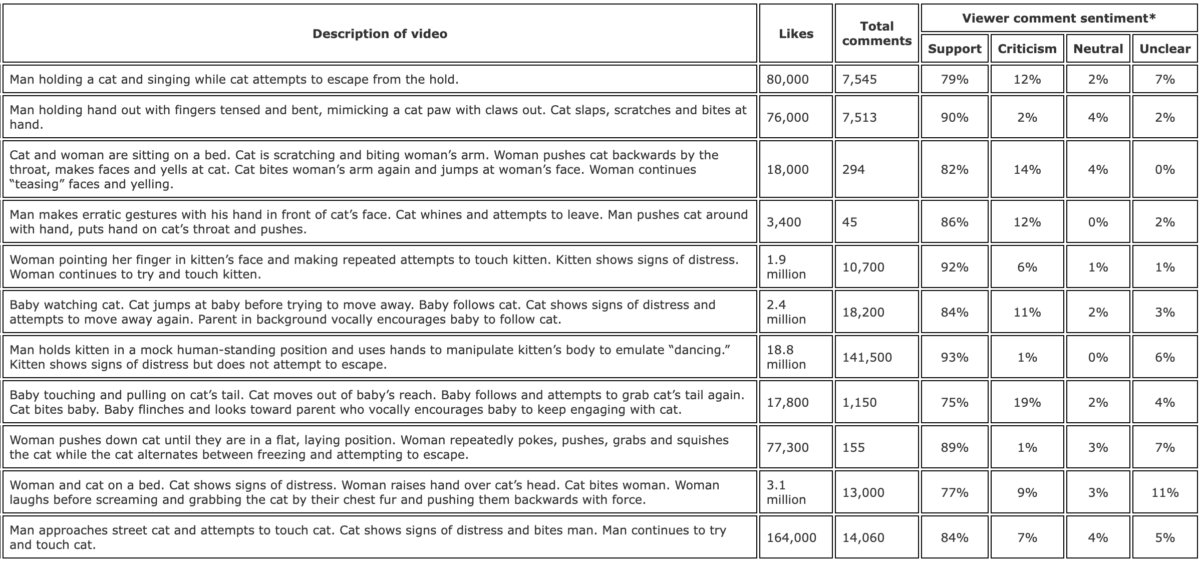
Veterinary scientist Julia Henning and her colleagues found 11 human-cat interaction videos across YouTube, TikTok, Instagram, and Facebook, which had all been labeled 'play' by their creators, and which all featured visible signs of cat distress – like hissing or attempting escape.
Then, they dived into the comments: 1,100 of them, in total.
Despite the signs of cat distress, 75-93 percent of comments across the videos were positive toward the interaction between the feline and the person.
"When a cat's early dissent signals go unrecognized or ignored (as they were in each of the videos included in this study), a cat experiences acute stress that may become chronic if unwanted interactions occur repeatedly," writes the team.
"This can have serious consequences for cat health and well-being.
"Despite this, cat dissent behaviors were frequently trivialized by viewers."
The researchers identified nine different themes that the comments could be grouped into, based on their content.
One category was 'if they didn't like it, you would know' – comments coming from a belief that the animal would show more signs of distress or simply leave if they weren't enjoying the interaction.
There was a 'lost in translation' category (viewers misinterpreted the distress cues), a 'they just get it' category (cats know when a human is just playing), and a 'you'll win them over' category (a belief that negative interactions will eventually do some good).

Other categories included 'that's cat love' (romanticizing dissent), 'satisfying the killer inside' (the predatory instinct of cats needs to be worked out), and 'but it's cute' (cuteness overrides other signals).
The final two categories were 'just having a laugh' (cat distress is actually amusing or enjoyable), and 'Karens take a back seat' – where commenters who criticized the interaction were dismissed as having a lack of knowledge about cats.
"Social media may magnify these perceptions through algorithms that reward engagement regardless of problematic content," write the researchers.
"Considering the influence of social media and perceived social norms in maintaining cognitive processes, guardian social media usage and media literacy are likely important elements to consider when creating preventative interventions."

It's not just cats that this harms either: 7 out of the 11 videos showed an observable human injury. While these injuries may have seemed minor and were often downplayed in the associated comments, they still carry a risk of infection.
Related: Cat Ownership Linked to Increased Risk of Schizophrenia, Study Suggests
As for next steps, the researchers suggest that more needs to be done to address preconceptions and cognitive biases when viewing content online – in addition to educating viewers as to what cat dissent really looks like, and removing some of the social media trappings that can encourage the normalization of animal distress.
"These findings suggest that traditional educational approaches focusing solely on correcting interpretation of cat body language are likely insufficient for long-term alteration of human behavior," Henning and team conclude.
The research has been published in Anthrozoös.
This article was fact-checked by Rachel Garner and edited by Rebecca Dyer. While we pride ourselves on our process, we are only human. If you spot a mistake, please let us know.