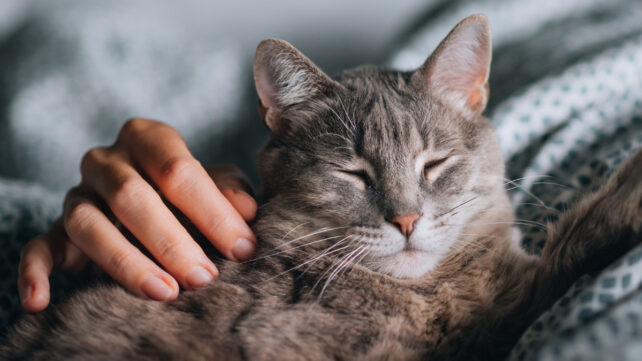
You might understandably think that pets always offer emotional support to their owners, but solid scientific evidence for this is surprisingly limited.
Despite the general assumption that pets are good for us, there are a lot of conflicting findings out there.
Dig through the research, and you'll see that having a pet in the family can have both positive and negative effects on physical and mental health.
A new study from researchers at the Open University in the Netherlands adds some intriguing detail, using data collected on owners of cats and dogs, the most popular pets globally.
The team found notable differences in the health impacts of both pets, but there was one specific scenario in which owning a cat seemed to have a detrimental effect.
Participants who reported feeling momentarily stressed found that more intense interactions with their feline often made them feel worse.
"Interaction with either species did not act as a buffer for negative emotions," says psychologist Mayke Janssens.
"In cats, we even observed that a higher level of interaction was associated with a stronger link between stress and negative emotions in owners."
The collected data covered 188 participants who owned either cats, dogs, or both.
The researchers pinged their phones via a data collection app multiple times per day, asking for quick reports on mood levels, stress, and the degree to which they were interacting with their pets.
This kind of monitoring has an official technical name: ecological momentary assessment, or EMA.
Relatively intense cat interactions were found to exacerbate feelings of stress in their owners, but dogs couldn't always be classed as stress buffers, either.
"Our findings indicate that stress-buffering is not the mechanism causing momentary emotional well-being when interacting with a pet," says Janssens.

Interacting with dogs showed neither positive nor negative effects on stress, statistically speaking.
"One speculative explanation is that because interactions with cats are often more passive and less demanding in nature, a higher level of interaction might be more emotionally evocative," says psychologist Sanne Peeters.
"This might not match the need for support in stressful moments."
There was better news for pet owners in terms of general mood, as well as positive and negative emotions. The study showed that spending time with both cats and dogs generally increased positive emotions and reduced negative ones.
So it could be that pets are beneficial in terms of mental health and well-being overall, just not when it comes to stress.

Further research could investigate the reasons behind these relationships and take a closer look at types of interactions.
This study only distinguished between the intensity of momentary interactions, not whether they were positive – like actual cuddles – or negative – like trying to give your cat a bath.
"The positive effects of pet interaction on well-being appear to be genuine, but they don't seem to happen because pets help people handle stress better at the exact moment the stress occurs," says Janssens.
"Interacting more intensively with the companion animal did not provide additional emotional benefits beyond those that may arise from the animal simply being present."
It's worth noting that while the researchers logged thousands of data points overall, cat owners were underrepresented compared to dog owners, and that may have skewed the data somewhat.
As with any study, it's important to look at the wider context as well. Pet ownership has been associated with brain benefits in old age, for example, protecting against cognitive decline and memory problems.
Related: Scientists Discover Why Cats Suddenly Stop Eating Their Food
When it comes to this research, though, the suggestion is that cats and dogs can be mood boosters, just not in the sense of relieving momentary stress.
"I wouldn't say that one species makes a better pet than the other," says Peeters. "Instead, it's more likely about owner personality and preference."
"The main conclusion is that interacting with dogs and cats appears to provide similar emotional benefits."
The research has been published in Frontiers in Psychology.