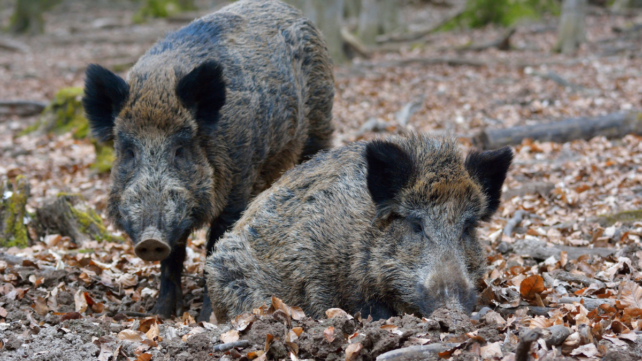
If it feels like there are wild boars everywhere now, you're not imagining things.
Feral pig populations are rapidly expanding in North America (especially Texas and Arizona), Europe, and South America.
Now, besides causing damage to agricultural crops and invading suburban backyards, these wild boars could also be helping to spread antibiotic-resistant bacteria, according to a new study from Brazil.
Public-health officials in Brazil have been concerned that the commercialization of wild boars, which are being bred for food there, may harbor zoonotic and antimicrobial-resistant bacteria.
But they didn't have good data, just a strong hunch.
So to find out if their suspicions were true, researchers collected rectal swabs from 100 healthy European wild boars (Sus scrofa scrofa) raised on two commercial farms in Goiás State, Brazil.

.jpg)
They screened the samples for Salmonella and E. coli, tested the bacteria against a panel of commonly used antibiotics, and searched for genes linked to virulence – the traits that can make bacteria better at infecting hosts.
The good news is that the researchers found very little evidence of Salmonella, but the bad news is that more than half of the animals carried E. coli, and almost every one of those bacterial strains was resistant to multiple antibiotics.
Although the one sample of Salmonella that turned up was resistant to several antibiotics, it lacked the virulence and resistance genes the researchers examined, suggesting the immediate Salmonella risk was relatively low.
E. coli painted a much more concerning picture.
The bacterium was isolated from 56 of the 100 wild boars, and 55 of them – a whopping 98.2 percent – qualified as multidrug resistant, meaning they could withstand antibiotics from multiple drug classes.
Resistance was particularly common against sulfonamides, tetracycline, amoxicillin, ampicillin, and doxycycline. If you recognize some of those names, it's because they are the most common, inexpensive frontline antibiotics.

Nearly all of the isolates remained susceptible to ceftriaxone, a critically important antibiotic in human medicine, but the researchers caution that even the small amount of resistance they detected deserves close monitoring.
Overall, they called the prevalence of drug-resistant E.Coli a "striking finding", which is as close to a 'yikes' as you can get from a scientist.
The team also looked for genes associated with bacterial virulence. Nearly 30 percent of the E. coli isolates carried the tsh gene, while fewer possessed papC and iss – genes linked to adhesion, survival in the bloodstream, and successful colonization of hosts.
Several bacteria carried more than one of these genes – combinations that could potentially increase their ability to cause disease.
According to farm managers, the wild boars were not routinely given antibiotics. That raises an obvious question: where did all this resistance come from?
The researchers suspect the environment itself may be the answer.
Antibiotic resistance genes can persist in soil and water, circulate among environmental microbes, and move between bacteria via mobile pieces of DNA.
Wild boars are also highly mobile, opportunistic animals that frequently interact with livestock, wildlife, and human-modified landscapes, creating all kinds of opportunities for resistant bacteria to spread even without direct antibiotic use.
Thinking holistically about the environment surrounding animals, even those in agricultural settings, is part of Brazil's One Health approach, which recognizes the "intersectoral health challenges" of human, animal, and environmental health.
Rather than viewing antibiotic resistance as purely a medical problem, One Health considers how resistant bacteria can move across ecosystems – from farms to forests, wildlife to livestock, and ultimately to people.
This systems thinking is why the researchers are looking at these wild boar-antibiotics issues.

As commercial wild boar farming expands in Brazil and escaped animals continue to establish wild populations, these invasive pigs could become an increasingly important reservoir for antimicrobial-resistant bacteria.
The researchers argue that captive wild boars should now be considered part of the health-surveillance network.
European wild boars weren't always part of South America's landscape.
Domestic pigs arrived with European settlers centuries ago, while wild boars were introduced in the early 1900s by an Argentine rancher for hunting. Since then, escaped animals have spread across the continent, interbred with domestic pigs, and established thriving populations.
In Brazil, their success has been fueled by a landscape that offers the best of both worlds: forest fragments that provide shelter alongside agricultural fields full of calorie-rich crops like corn and sugarcane.

Their continued spread has turned them into one of the country's most successful – and controversial – invasive mammals.
The study does come with important caveats. The samples were collected between 2014 and 2017, so the scale of the issue may have changed in the years since.
The researchers also relied on farm managers' reports that antibiotics were not routinely used, rather than independently verifying those records, and they examined animals from only two farms.
Related: Drug-Resistant Bacteria May Be Jumping Between Pets And Humans, Scientists Warn
Even so, the work provides some of the first detailed data on antibiotic resistance in wild boars in Brazil – and a timely reminder that the fight against antimicrobial resistance won't be won in hospitals alone.
Sometimes it starts by paying attention to what's wandering through the woods.
Read the full report in Archives of Microbiology.
This article was fact-checked by Fiona MacDonald and edited by Peter Dockrill. While we pride ourselves on our process, we are only human. If you spot a mistake, please let us know.