
A common drug that's been used to treat patients since the 1950s may hold transformative potential for human health, researchers say.
In a new review, scientists go as far as calling it a potential "wonder drug" but say more research is needed to understand how it can benefit modern medicine – especially with regard to its promise for slowing down biological aging.
The drug in question is called metformin, which is a first-line medication for type–2 diabetes and one of the World Health Organization's Essential Medicines.
Having first been synthesized by scientists over 100 years ago – and long one of the most-prescribed medicines in the US – you might think doctors know all there is to know about metformin.
But you'd be wrong.
In recent years, a growing body of scientific evidence has revealed that metformin's true potential hasn't been tapped, with researchers finding the drug works in ways we never realized.
Most importantly of all, studies have suggested it may hold powerful anti-aging properties in humans as well as in animals, although we're still only just starting to understand how metformin might confer these effects.
In a paper published in Aging, scientists review what we know about metformin, and explore how it might achieve its anti-aging and longevity-boosting results.
"Apart from its primary role in lowering blood glucose levels, metformin has been shown to have several effects at the molecular level," the research team, led by first author and genomics researcher Jarra Manneh from Hamad Bin Khalifa University in Qatar, explains in their study.
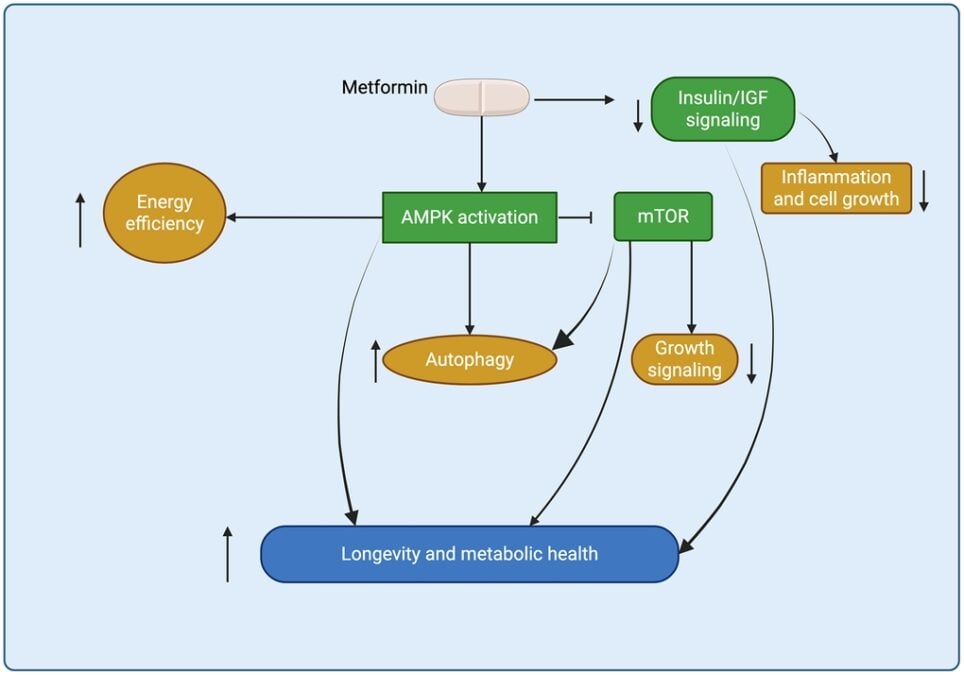
Chief among these is metformin's role in activating an enzyme in cells called AMP-activated protein kinase (AMPK).
Not only does that help lower blood glucose, but it also has other effects, including inhibiting a protein kinase known as mTOR, which results in increased autophagy (cells recycling damaged or unnecessary components), reducing oxidative stress, and improving insulin sensitivity.
These processes all contribute to slowing cellular aging, which potentially might lead to extended longevity in animals.

While the pathway in humans remains largely hypothetical, studies have shown that boosted levels of AMPK can extend the lifespan of worms, while knocking out the enzyme in mice shortens their lifespan.
Another way metformin may slow aging processes is by making epigenetic alterations linked to metabolism, aging, and inflammation, including through modifying production of an enzyme called ten-eleven translocation 2 (TET2).
"Increased TET2 stability induced by metformin intake leads to lower abnormal methylation patterns that result in genomic instability during the aging process," the researchers write.
"This decrease in abnormal DNA methylation patterns results to better genomic stability and prevents the risk of age-related diseases thereby maintaining a methylation profile that remains youthful."
One notable study published in 2022 found that metformin intake among patients with type 2 diabetes was associated with epigenetic evidence of slower aging compared to people who didn't take the drug.
The differences amounted to 2.7–3.4 years of reduced biological aging, but it's worth noting that this was only a small study (of 32 patients), and it doesn't demonstrate that metformin use caused the changes observed.
Metformin is also thought to have geroprotective effects through its effects on gut bacteria, by inducing changes in the gut microbiome that reduce inflammation, strengthen intestinal integrity, and boost metabolic health.
An experiment reported in 2022 found that metformin given to mice fed a high-fat diet was linked to reduced tumor growth, thought to be mediated via changes in the gut microbiome.
While there is a huge amount of research investigating metformin and its numerous mechanisms that may boost longevity, Manneh and team are careful to point out that we still don't currently have large-scale or definitive evidence of how the drug affects longevity in people, as most of the studies so far have been observational in nature, or conducted in animals.
Among the research in human patients, many of the studies so far have primarily investigated metformin in the context of specific kinds of disease, which makes identifying a singular geroprotective effect on healthy people difficult, despite the volume of circumstantial evidence from other lines of research.
"Most of these studies had heterogeneous endpoints (mortality, cancer incidence, cardiovascular events, frailty-related, biological aging markers) usually combined under aging," the researchers write.

"While this broad scope is conceptually useful, it makes it difficult to determine if metformin improves healthspan or just affects selected disease outcomes in selected populations."
Related: Diabetes Drug Used For More Than 60 Years Found to Unexpectedly Affect The Brain
Still, there are positive signs for the future.
An upcoming landmark study called Targeting Aging with Metformin (TAME) proposes to measure the effects of the drug in some 3,000 participants in clinical trials run across 14 US research institutions over six years.
If TAME or other clinical trials get underway, they could finally deliver some hard evidence to back up the multitude of promising signals we've seen so far.
Until then, metformin's ultimate potential to soothe the passage of time remains unrealized.
"More research, especially randomized clinical trials in non-diabetic populations, are needed to investigate the drug's epigenetic and microbiome-mediated effects as well as develop predictive aging biomarkers reactive to metformin," the researchers write.
"By merging data from clinical, molecular and population level, metformin could be the wonder drug that redefines the limits of healthy aging."
The findings are reported in Aging.
This article was fact-checked by Clare Watson and edited by Clare Watson. While we pride ourselves on our process, we are only human. If you spot a mistake, please let us know.