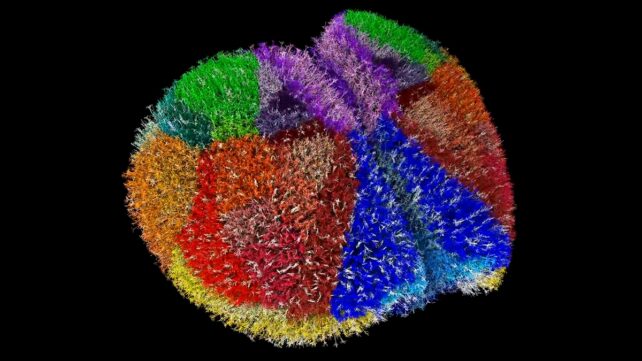
Getting a better understanding of how the brain works is tricky, as living brains aren't easily prodded and analyzed. Scientists now have a new simulation of a mouse's brain to refer to – one of the most comprehensive that's ever been put together.
The creation was led by a team from the Allen Institute in the US and the University of Electro-Communications in Japan, and it may allow diseases such as Alzheimer's to be modeled and studied in greater detail.
The simulation models an entire mouse cortex. While this isn't nearly as large or as intricate as a human brain, which contains billions of neurons, there are similarities between human and rodent brains – so this could be a useful study tool.
Related: Boosting One Protein Reawakens Aging Brain Cells in Mice, Study Shows
The numbers are impressive: the virtual brain contains 9 million neurons, as well as 26 billion synapses (neuron connectors). There are 86 interconnected regions in the brain simulation, and it can process quadrillions of calculations every second.
To put that in perspective, the real and full mouse brain contains roughly 70 million neurons in a space about the size of an almond.
"This shows the door is open," says computational neuroscientist Anton Arkhipov, from the Allen Institute. "We can run these kinds of brain simulations effectively with enough computing power."
"It's a technical milestone giving us confidence that much larger models are not only possible, but achievable with precision and scale."
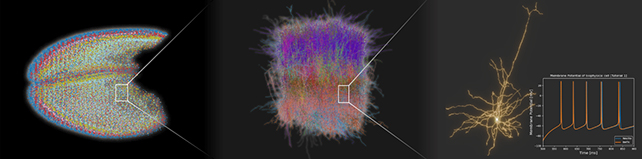
The complexity of the simulation means that researchers can watch as models of cognition, consciousness, and disease spread through the brain. It's a three-dimensional, moving map that shows individual neurons firing and connecting.
Some of the ways this could be used, according to the researchers, are to test hypotheses on how seizures spread in the brain, or how brain waves contribute to focus – without any need for repeated, invasive, physical brain scans.
The necessary computing power was provided by the Fugaku supercomputer in Japan, which built upon existing cell databases and charts to form the model. The team also developed new software to more efficiently process brain activity and keep unnecessary calculations down to a minimum.

"Fugaku is used for research in a wide range of computational science fields, such as astronomy, meteorology, and drug discovery, contributing to the resolution of many societal problems," says computer scientist Tadashi Yamazaki, from the University of Electro-Communications.
"On this occasion, we utilized Fugaku for a neural circuit simulation."
Our brains are, of course, essential to good physical and mental health, and healthy old age – and studies of virtual brain maps and mini-brain structures are going to be crucial in learning more about how this organ works, and how it can break down.
The team has already been busy putting their new model to use, making discoveries about brain wave synchronization and the way the two hemispheres of the mouse brain interact with each other.
It's a massively impressive feat of computing and biological modeling, but the researchers have even grander plans, and one day want to build a full-sized model of a human brain inside a virtual computing space.
"Our long-term goal is to build whole-brain models, eventually even human models, using all the biological details our Institute is uncovering," says Arkhipov. "We're now moving from modeling single brain areas to simulating the entire brain of the mouse."
The research has been presented at the SC25 supercomputing conference, and is available online.