
The first humans arrived upon the landmass now known as Australia around 60,000 years ago along two distinct routes, according to a new genomics study.
The question of when humans first arrived on the continent is contentious among archaeologists. Some cite previous genetic evidence that suggests dates of around 45 to 50,000 years ago, while others suggest the southern landmass may have been peopled as early as 65,000 years ago.
The new study, based on almost 2,500 sets of mitochondrial DNA from indigenous peoples of Australia, New Guinea, Oceania, and Southeast Asia, adds further support to an earlier arrival date, while also revealing it was not a singular voyage.
Related: Archaeologists Map Hidden Landscape Where The First Australians Emerged
Sahul was a landmass that existed during the Pleistocene epoch, made up of what we now call Australia, Tasmania, and New Guinea, which were all connected by land until about 9,000 years ago when sea levels rose at the end of the last ice age.
Archaeogeneticist Martin Richards, from the University of Huddersfield in the UK, and his colleagues analyzed DNA mutation rates and genetic connections between contemporary and ancient human populations, to trace the incredible passage trod – or rafted – so remarkably early in human history.
The researchers also compared this genetic information to archaeological evidence and climatic data.
It appears people took two routes from the ancient landmass Sunda to reach Sahul. Some travelled via Malaysia, Java, and Timor, entering Sahul west of the site of the modern-day city of Darwin. The researchers refer to these as the 'southern route lineages'.
Meanwhile, a separate flow of genes, which the researchers refer to as the 'northern route lineages', can be traced along the island chain that runs from the Philippines and Sulawesi through to Papua New Guinea, landing in Sahul via the northern tip of modern Queensland.
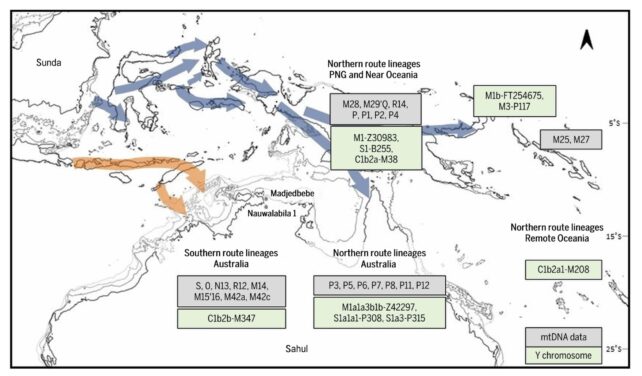
"We dated both dispersals to about the same time – roughly 60,000 years ago," Richards told journalist James Woodford of New Scientist. "This supports the so-called long chronology for settlement, as opposed to the so-called short chronology, which suggests settlement around 45,000 to 50,000 years ago."
The team estimates that roughly 36 percent of those first-wave lineages can be traced back to people who arrived in Australia via the northern route, while 64 percent descend from ancestors who took the southern route.
The research also suggests that some of the earliest pioneers of the northern route continued onward to the Bismarck Archipelago and Solomon Islands soon after landing in Sahul.

Taking their legacy into account, "most of the extant [surviving] lineages in ancient Sahul and Near Oceania descend from ancestors who arrived via the northern route, by way of the northern part of the now submerged Sunda continent and northern Wallacea, at around 60,000 years ago," the authors write.
"However, a minority of lineages overall (but around two-thirds of those in Australia) arrived via a southern route, through southern Sunda."
The authors note that ancient DNA from southern Asia and Sahul is lacking, which would offer further detail on the timing of these genetic events.
The research was published in Science Advances.