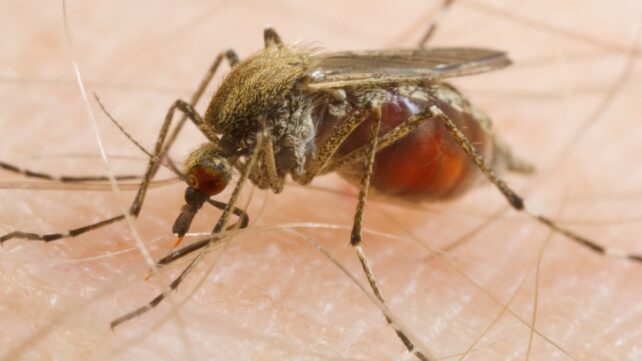
Some mosquitoes have become increasingly reliant on human blood, new research shows – and it's probably our own fault.
A sampling study of the bloodsuckers in Brazil has found that as biodiversity drops, mosquitoes are more likely to hunt us down. It makes sense, really: As human activity pushes other animals out of the region, mozzies have fewer alternatives to feast on.
The consequences are more dire than just an itchy annoyance, though. Mosquitoes are key vectors of disease, so a shift in preference for biting humans can have major health implications.
Related: Jurassic Park Was Right: Mosquitoes Really Can Carry Libraries of Animal DNA
Researchers from the Federal University of Rio de Janeiro and the Oswaldo Cruz Institute set up light traps in two nature reserves in the Atlantic Forest, Brazil, to capture 52 species of mosquito.

The team then separated blood-engorged females from a sample of more than 1,700 individuals. Of these, 24 contained identifiable DNA, which contained traces of 18 different humans.
The next highest group was birds, with blood from six different birds present in the samples, while amphibian, rodent, and canid blood each turned up once in the samples.
"Here we show that the mosquito species we captured in remnants of the Atlantic Forest have a clear preference for feeding on humans," says Jeronimo Alencar, biologist at the Oswaldo Cruz Institute.
There could be a few reasons for the high human count, the team says. But the most obvious is that with increased deforestation, there are just more people around.
"With fewer natural options available, mosquitoes are forced to seek new, alternative blood sources. They end up feeding more on humans out of convenience, as we are the most prevalent host in these areas," says Sergio Machado, microbiologist at the Federal University of Rio de Janeiro.

The team says more detailed analysis is needed, including perhaps better methods for capturing the insects.
The light traps are much more likely to attract hungry mosquitoes, while those that have recently fed prefer to sleep it off, making them harder to catch.
A better understanding of mosquito feeding habits could improve disease prevention strategies.
The research was published in the journal Frontiers in Ecology and Evolution.