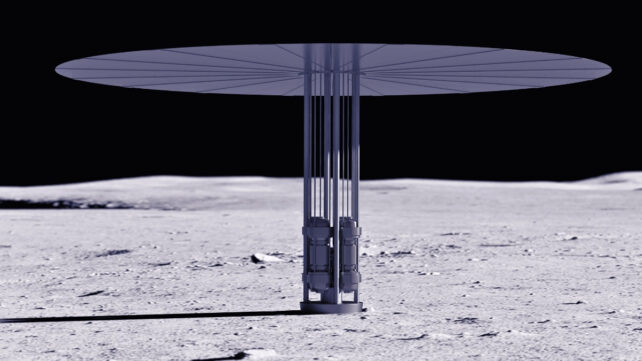
NASA and the US Department of Energy have reaffirmed their joint project to develop a nuclear fission reactor for the surface of the Moon.
According to an announcement from the space agency, the two bodies hope to complete the development phase – likely including testing on Earth – of this facility by 2030. The reactor would be designed to provide continuous power for years for planned lunar surface missions, eliminating the need for constant fuel resupply from Earth.
"This agreement," says NASA administrator Jared Isaacman, "enables closer collaboration between NASA and the Department of Energy to deliver the capabilities necessary to usher in the Golden Age of space exploration and discovery."
Related: Ghostly Glow of a Nuclear Power Station Was Detected in Pure Water 150 Miles Away
They have their work cut out. It's challenging enough to build a nuclear reactor that is safe and reliable on Earth. The Moon is a whole different ball game. Its environmental conditions present huge problems for fission reactor design, the biggest of which is the management of waste heat.
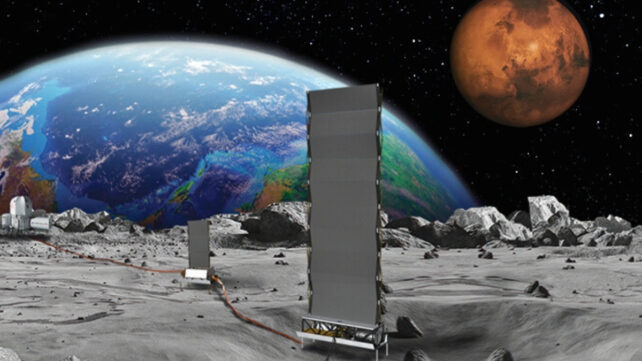
Here on Earth, reactor cooling towers use water, which releases the excess energy as steam borne away by the atmosphere. However, fluids behave differently in low-gravity and low-pressure conditions; the Moon is a near-vacuum, with no real, swirling atmosphere to help dissipate heat.
Possible solutions include solid-state conduction and liquid metal coolants, but each adds additional complexities to the design.
The Moon is also covered in dust. It's not like Mars, with its scouring, global dust storms, but the dust on the Moon is abrasive and electrostatically charged by solar radiation. It sticks to everything, which means any machinery destined for use on the Moon must be carefully designed to avoid lunar dust fouling up the works.

Not to mention that radiation shielding needs to be sufficiently strong to protect any lunar explorers working nearby. And all this needs to be robust enough that maintenance and repairs will be minimal, at most.
Scientists have been working on these technical problems for years, so NASA and the DOE aren't starting from square one.
Current plans involve designing and developing a reactor that can provide at least 40 kilowatts of power – enough to run about 30 households continuously for 10 years. But there is no firm timeline yet for when such a system might actually be deployed on the Moon.
The initial design phase has been completed. However, the translation of that design into flight-ready hardware is, by necessity, a slow process, shaped as much by funding and regulation as it is by engineering.
A fission reactor on the Moon would be an incredible resource for space exploration. This new announcement, however, suggests that it remains a long-term ambition rather than an imminent reality.