
We know that physical exercise is good for our health and longevity, but new research shows how even the smallest differences in our daily habits can lead to meaningful benefits.
Based on an analysis of wearable data from more than 130,000 people across several countries, just 5 minutes of extra exercise each day, or reducing sitting time by half an hour, is linked to noticeable improvements in lifespan.
The research, led by a team from the Norwegian School of Sport Sciences, focused on two groups: a high-risk group composed of the least active 20 percent of participants, and a broader population group comprising everyone except the most active 20 percent.
Related: One Type of Activity Is Particularly Effective at Keeping Your Brain Young
"Small and realistic increases in moderate-to-vigorous physical activity of 5 min/day might prevent up to 6 percent of all deaths in a high-risk approach and 10 percent of all deaths in a population-based approach," write the researchers in their published paper.
"Reducing sedentary time by 30 min/day might prevent a smaller, but still meaningful, proportion of deaths in the two risk scenarios."
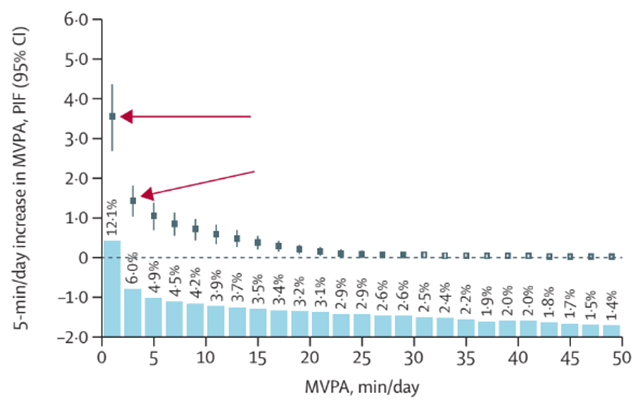
These figures were generated using statistical models rather than tracking participants' activity over time. Instead, each person's risk of death was estimated and compared with that of their peers, allowing researchers to model how changes in activity levels might impact their risk.
It's notable that the biggest benefits were predicted among people who were typically less active and spent more of the day sitting. In other words, in terms of physical exercise and avoiding a sedentary lifestyle, those who are currently doing the least stand to gain the most from making relatively small changes.
While the observational nature of the study leaves it short of proving a direct cause-and-effect relationship, the large datasets involved and the significance of the association suggest it's something worth studying further.

"We only investigated all-cause mortality; thus, future research should examine other health outcomes," write the researchers in their published paper.
"Additional research using device-measured physical activity is needed in low-income and middle-income countries where the age structure, physical activity levels, and disease burden differ from those included in the present study."
The findings offer encouragement for people who struggle to find the time or motivation to exercise regularly. Even just a few minutes of brisk walking or cycling, or half an hour of doing something that isn't sitting, may make a difference.
Related: Not All Sitting Is Equal. One Type Was Just Linked to Better Brain Health.
It's still the case that more exercise is better for you, of course – the World Health Organization recommends 150 minutes of moderate-to-vigorous physical activity a week – but small steps still make a difference.
"A clear message we want to get across is that every movement counts and getting inactive people to do some activity is where we see the biggest gains in health," says sedentary behavior scientist Daniel Bailey from Brunel University of London, who wasn't involved in the study.
"So, GPs, policymakers, or campaigners can certainly be looking to support patients and the public with making these relatively small changes to start with, which would give people a starting point to then kick on and increase their activity even more."
The research has been published in The Lancet.