
One of the largest stars known in the Universe has done something strange – and scientists are debating what it means.
WOH G64, a colossal star in the Large Magellanic Cloud, is – or was? – one of the largest red supergiants known, measuring more than 1,500 times the radius of the Sun. In 2013 and 2014, telescopes captured a dramatic transformation, with the star appearing to shift from a classic red supergiant toward a hotter, yellower state.
A team of researchers led by Gonzalo Muñoz-Sanchez of the National Observatory of Athens in Greece concluded the star had evolved into a rare yellow hypergiant phase, potentially taking a step toward its ultimate demise.
Presenting their study on the preprint server arXiv in November 2024, they argued the change marked an abrupt transition from a red supergiant to a short-lived evolutionary stage that can precede a core-collapse supernova.
"This drastic transformation," they write in their now-published paper, "can be explained either by the partial ejection of the pseudo-atmosphere during a common-envelope phase or the return to a quiescent state after an outstanding eruption exceeding 30 years in duration."
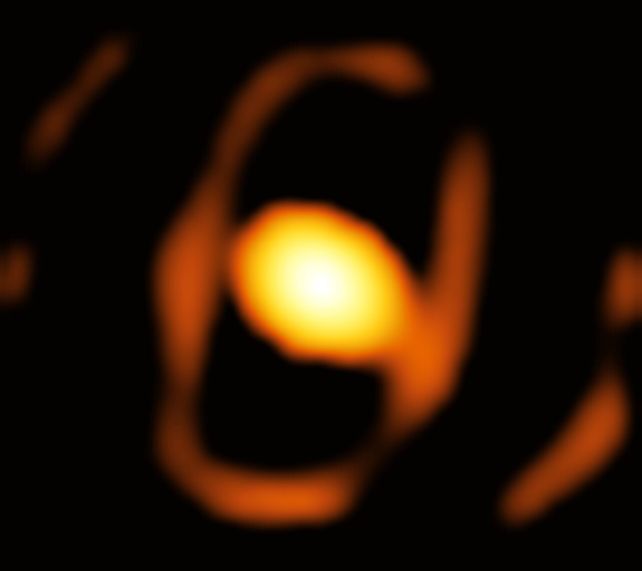
According to their analysis, the changes included a temperature increase, a reduction in size to around 800 solar radii, and shifts in its atmospheric chemistry. They also identified a hot binary companion star interacting with its larger, puffier companion.
But more recent observations suggest the star may never have stopped being a red supergiant at all.
Red supergiants are among the largest stars in the Universe by volume, evolving from massive stars typically around 8 to 30 times the mass of the Sun that are in the final stages of their nuclear burning. As a red supergiant's fuel reserves shift to heavier elements, it puffs up, expanding its outer layers to hundreds of times the radius of the Sun.
Such stars are inherently unstable and can undergo dramatic changes, including shifts in brightness or hue, as they shed material into space.

Located about 160,000 light-years away, WOH G64 is both exceptionally large and extensively monitored, offering astronomers a rare opportunity to watch how massive stars behave in their final evolutionary stages.
But interpreting the behavior of such unstable stars is difficult. A change in brightness or color does not necessarily mean a change in identity.
The 2024 release of the paper led by Muñoz-Sanchez and his team gave other researchers time to conduct their own follow-up observations before the peer-reviewed version was published in Nature Astronomy.
Between November 2024 and December 2025, astronomers Jacco van Loon of Keele University in the UK and Keiichi Ohnaka of Universidad Andrés Bello in Chile conducted observations using the Southern African Large Telescope.

In January 2026, they published their conclusions in the Monthly Notices of the Royal Astronomical Society. They found titanium oxide in the atmosphere of WOH G64.
A yellow hypergiant, however, is too hot to sustain titanium oxide.
"WOH G64 has been claimed to have turned into a yellow hypergiant, which could signal a pre-supernova post-red supergiant evolution," van Loon says.
"However, our new spectra obtained with SALT show the hot companion's presence but also clear molecular absorption bands from titanium oxide. This implies that WOH G64 is currently a red supergiant and may never have ceased to be."
A red supergiant star exhibiting strange changes that do not necessarily signal an imminent explosion is not without precedent; who, after all, can forget the dramatic tantrums of Betelgeuse, during which its brightness dropped by almost 25 percent?
Related: For The First Time, We've Seen a Red Giant Star Transition Into a Supernova
That doesn't mean that nothing dramatic is happening with the star. Van Loon and Ohnaka agree that the star likely has a binary companion. They believe interactions between the two stars may have complicated the environment around them, producing changes that could resemble a spectral shift without requiring a fundamental evolutionary leap.
To better understand what's going on with WOH G64, continued monitoring is crucial. How it continues to evolve will give scientists a clearer picture of whether the star is on the brink of an evolutionary transition, or whether messiness is its current baseline state.
One thing, however, remains crystal clear. This strange system is full of surprises and will remain a fascinating little corner of the Universe.
The paper by Gonzalo Muñoz-Sanchez and his team has been published in Nature Astronomy.