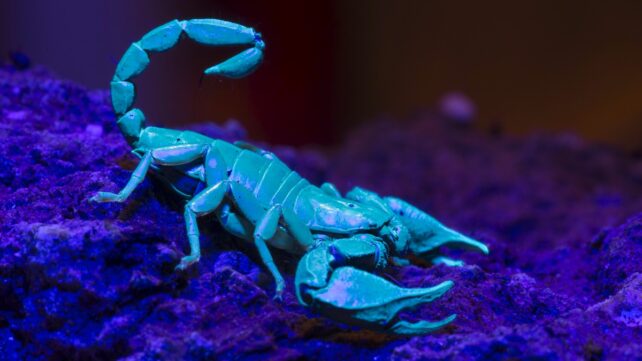
Armed with stingers and pincers, scorpions sport some of the most formidable weapons in the animal kingdom – weapons which, it turns out, are reinforced with heavy metals.
Now, scientists have found that different species incorporate those metals into their exoskeletons in different ways, depending on how they hunt and defend themselves.
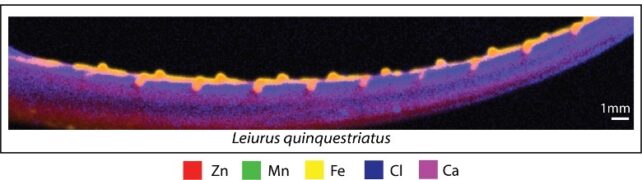
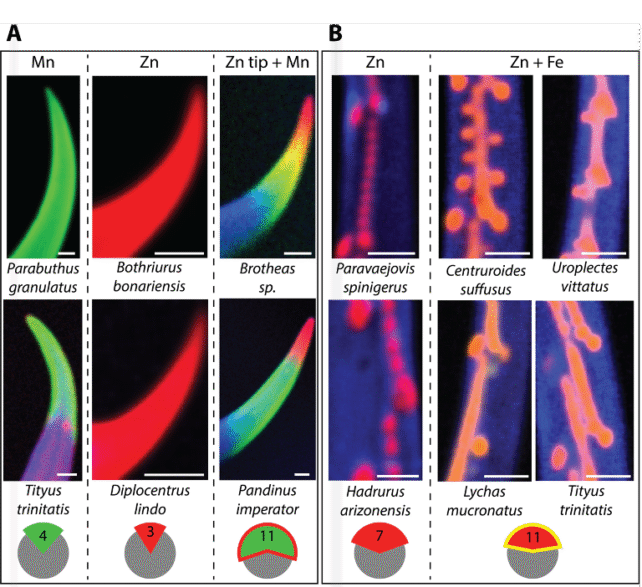
The researchers examined the stingers and pincers of 18 scorpion species using X-rays and electron microscopes, and analyzed where metals such as zinc, iron, and manganese were being enriched.
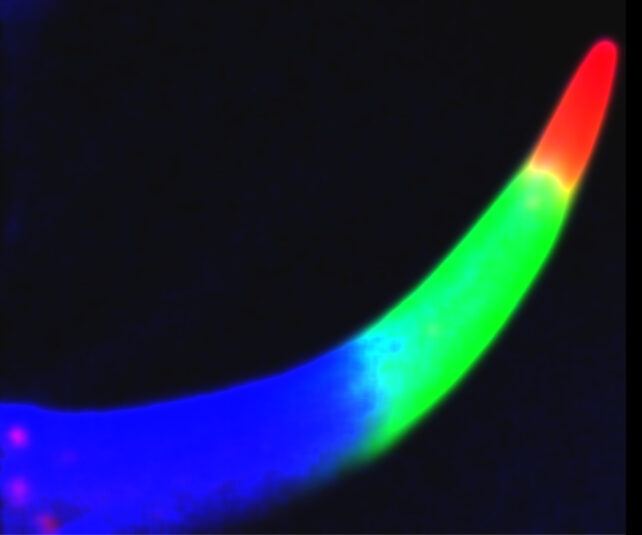
They found that zinc is often concentrated right at the tip of the stinger, while manganese becomes the predominant metal further down the length.
In the pincers, however, zinc and iron appear most often along the inner surface of the cutting edge, helping it withstand the stress of grasping and crushing prey.
These patterns generally didn't occur in the same species, though: Higher levels of zinc in the pincers usually meant lower levels in the stinger, and vice versa.
"The microscopic-scale methods we used allowed us to identify individual transition metals in extremely high detail, showing us how nature skillfully engineered these metals in the scorpion's weapons," says Edward Vicenzi, a research scientist at the Smithsonian Museum Conservation Institute.
While scorpions generally follow the same basic body plan, different species prioritize different weapons.
The Opistophthalmus genus, for instance, packs a pair of powerful pincers but a rather underwhelming tail.
That's because it's always arm day – these scorpions use their forelimbs to dig burrows, and focus more on crushing prey with their claws, only using the stinger as backup.
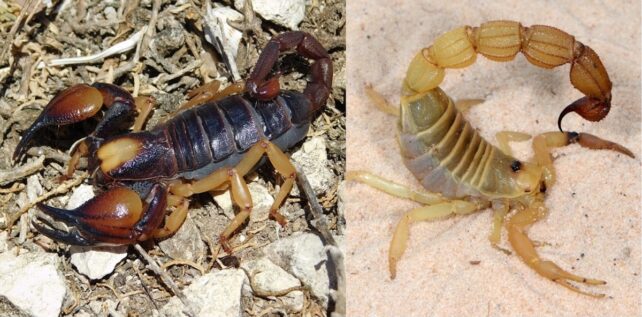
Those in the Parabuthus genus, however, aren't called thick-tailed scorpions for nothing. Their beefy backends deliver fast-acting venom, so grabbing their prey isn't a priority. That's pretty clear from the puny pincers they're packing.
At a glance, you might expect that bigger pincers would be reinforced with more metal than smaller ones, and that was the team's hypothesis in this study. But the results surprised them.
The analysis showed that in species with longer claws and weaker crushing power, their pincers had higher levels of zinc enrichment compared to those with more powerful pinch strength.
It may seem counterintuitive, but it does follow its own kind of logic too.
"This points to a role for zinc beyond hardness, perhaps playing a bigger role in durability," says Sam Campbell, an evolutionary biologist at the University of Queensland in Australia.
"After all, long claws need to grasp prey and prevent it from escaping before being injected by venom.
"This is an interesting finding because it suggests an evolutionary relationship between how a weapon is used and the specific properties of the metal that reinforces it."

Related: Komodo Dragon Teeth Have Iron Caps For Sharpness, Scientists Discover
It's an intriguing study with wide implications, not just for scorpions but other arthropods that reinforce their bodily weapons with metals – whether that's spider fangs, ant mandibles, or bee or wasp stingers.
And let's take a moment to be thankful that the prehistoric 'hell ants' – and the huge metal spikes growing on their heads – are extinct.
The research was published in the Journal of the Royal Society Interface.