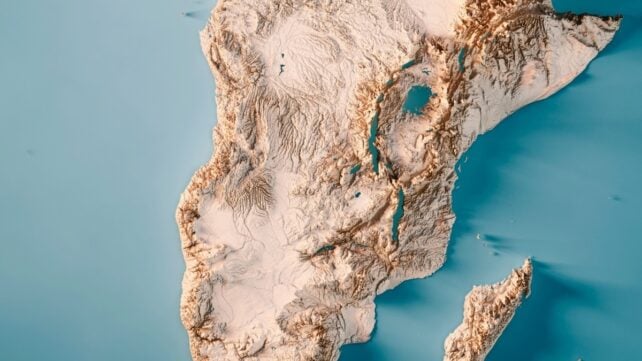
Geologists have discovered that the African continent will split apart sooner than we thought. An active rift has reached a "critical threshold" and will soon break apart, forming a new ocean.
That said, 'soon' is a relative term – it'll still take a few million years more, but that's a blink of an eye on a geological scale.
"We found that rifting in this zone is more advanced, and the crust is thinner, than anyone had recognized," says Christian Rowan, a geoscientist at Columbia University.
"Eastern Africa has progressed further in the rifting process than previously thought."
The most intriguing thing about the find is its implications for our own history. The Turkana Rift Zone in Kenya is rich in early hominin fossils, which implies it was a key location for human evolution.
But the new find suggests the region may not necessarily have been more important to our ancestors than anywhere else in Africa – instead, it may just be that these geologic processes created very favorable conditions for fossilization.
Earth's current arrangement of continents feels like a constant to us, but they're always moving – albeit extremely slowly.
More than 200 million years ago, they were all smushed together in one supercontinent, and it's predicted that in the distant future, they'll (mostly) end up getting back together again.
Where two tectonic plates meet, mountains form. Where they drift apart, oceans are born.
The East African Rift System is a clear example of the latter. The African plate is currently splitting into two: the massive Nubian plate to the west, which contains most of the continent; and the smaller Somali plate, which contains much of the eastern coast and the island of Madagascar.
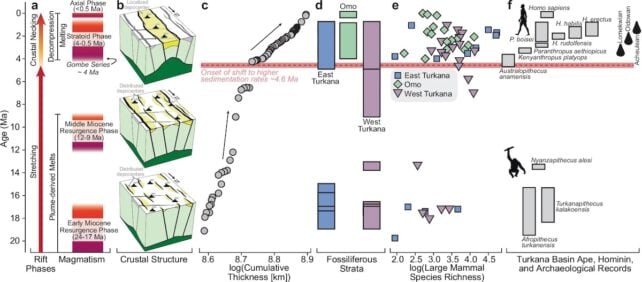
For the new study, scientists focused on a specific part of that system: the Turkana Rift, which stretches for hundreds of kilometers through Kenya and Ethiopia. The team analyzed seismic measurements previously taken in the region, and calculated how thick the crust is there.
It turns out that it's much thinner than expected: only around 13 kilometers (8 miles) thick in the center of the rift. For comparison, the crust is more than 35 kilometers thick along the edges of the rift region.
And when crust in a rift zone becomes thinner than about 15 kilometers, that means it's entered a phase called 'necking.' After it reaches that point, a continental breakup is all but inevitable.
"The thinner the crust gets, the weaker it becomes, which helps promote continued rifting," says Rowan.
In a few million years, it will complete this phase and enter the next: oceanization. As the name suggests, this is how a new ocean forms.
The crust will stretch so thin that magma erupts from beneath, which then pools and cools to form a basin. This will become a new seafloor, as water begins to rush in from the Indian Ocean.
This process is already beginning in the Afar Depression, which lies in northeast Africa near the Red Sea.

The researchers estimate that the Turkana Rift entered its current necking phase around 4 million years ago, after an extended period of volcanic activity. Intriguingly, this lines up with the age of the earliest hominin fossils and evidence found in the area.
This is probably no coincidence, the team suggests. As the rift began necking, sedimentation began accumulating faster, making it perfect for capturing a detailed record of the life that lived there at the time.
Related: 'Extinct' Volcanoes May Be Silently Building Magma For Future Eruptions
"The temporal coincidence between this tectonic transition and the onset of continuous, thick fossil-bearing strata suggests that the necking phase provided critical conditions for fossil preservation," the researchers write.
"We propose that these tectonic changes played a fundamental role in shaping the Turkana Rift Zone's exceptional paleoanthropological record."
The researchers say that future work could investigate this connection.
The research was published in the journal Nature Communications.