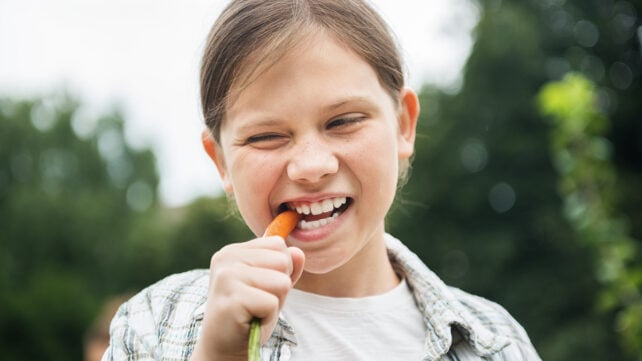
Trying to persuade kids to eat healthily is a challenge many parents face, and a small new study suggests that pregnancy might be a prime time to influence toddlers' tastes.
Researchers found that children who had been exposed to specific vegetables through their mothers' diet before birth were then less likely to react negatively to the smell of those same foods at three years old.
In addition to deepening our understanding of how much fetuses can absorb during pregnancy, there's potential here to reduce kids' aversion to vegetables before they're even aware of them.
The findings come from a team led by researchers at Durham University and Aston University in the UK and show that likes and dislikes established during gestation can persist to the infant stage.
"What we see over time is that the children are still more favorable to the vegetables they were exposed to while they were in the womb," says psychologist Nadja Reissland, from Durham University.
"From this we can suggest that being exposed to a particular flavor in late pregnancy can result in long-lasting flavor or odor memory in children, potentially shaping their food preferences years after birth."

These same children had previously been exposed to carrots and kale through their mothers' diets. Before birth, at 32 and 36 weeks' gestation, researchers used ultrasound to record fetal facial responses after mothers consumed a high-potency capsule containing either kale or carrot powder.
As reported in a 2022 study, there was evidence that the unborn babies reacted to those tastes and smells.
By the third trimester (about 28 weeks into pregnancy), humans are developed enough to taste and smell flavors in the amniotic fluid surrounding the fetus, which is passed through the placenta from the mother.
Here, the researchers wanted to see if those reactions and that conditioning lasted into childhood. At age three, 12 of the children were presented with odors of both kale and carrot on cotton swabs, and their reactions to each were recorded as 'cry face' (negative) or 'happy face' (positive).
Overall, the three-year-olds showed fewer negative reactions to the vegetable they were exposed to in the uterus than to the other one. The bitter kale elicited more negative reactions overall, but early exposure seemed to reduce them.
There are limitations to this study, including its very small size and the inclusion of only one population. The young participants didn't actually eat anything or specifically choose what to eat, and no monitoring was done between birth and age three to rule out the influence of later exposure.
However, the findings are significant enough to make this worth exploring further in future studies.

Those studies could cover larger groups of children, and in more detail over time. They could also account for other factors that influence dietary preferences, of which there are many, as the researchers acknowledge.
"It is important to note that flavor preferences and dietary habits are influenced by a complex interplay of genetic, environmental, and cultural factors," write the researchers in their published paper.
"For example, genetic differences among individuals play an important role in how various foods and odors are experienced. Therefore, genetic predispositions, causing various levels of sensitivity for flavors, may change the importance of prenatal exposure effects."
We know that kids can be picky eaters, and nudging them in the right direction from the start has the potential to lead to a healthier overall population.
A balanced diet has knock-on effects on just about every other aspect of physical and mental health, the science has shown, from longevity and cancer risk to obesity and diseases such as Alzheimer's.
Related: This Unique Diet Could Slow Your Brain Aging by Over 2 Years, Study Suggests
And it's another reason – among many – for pregnant people to watch what they're eating: Past studies have shown connections to heart health and neurodevelopmental conditions, for example.
"These findings give further support to the use of prenatal exposure for improving children's acceptance of often disliked vegetables," says psychologist Jacqueline Blissett, from Aston University.
The research has been published in Developmental Psychobiology.