
The agents guiding the shape of your aging journey may not just come from within.
Although your genes play a powerful role in the way you age, a new study of people around the world suggests that it's not just where you're from that matters – where you live geographically also appears to affect how you age.
That's because your environment can alter how your genes behave, meaning two people with similar genetic backgrounds can have different patterns of aging and disease risk.
"For the first time, we have deeply profiled people from around the world," says geneticist Michael Snyder of Stanford University.
"This enables us to see what properties, such as metabolites and microbes, are correlated with ethnicity and which ones with geography."

Humans are complex creatures living complex lives, and it can be difficult to determine what pressures shape our biology. Factors such as ancestry, geography, and lifestyle are all at play, and teasing out what they all do and how they interact can be extremely difficult.
Humans have been geared toward migration for many thousands of years, but in the last few centuries, advances in technology have exponentially expanded our ability to move around our planet.
This very phenomenon is what Snyder and his colleagues leveraged to try to unravel the differences between genetic and environmental pressures on the human body.
They recruited 322 people from around the world, most of whom attended one of five scientific conferences, representing ancestry from Europe, East Asia, and South Asia.

This cross-section, therefore, consisted of groups of people with similar ancestral backgrounds who were now living in different parts of the world.
The researchers did not just look at DNA, but included a wide range of health biomarkers, such as proteins, fats, gut bacteria, immune markers, and metabolites – all of which can be put together to build a comprehensive picture of a person's biology.
The results showed that ancestry cannot be erased simply by packing up and moving. People with shared heritage also shared a baseline of genetics, gut microbiome, and metabolism, no matter where in the world they were living.
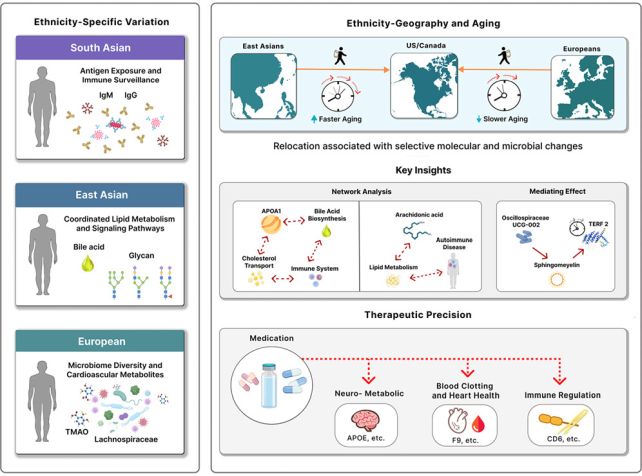
For example, people of South Asian descent showed higher immune surveillance – the active patrolling of the immune system – in response to higher exposure to antigens.
People of East Asian heritage showed distinct patterns of fat metabolism. And people of European ancestry had a more diverse microbiome than the other populations.
However, living far from home was also associated with changes, with specific patterns emerging in different populations.
One of the most striking findings concerned biological age – that is, how old the body's cells and tissues appear to be, rather than how old the person is chronologically.
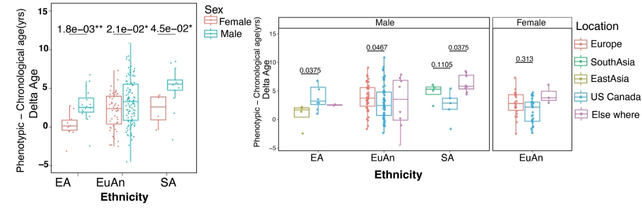
In particular, East Asians living outside East Asia showed faster biological aging than those living in the region.
For Europeans, the reverse was true: Those living in Europe showed more advanced biological aging than those living in North America.
"We were struck by how consistently ethnicity influenced immunity, metabolism, and the microbiome, even when people moved thousands of miles away," says geneticist Richard Unwin of the University of Manchester in the UK.
"However, it is equally clear that where we live can have substantial impacts on nudging key molecular pathways – even how our cells appear to age – in different directions depending on who you are. It proves that precision medicine must reflect real global diversity, not a single population."
The researchers believe these differences may be driven by a combination of factors, including diet, exposure to pollution, healthcare access, stress, lifestyle, and changes in the gut microbiome after relocation.

The microbiome in particular appears to play an important role. Certain gut bacteria were associated with changes in fats known as sphingolipids, which in turn were linked to genes involved in maintaining telomeres – the protective caps on chromosomes that are often associated with aging.
Related: Humans Age Faster at 2 Sharp Peaks, Research Shows
"Elevated sphingolipid levels have been associated with increased cardiovascular disease risk, insulin resistance, atherosclerosis, and neurodegeneration," the researchers note in their paper.
This research does not mean that one ethnicity ages 'better' than another, or that the effects are universal.
Instead, it suggests that medical and nutritional advice cannot rely on a one-size-fits-all model and needs to take factors such as ethnicity and physical location into account.
"What this study shows, more clearly than ever before, is that our biology is shaped by a combination of both our genetic ancestry and the places we live," Unwin says.
The research has been published in Cell.