For more than three decades, experts have been trying to solve the mystery of why a certain kind of underwater fault triggers earthquakes way more predictably than others.
These quakes can happen almost like clockwork, and nearly always the same size.
A new study offers a possible answer.
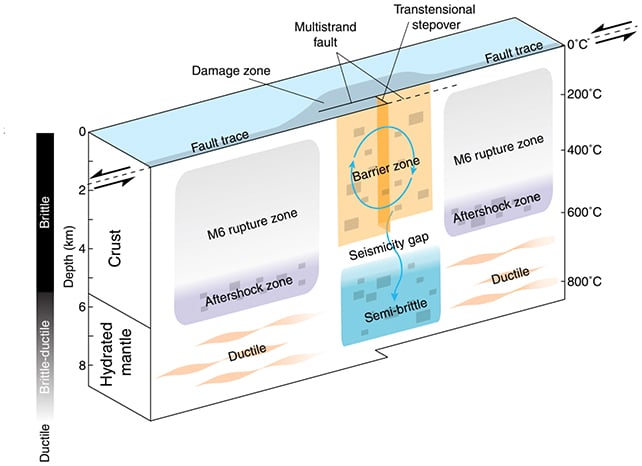
These oceanic transform faults, as they're known, are surrounded by barrier zones, which researchers from across the US and Canada have shown act as natural 'brakes' for earthquake activity.
A process known as dilatancy strengthening – that occurs when seawater seeps deep into the rock – is what buffers these fault sections from the violence of larger quakes, the researchers report.
By revealing the secrets of these unusually predictable faults, the hope is that earthquake models can be upgraded more generally.
"We've known these barriers existed for a long time, but the question has always been, what are they made of, and why do they keep stopping earthquakes so reliably, cycle after cycle?" says seismologist Jianhua Gong, from Indiana University Bloomington in the US.
The researchers studied data from two sections along the Gofar transform fault, an extended underwater trough marking the boundary between the Pacific and Nazca tectonic plates, west of Ecuador and deep under the Pacific Ocean.
These plates are scraping past each other at a rate of around 140 millimeters (5.5 inches) a year, and the fault has been generating a regular magnitude six earthquake every five or six years since full record-keeping started in 1995.
In two separate experiments, carried out in 2008 and 2019-2022, ocean bottom seismometer (OBS) devices were placed directly on the seafloor to track movement. These instruments captured the details of tens of thousands of tiny earthquakes around two major ones.
The data analysis showed that the two segments of the Gofar fault, each with a barrier zone, shook in a similar way. The barrier zones are actually complex networks of small faults, absorbing the numerous minor shocks that precede big quakes, measurements showed.
When the main quakes occur, the fluid-filled rock around these buffer zones shifts and expands, and more water rushes into the gaps. This creates changes in pressure that cause the rock to 'lock up' and prevent further sliding, effectively stopping the earthquake from getting larger.

"These barriers are not just passive features of the landscape," says Gong.
"They are active, dynamic parts of the fault system, and understanding how they work changes how we think about earthquake limits on these faults."
Seismologists have noticed similar scenarios at oceanic transform faults around the world: Earthquakes at these faults are smaller than expected, given the geological pressures and layout.
While only one specific fault has been analyzed so far in this study, barrier zones like those around the Gofar fault could be gripping other faults too.
That would require the same type of complex fracturing and seawater infiltration as observed in this study. Future research could look into that, perhaps using techniques such as seafloor drilling, the researchers suggest.

Given the location of the Gofar fault, there's no real concern for earthquakes here causing damage to built-up areas or loss of life. However, these findings may offer new insight into earthquake zones that are potentially more dangerous.
Earthquakes from most faults other than oceanic transform faults – whether under the ocean or on land – are notoriously unpredictable, but each step forward in scientific understanding gets us closer to knowing when and where quakes will strike.
Related: How a Giant Earthquake Triggered a Surprisingly Small Tsunami
"The predictable seismic cycles and spatially confined rupture areas documented by the 2008 and 2020 OBS experiments demonstrate that targeted, multi-year deployments are essential for capturing the details of seismicity associated with large oceanic transform fault earthquakes and to resolve their underlying mechanisms," write the researchers in their published paper.
"Such observations yield fresh insights into earthquake physics and provide robust constraints for numerical models."
The research has been published in Science.