In case you missed it, last week the ScienceAlert team shared their favorite science facts for you to use as conversation starters over the 4th of July weekend.
We all enjoyed them so much we thought we'd ask you, our loyal readers, for your own go-to science facts to inspire family and friends.
And, wow, you guys blew us away!
We had more than 500 responses from our readers. Below are our favorites.
"Every breath you take contains air molecules that were also breathed by pretty much every other person in history."
– Joseph Johnson
"If you scale our Solar System down to the size of a red blood cell, the Milky Way would be the size of the United States."
– Huw F. Rees
"The thickness of Earth's atmosphere relative to the planet is roughly the same as the skin on an apple."
– Louis Macallistar-Menzies
"When you look at the night sky, you are literally looking back in time – some of those stars no longer exist."
– Rebecca Congreve
"Coyotes can't go extinct. If a pregnant female howls and doesn't hear a response from another expecting mother, she can nearly double the size of her litter."
– Joshua Riley
"The Sun is about 400 times wider than the Moon, but also about 400 times farther away – which is why they appear the same size in our sky. No other planet in the Solar System has this."
– Michael O'Brien

"It took 45,000 years for a photon of light to travel from the core of the Sun to its surface. Then just eight minutes to reach your eyes."
– Michael Koa
"Birds are living dinosaurs. Every bird you've ever seen is a direct descendant of theropod dinosaurs."
– Sean Newell
"There is a mushroom – Chorioactis geaster – found almost exclusively in Texas and Japan. DNA tests show the two populations separated 20 million years ago, 7,000 miles apart, with no human explanation."
– Kenneth Shawn
"At -40 degrees, Celsius and Fahrenheit are exactly the same temperature. It's the one point where the two scales meet."
– William E. Davenport
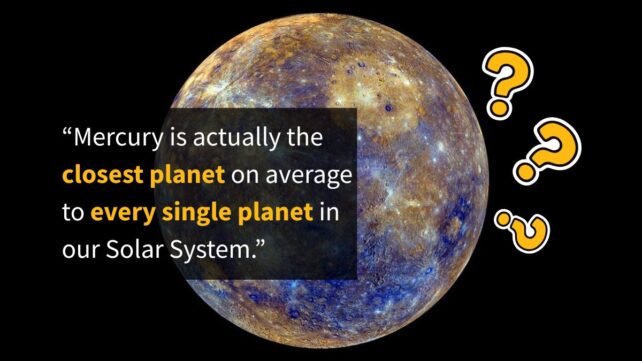
" Mercury is actually the closest planet on average to every single planet in our Solar System – not just Earth. Because it orbits so close to the Sun, it never gets too far away from anything."
– @remuslup19

"In 1982, computers had switches that could open and close in the time it takes light to travel one foot. Light travels 186,000 miles per second – and we were already working at that scale over 40 years ago."
– Daniel Lockwood
"Less time separates us from T. rex (66 million years) than separates T. rex from Stegosaurus (76 million years)."
– Eric Dunlap
"When you look at the stars, you're looking back in time. The light from Polaris left 450 years ago. The Andromeda Galaxy? You're seeing it as it was 2 million years ago."
– George Zoric Jr.
"Your brain is nearly 60 percent fat. It's the fattiest organ in your body."
– Rebecca Dyer, ScienceAlert Assistant Editor
"Cuttlefish can change the colors displayed on their skin – and yet they are completely colorblind. Their eyes are sensitive to polarized light: an entirely different way of seeing."
– Jess Cockerill, ScienceAlert Journalist and Editorial Assistant

"If your peripheral vision were as sharp as your central vision, you'd probably need a visual cortex the size of a classroom to process it all."
– Carly Cassella, ScienceAlert Senior Journalist
"There are more possible games of chess than there are particles in the observable Universe."
– @gurubob12
"Spider silk is so incredibly fine, a single pound of it would extend all the way around Earth – and keep going."
– Peter Dockrill, ScienceAlert Managing Editor
"Voyager 1 has been travelling through space since 1977 and still hasn't made it one light-year from Earth."
– Fiona MacDonald, ScienceAlert Co-Founder
"A day on Venus is longer than a year on Venus."
– @sad.foto
"The smell of fresh cut grass is actually a distress signal – the plant warning its neighbours it's been damaged."
– Wezze Van Ongevalle

"Flamingos can freeze into a lake overnight and simply walk away when the ice melts in the morning."
– Renee Michele
"In a double rainbow, the colors of the outer bow are inverted."
– Alex Mayberry
"The ovum that became you was created in your mother's ovaries three months before she was born – making your biological starting point older than her birth."
– Ian Graham
"There are more trees on Earth than stars in the Milky Way."
– Ben Fincher
"All the planets in our Solar System could fit in the space between Earth and the Moon."
– Melina O'Brien

"Sharks are older than trees."
– Jacob Anthony
"When a star's core turns to iron, it signals the end of its life – iron is the one element that can't be fused to release energy, so fusion stops, gravity wins, and the star collapses."
– John Rider
"Coal exists because, for about 60 million years, trees evolved wood before fungi evolved to break it down – so dead trees just piled up, undecomposed, and became coal."
– Ben Bailey
These facts have been collected together and edited by Fiona MacDonald from our reader submissions. If you spot a mistake, please let us know.