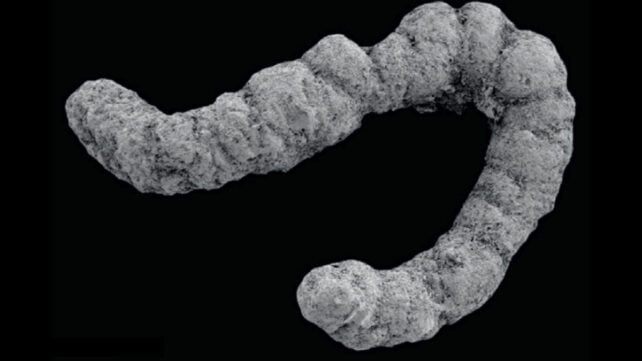
We may owe our very existence to an ancient poop explosion.
If the earliest animals hadn't been such prolific poopers, life might not have diversified into all the weird and wonderful forms we see today.
That's the conclusion reached by a new review study published in Trends in Ecology & Evolution.
The team of scientists in Australia and Germany found that the Cambrian explosion – a period around 540 million years ago when the ancestors of most animal groups arose – could have been partly set in motion by an explosion of feces, left by those that came before.
"Next to rising oxygen levels and other contributing factors, the importance of feces in ancient ecosystems is often overlooked," says Russell Bicknell, an evolutionary biologist at Flinders University in Australia.
"We have considered these ancient diets, increasingly sophisticated digestive systems and trophic interactions as part of a much bigger picture to help explain how more organic matter and nutrients poured into the ancient oceans to accelerate ecosystem development at the end of the Ediacaran and early Cambrian periods."
Life first appeared on Earth surprisingly soon after the planet itself was born, around 4.5 billion years ago.
But after that initial spike of inspiration, evolution seems to have rested on its laurels for a few billion years, and there wasn't really anything bigger than a few cells.
When evolution did finally dabble in more complex life, it apparently sparked a renewed wave of creative inspiration, and quickly branched out into all kinds of wacky creatures the likes of which Earth had never seen before.
This spike in diversity occurred over a period of about 25 million years. That sounds like a long time, but it's just one frenzied afternoon in the studio relative to the almost 4 billion years it took for complex life to appear in the first place.
But why did the tree of life explode like this?
It's generally thought that the Cambrian explosion was fueled by an increase in oxygen in the atmosphere and water, a new protective layer of ozone, or an influx of nutrients washed into the oceans from erosion as the Snowball Earth melted.
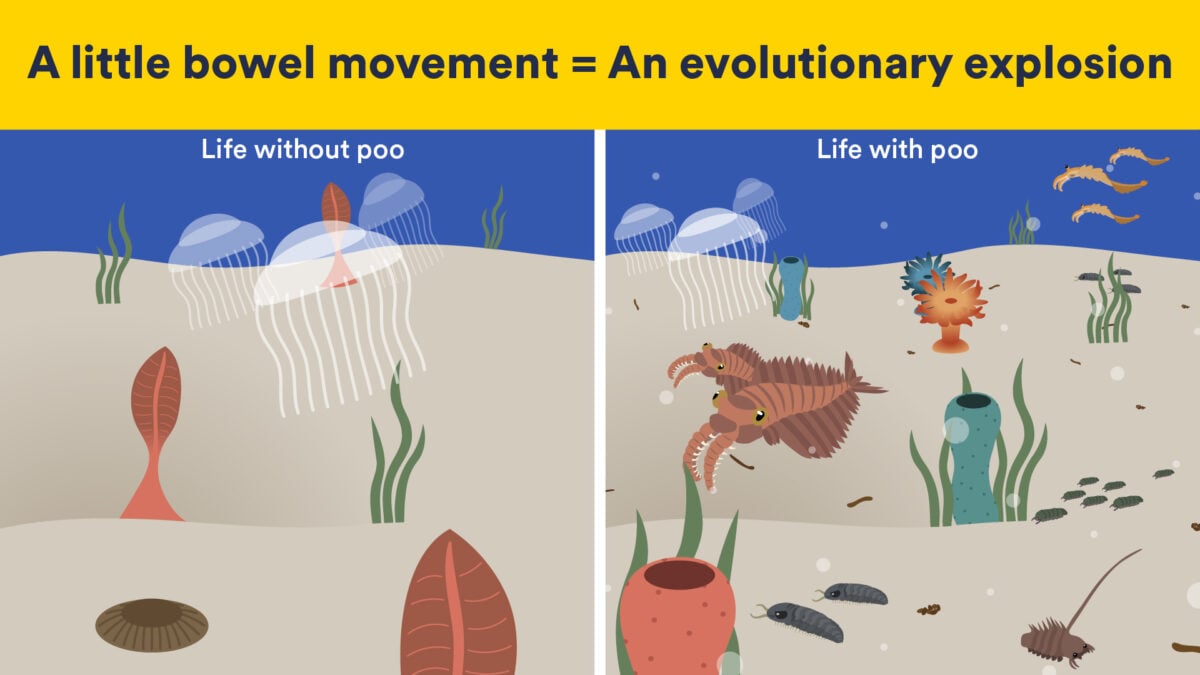
The new study suggests an overlooked factor: A fecal revolution.

As you might remember from kindergarten, everybody poops – from microscopic zooplankton to blue whales, the largest animals on the planet.
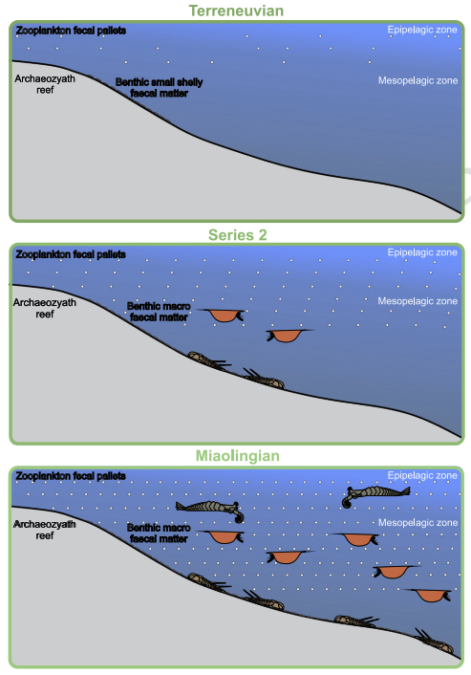
In today's ocean, that floating feces plays a key role in cycling nutrients like carbon, iron, nitrogen, and phosphorus from waters near the surface down to the deepest depths. It also makes these nutrients more accessible for other organisms.
This kind of cycle, the team suggests, was also playing out during the Cambrian. As evolution was experimenting with a range of new forms of life, so too did those creatures experiment with new ways to offload their waste.
"During the Cambrian, the amount of particulate organic matter reaching deeper water must have constantly increased as biomass grew significantly and more animals with guts arose," the researchers write.
To investigate whether the hypothesis was just a load of crap, the researchers examined these ancient excretions, known as coprolites, from across the Cambrian.
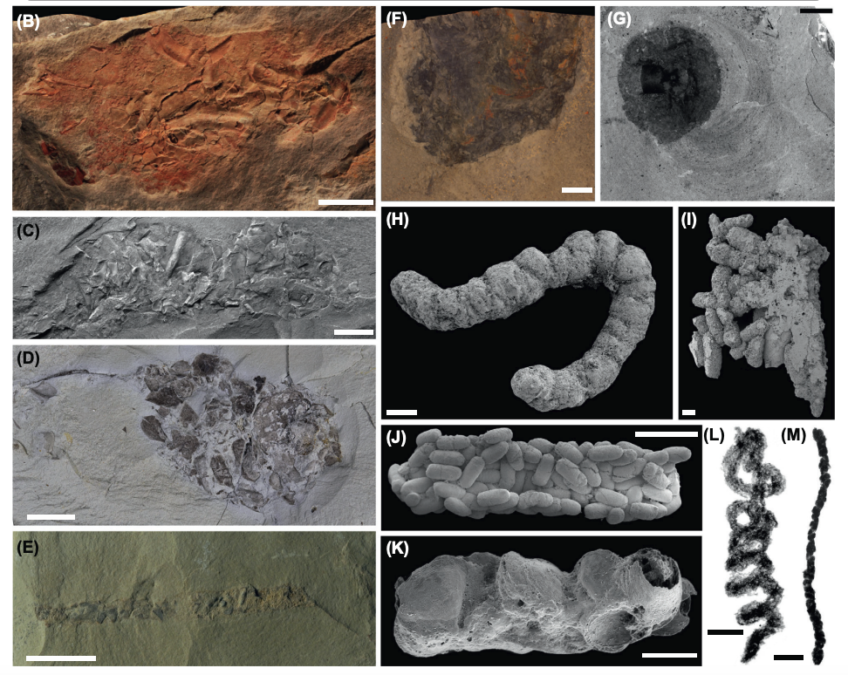
The oldest fossilized feces dates back to the early Cambrian, around 540 million years ago. And, perhaps unsurprisingly, as the fossil record becomes more diverse and crowded, so too does the preserved poop.
The earliest examples tend to be tiny pellets, either loose or smooshed together before being fossilized. Some of it is long and stringy, like you'd see trailing behind a goldfish, while others form films on long-abandoned burrows.
But as the lifeforms get bigger, so too does their poop. Later leavings look like logs, a few millimeters long, with crushed shells or fragments of other animals inside.
"With this shift, we see increasingly complex digestive systems, particularly in early arthropods which evolve specialized foreguts and digestive glands capable of processing a wider variety of food," says Bicknell.
"It becomes clear in the fossil record that the evolution of feeding strategies aligns with the production and distribution of organic carbon and nutrients to start creating conditions we see in modern oceans and later on land, where fertilizer today is used to produce our food."
As more varied butts appeared and did their thing, they unknowingly helped pave the way for future lifeforms.
Related: Extraordinary Fossils Solve a 500-Million-Year Evolution Mystery
"Complex marine systems can only develop when a combination of temperature, nutrition, and biological drivers are present," the researchers conclude.
"The rapid acceleration of organism size during the Cambrian Radiation increased coprolite size, which yielded a positive feedback loop, further accelerating the establishment of these ecosystems."
The researchers say this kind of work gives us a new framework to examine evolution, one which scientists tend to turn their noses up at.
The review was published in the journal Trends in Ecology & Evolution.
This article was fact-checked by Rachel Garner and edited by Rebecca Dyer. While we pride ourselves on our process, we are only human. If you spot a mistake, please let us know.