Celebrating a dog's birthday is one of the genuinely great things to share and enjoy on social media.
Part of the fun is figuring out how old your friend is in 'dog years', with the traditional estimate being to count seven human years for every year your dog has lived.
It's a nice, simple calculation. But it's also wrong.
A 2020 study found that dogs don't age at a steady seven-times-human rate. They age much faster than humans through some stages of life, and slow down in others, meaning there's literally a whole new calculation to make.
Scientists figured out the new dog-age formula by collecting blood samples from 104 dogs (all Labrador retrievers, mostly unrelated), from puppies to age 16.
They then sequenced methylation patterns at tens of thousands of DNA sites and compared them with existing methylation data from 320 humans ranging from 1 to 103 years old.
DNA methylation is a chemical marking system that helps regulate which genes are switched on or off.
As we age, patterns of methylation at tens of thousands of sites in our DNA change in predictable ways. Those patterns can be used to build what scientists call an 'epigenetic clock': a molecular estimate of biological age.
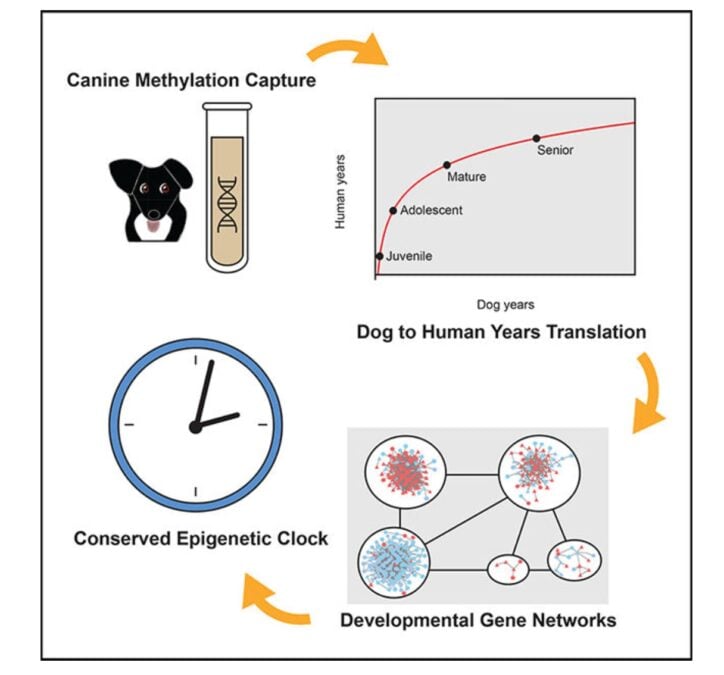
In the study, young dogs had methylation patterns most similar to young humans, while older dogs looked increasingly like older humans, but in between there were differences.
In other words, dogs appear to do a lot of their biological aging very early in life, before the process slows down.
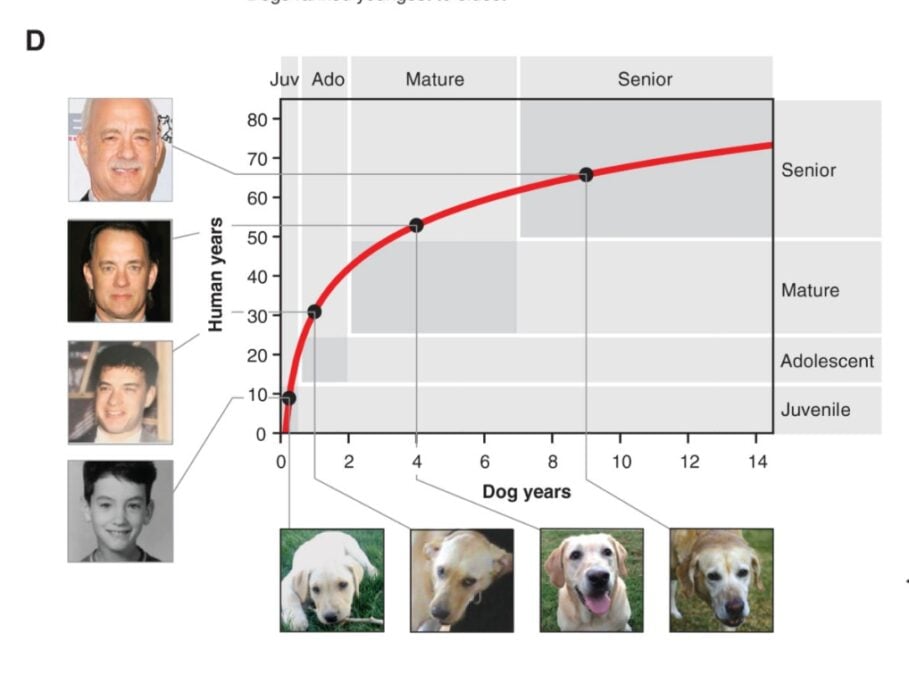
The molecular clock lined up well with some major physiological milestones. An eight-week-old puppy, for example, had an epigenetic age corresponding to roughly a nine-month-old human.
The researchers came up with a mathematical formula that translates dog age into human age: human age = 16 × ln(dog age) + 31, where ln(dog age) is the natural logarithm of the dog's age in calendar years.
Using that formula, a year-old dog is about 31 in human years, a two-year-old dog is equivalent to a human at age 42, and a four-year-old dog is cruising through midlife at around 53 human years of age.
The aging keeps slowing down until a 12-year-old dog is about as old as a human at 71.

A limitation of the study is that it looked exclusively at Labradors, and the researchers caution that different dog breeds, which can have dramatically different lifespans, might have different age-translation curves.
There is also evidence that larger dogs live shorter lives than smaller dogs, mixed-breed dogs live longer, and dogs that are spayed or neutered also live longer. So dogs that are different breeds or varied sizes (or different from each other in one of the other ways above) might be aging at different rates.
A chihuahua probably doesn't age the same as a Newfoundland (as much as the little guy might believe he's as big as the Newfie). But the research showing their DNA methylation hasn't been done, so that's not yet known.
The point of all of this work wasn't just to create a better dog-age calculator, though that's a pretty fun new piece of info for dog lovers.
The researchers also wanted to know what was changing in the DNA as mammals aged.
When they compared dogs, humans, and mice, they found 394 genes whose methylation changed with age in a similar way across all three species. Those genes clustered into five interconnected networks, and most were involved in development.
That suggests that aging may not be entirely separate from development. Instead, at least some of the molecular machinery involved in building an organism may continue to change throughout its life, meaning that aging is a continuation of the developmental process.
So mammals separated by millions of years of evolution can carry remarkably similar molecular signatures of aging. And if those signatures can be used to translate biological age between species, dogs could become an especially useful window into the aging process.
Related: Having a Dog in The House Could Improve Children's Respiratory Outcomes
After all, as the authors of the study write: "Dogs share nearly all aspects of their environment with humans, including factors associated with aging such as diet and chemical exposure."
So dogs could help researchers understand human aging better, and vice versa.
Ultimately, the goal is for researchers to find interventions to help both people and dogs live longer, healthier lives.
For now, though, we've got a new (dog-birthday) party trick.
The next time someone tells you their dog is 47 in human years, you can gently tell them they're doing the math wrong.
Read the full report in Cell Systems.
This article was fact-checked by Rachel Garner and edited by Peter Dockrill. While we pride ourselves on our process, we are only human. If you spot a mistake, please let us know.