The Universe is like water flowing downhill, and that's not a New-Age-style spiritual mantra.
Particles and systems spontaneously move to lower energy states, including heavy particles decaying into lighter ones.
Protons are at the bottom of this hill. They're the lightest baryon (a subatomic particle composed of quarks), and no proton decay has ever been observed.
And now, researchers have found evidence that one of the proton's defining properties may work differently than we assumed. And this could help explain a long-standing mystery about what exactly holds matter together in the Universe.
The proton's apparent stability is tied to baryon-number conservation, which helps distinguish matter from antimatter.
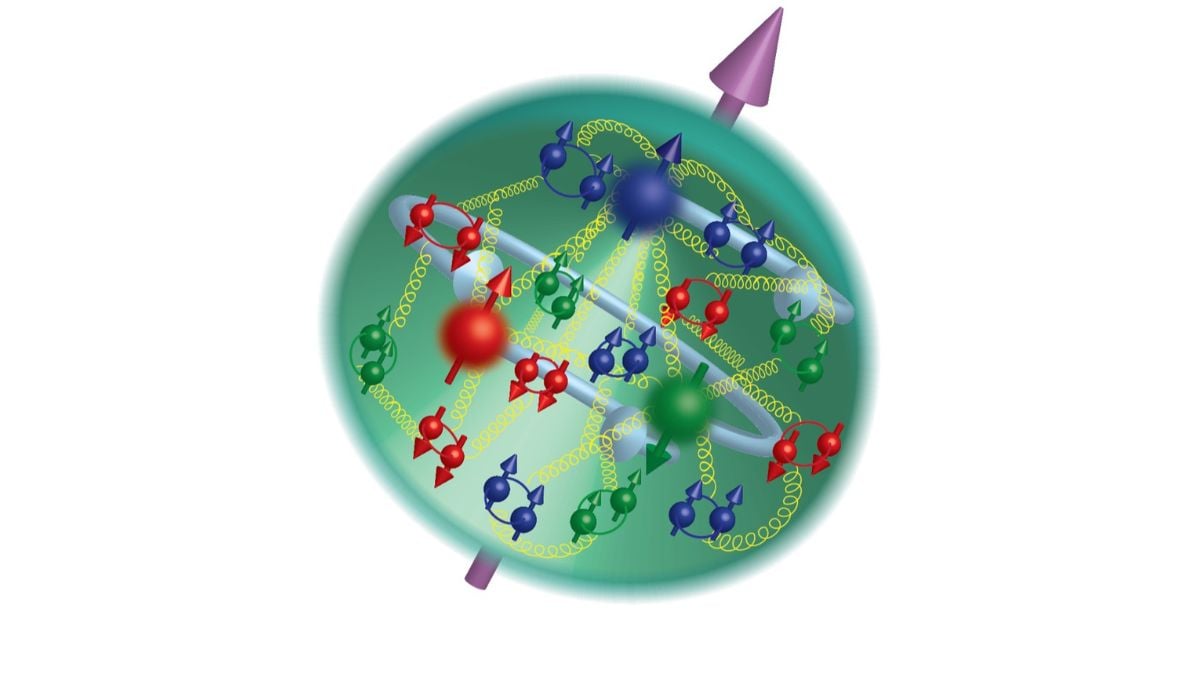
It's conventionally assumed that the baryon number is carried by the three valence quarks that make up baryons, such as protons and neutrons.
But now, after decades of uncertainty, a breakthrough new study using high-energy particle collisions has provided some of the strongest experimental evidence yet against this simple valence-quark picture.
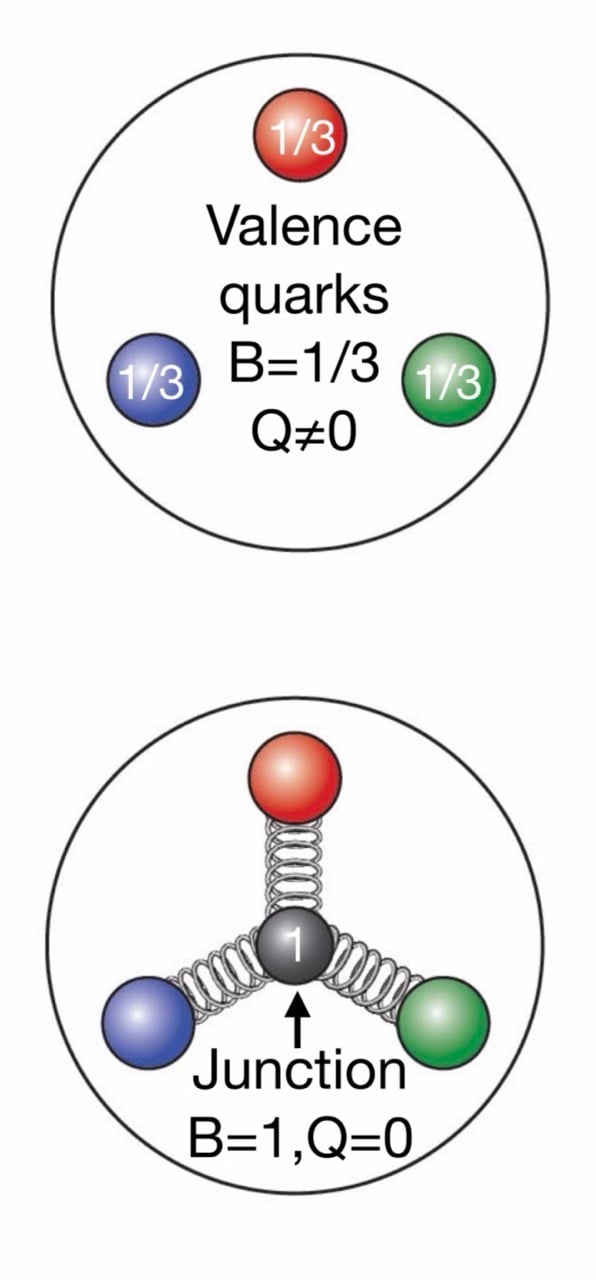
Published in Science, the study supports the idea that the baryon number is actually carried in a particle's Y-shaped "baryon junction," formed by massless gluons that act as glue to keep baryons together.
Although this was proposed in the 1970s, physicists have not been able to properly test these two competing theories – until now, illuminating a fundamental conundrum:
"The three ends of the baryon junction are connected to valence quarks, making it indistinguishable for most physical processes whether the junction or valence quarks carry the baryon number," the researchers write.
"For this reason, neither scenario has been unequivocally verified experimentally."
As is often the case with puzzling particle physics, the best way to explore them may be to smash particles into each other at nearly the speed of light.
Accordingly, a massive research team called the STAR Collaboration analyzed the results of different types of collisions produced in the Relativistic Heavy Ion Collider (RHIC), the now-retired particle accelerator-and-smasher at the Brookhaven National Laboratory in New York.
The team analyzed the results of photonuclear collisions and isobar nuclear collisions, then compared these results with multiple computational models that simulate high-energy particle collisions.
Isobar nuclear collisions involve colliding two nuclei of the same mass number, then measuring the net number of baryons transported in relation to the net electric charge across different nuclei species – in this case, the colliding nuclei of ruthenium and zirconium atoms.
This should produce a specific signature because valence quarks are known to carry electric charge, whereas the junction carries zero electric charge.
The researchers found that the baryons travel farther through the dense, energetic collision zone than the electric charge does, suggesting that the baryon number is carried by the junction, which isn't slowed as much as the electrically charged valence quarks.

Photonuclear collisions, on the other hand, explore the interactions of photons (particles of light) and the nuclei of gold atoms as they zoom near each other at relativistic speeds.
At these breakneck speeds, the positively charged gold nuclei generate an electromagnetic field, or basically a virtual, "quasi-real" photon.
"So, when the ions are moving close to the speed of light, there are a bunch of photons surrounding the gold nucleus, traveling with it like a cloud," explains Zhangbu Xu, a physicist at Kent State University and member of the STAR Collaboration, in a previous paper.
These makeshift photons then collide with the gold nuclei, providing a "clean" view of baryon number transport – all baryons detected in the resultant 'debris' must be associated with the gold nuclei.
In other words, because the incoming photon carries zero baryon number, any net baryon number measured after the interaction must ultimately come from the gold nucleus.
As per the isobar experiments, this appears to agree with the predictions of Regge theory, which incorporates a baryon junction better than valence-quark-based simulations.
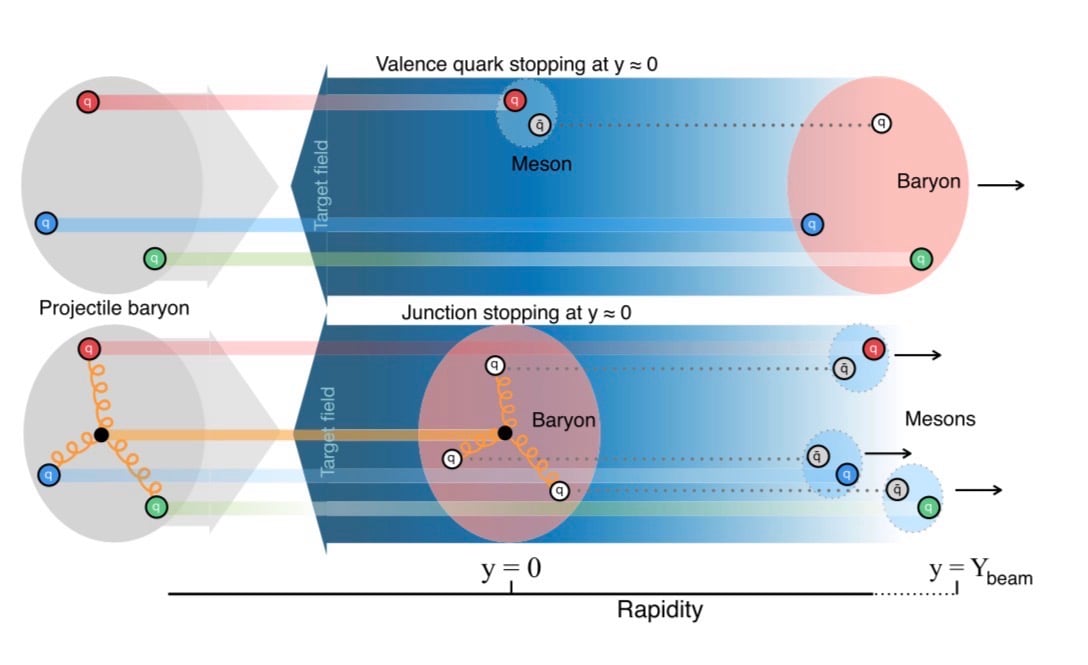
"These results, supported by data previously reported by STAR from Au+Au collisions at a variety of beam energies, disfavor the valence quark picture," the researchers write.
In an accompanying Science Perspective, Mississippi State University physicist Wenliang Li emphasizes that while the new measurements suggest that gluons may contribute to baryon-number transport, they do not provide a direct, tightly controlled measurement of the underlying mechanism.
With more research, this could eventually help physicists understand the imbalance of matter and antimatter that facilitated the existence of the Universe as we see it today, one of the greatest cosmic mysteries.
"Determining whether quarks or the gluon field transports baryon number could contribute to understanding how strong interaction between subatomic particles organizes stable matter and what causes the imbalance between matter and antimatter in the Universe," writes Li.
Related: Physicists Find a Way to 'Split' Particles of Light in Half to Make Infinite Photons
The future holds more atom smashing, including with the Brookhaven National Laboratory's upcoming, powerful Electron-Ion Collider.
"Further investigations into existing and alternative theories are warranted; to be viable, such theories must simultaneously explain all observed phenomena," the researchers conclude.
"And so far, only the baryon junction framework remains qualitatively consistent."
This research was published in Science.
This article was fact-checked by Rebecca Dyer and edited by Rebecca Dyer. While we pride ourselves on our process, we are only human. If you spot a mistake, please let us know.