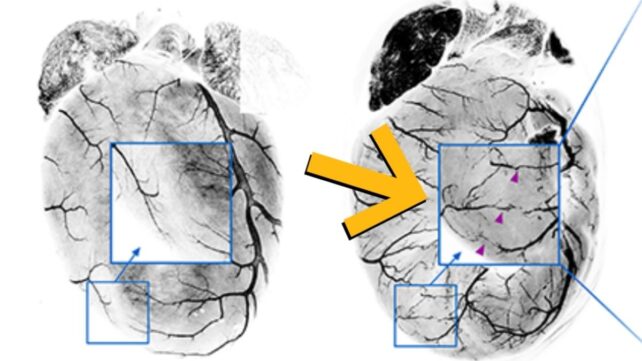
When heart attacks (myocardial infarctions) strike, it's because a coronary artery supplying the heart muscle gets blocked, cutting off the oxygen and nutrients the heart needs to keep going.
Several natural biological emergency measures then get activated. Previous studies have shown the heart tries to enlarge other arteries and even build new ones to act as a bypass – though these reactions usually aren't fast or effective enough to prevent heart damage or a fatality.
Led by a team from the University of Chinese Academy of Sciences, researchers have now discovered there's actually a different bypass mechanism at play, involving the tiny capillaries that connect arteries to veins.
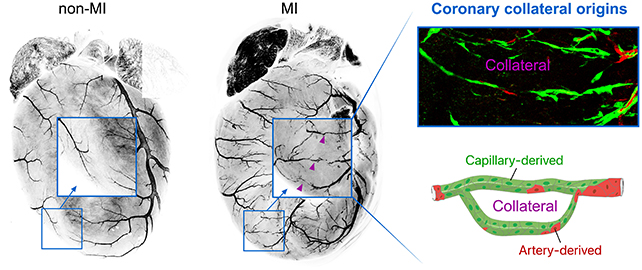
In their study, published in Science, the researchers detail how this natural repair system functions for the first time – and how it could potentially be boosted artificially to improve the chances of recovery after a heart attack.
"Collectively, these findings redefine the cellular origin and mechanism of coronary collateral formation and highlight its role in facilitating efficient cardiac repair," write the researchers in their published paper.
The team started by using a more precise cell-tracking technique than deployed in earlier studies, meaning they were able to watch the progress of endothelial cells (which line blood vessels) in both the major arteries and the much smaller, connective capillaries.
In mouse models of heart attack events, a surprise result was revealed.
It was the endothelial cells in the smaller capillaries, not the larger arteries, that were doing the bulk of the work in trying to reroute blood flow.

The capillaries are essentially trying to upgrade themselves into something more like arteries as a repair mechanism. It's actually a trick that's similar to what happens in newborn mice when the heart is still developing.
"This process mirrors the developmental program in which capillary endothelial cells coalesce to form coronary artery branches of small diameters during neonatal heart growth," write the researchers.
As a follow-up, the researchers wanted to see if they could somehow boost this bypass construction, potentially as a way of improving treatments in the future.
They identified the signaling protein VEGF-A, which encourages blood vessel growth, as a possible candidate. Administered to the mice in short, temporary bursts, the protein kicked off a chemical chain reaction that improved the strength of the bypass arteries.
The mice given the optimized VEGF-A treatment showed better blood flow around the injury, smaller heart scars, and improved heart function.
"Moderate VEGF-A supplementation may also restore microcirculatory function, suggesting that targeting the vascular microenvironment represents a valuable therapeutic strategy," write the researchers.

The obvious caveat here is that all this involved tests on mice, not humans – but it's likely that there are similar processes going on in our own hearts after injury.
Now that the mechanism for this natural backup system has been laid out in detail, researchers can start looking at how it might inform the development of drugs given to heart attack patients.
In the US, the heart attack survival rate is now over 90 percent for hospitalized patients, but these incidents often leave behind long-lasting damage that then leads to other cardiovascular problems.
By administering treatments that increase blood flow and reduce scarring straight after a heart attack, we might be able to do something about that.
Related: Your Heart Has Its Very Own Brain – And It's Surprisingly Complicated
The good news is we're making progress at understanding the underlying causes of heart attacks, and the best ways to treat them, and one of those ways could involve giving the body's own repairs a helping hand.
"These results position capillary arterialization as a central mechanism of endogenous revascularization and present a potential therapeutic strategy for ischemic heart disease," write the researchers.
The research has been published in Science.
This article was fact-checked by Rachel Garner and edited by Peter Dockrill. While we pride ourselves on our process, we are only human. If you spot a mistake, please let us know.