In an experiment deep underground, a tiny flash of light may, ironically, mark the first detection of dark matter.
This mysterious stuff should outnumber regular matter by a ratio of 5 to 1, but despite decades of searching, it's remained frustratingly elusive.
Now, physicists are reporting a strange signal in the LUX-ZEPLIN (LZ) experiment that has all the characteristics expected of a leading dark matter candidate, and is tricky to explain through known physics.
The results – which are yet to be peer-reviewed – were announced in a presentation at an astrophysics conference in Japan this week.
The team is cautious about calling it too early: The event hasn't crossed the statistical threshold that allows scientists to effectively rule out other explanations.
"We're very intrigued to see this event in the data, in the region where we expect dark matter to show up and the competing backgrounds are very low," says Rick Gaitskell, a physicist at Brown University and spokesperson for LZ.
"With only one event, we don't want to get ahead of ourselves. We are not claiming to have seen dark matter. But we have seen something interesting that we want to share with the scientific community for their input."
As far back as the 1930s, astrophysicists realized that what we see out in the cosmos doesn't quite line up with our models of the Universe. There seems to be extra mass out there that mostly interacts with ordinary matter through its gravitational influence.
Because it doesn't emit or reflect light, this mysterious substance was dubbed 'dark matter'.
Exactly what form it takes remains unknown, so a variety of experiments have been searching for different potential candidates, to no avail.
LZ is just one of these experiments, and it's specifically tuned to detect signals from a dark matter candidate physicists call weakly interacting massive particles (WIMPs).
As the name suggests, this form of dark matter would be made up of discrete particles with high masses and only weak interactions with regular matter, which are hard to detect.
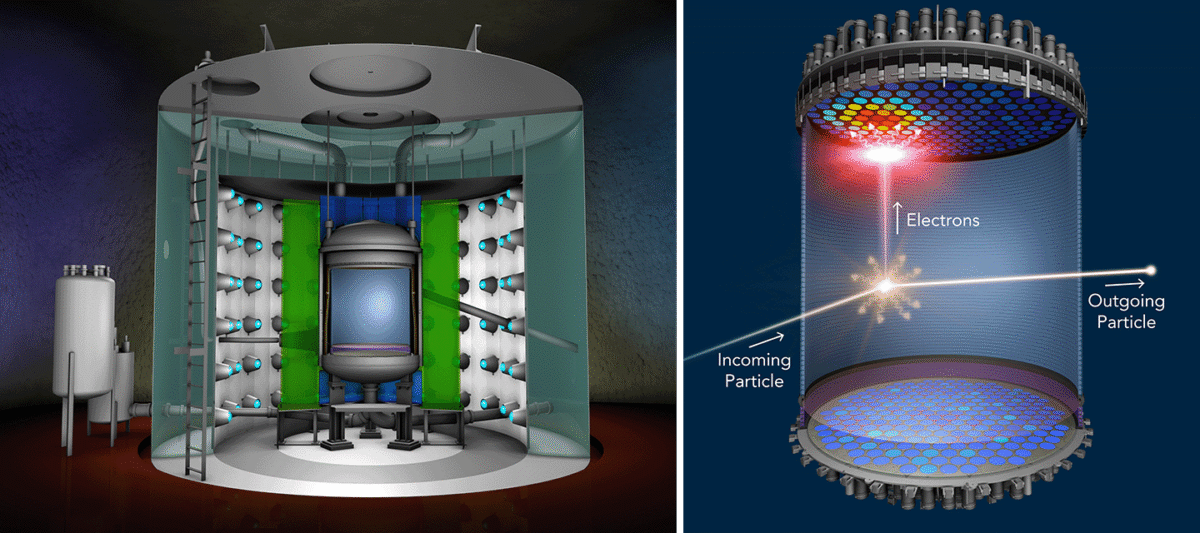
Most of the time, WIMPs should pass right through normal matter without a trace, but on extremely rare occasions, one might bump into an atom of regular matter, creating a faint flash of light and electrons.
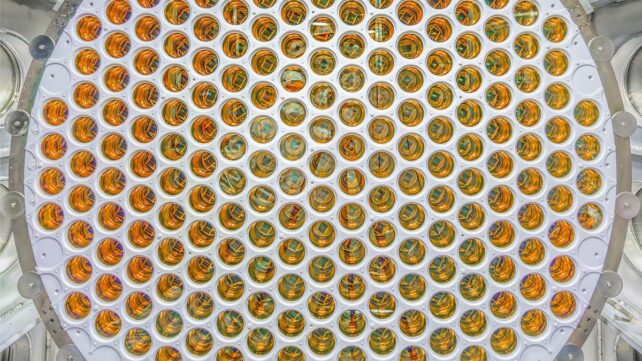
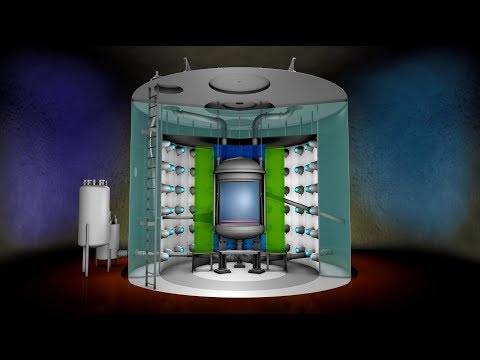
The LZ is designed to detect these elusive interactions. It consists of a huge tank of liquid xenon with a thin layer of gaseous xenon above it. If a WIMP whizzes through and knocks an atom, it produces a flash of light that photodetectors lining the bottom of the tank can pick up.
The electrons from the event are guided upwards, and when they reach the gaseous xenon, they produce a second flash. The timing and strengths of these two flashes can tell the scientists plenty about the source particle.
Unfortunately, a lot of other particles produce similar signals, and do so far more often than dark matter. As such, LZ is built to reduce this background noise.
The first line of defense is the 1.5 kilometers (0.9 miles) of rock the experiment is buried beneath. Then there's a tank of water surrounding the one full of xenon, and finally a radiation detector that can identify other types of events.
Together, these precautions keep unwanted particles from cosmic rays or background radioactivity to a minimum.
But now, physicists scouring data collected over the last few years have identified an intriguing signal. On 16 June 2023, LZ detected two flashes of light at just the right energies to have come from a WIMP bumping into an atomic nucleus in the xenon tank.
After spotting the candidate, researchers then spent months analyzing the data to see whether the event could be easily explained by known background processes.

The energy of the event was too high to be neutrons or neutrinos – and those would have also produced lower-energy scatterings, which weren't detected.
If it was from a stray gamma ray, it would have had to travel an unusually long way through the tank, scattered a second time in a way that didn't produce another flash, or have evaded detection by the outer instruments designed to catch them. All of these scenarios were deemed unlikely.
There's also a chance that the two flashes seen were from two unrelated events that just happened to strike close together in time. Data analysis also found this to have a very low probability.

Instead, the best fit for the data is that this was caused by a WIMP, with a mass of over 200 gigaelectronvolts.
"Outlier events in the data are not unexpected, but they usually stand out as a background of some kind when you look at them deeper," says Aaron Manalaysay, a physicist at Berkeley Lab.
"This is the first example in any experiment I've worked on of an outlier that appears valid in every way.
"Of course, we're still twisting our brains trying to think if there's a rare background mechanism we could've missed, but it's thrilling to wonder if this could be the first hint of a dark-matter observation."
Related: Dark Matter May Have a Secret, Extra Force That Doesn't Work The Way We Expect
Before anybody busts out the champagne, though, it's important to remember that this detection hasn't yet hit the 5-sigma threshold of statistical significance to claim a new discovery in particle physics. That would mean there's a roughly 1 in 3.5 million chance that background effects are randomly producing the result seen.
The new LZ result is currently sitting at a significance of 2.6 sigma, which puts the odds of an error at 1 in 200. We'll need much more data and more detections before we can be confident we've found dark matter.
Still, this is one of the most tantalizing clues yet that we might be on the way towards solving one of the most confounding cosmological conundrums ever.
The paper describing the event has yet to be peer-reviewed, but has been submitted to the journal Physical Review Letters. A preprint version is available on arXiv.
This article was fact-checked by Fiona MacDonald and edited by Fiona MacDonald. While we pride ourselves on our process, we are only human. If you spot a mistake, please let us know.