
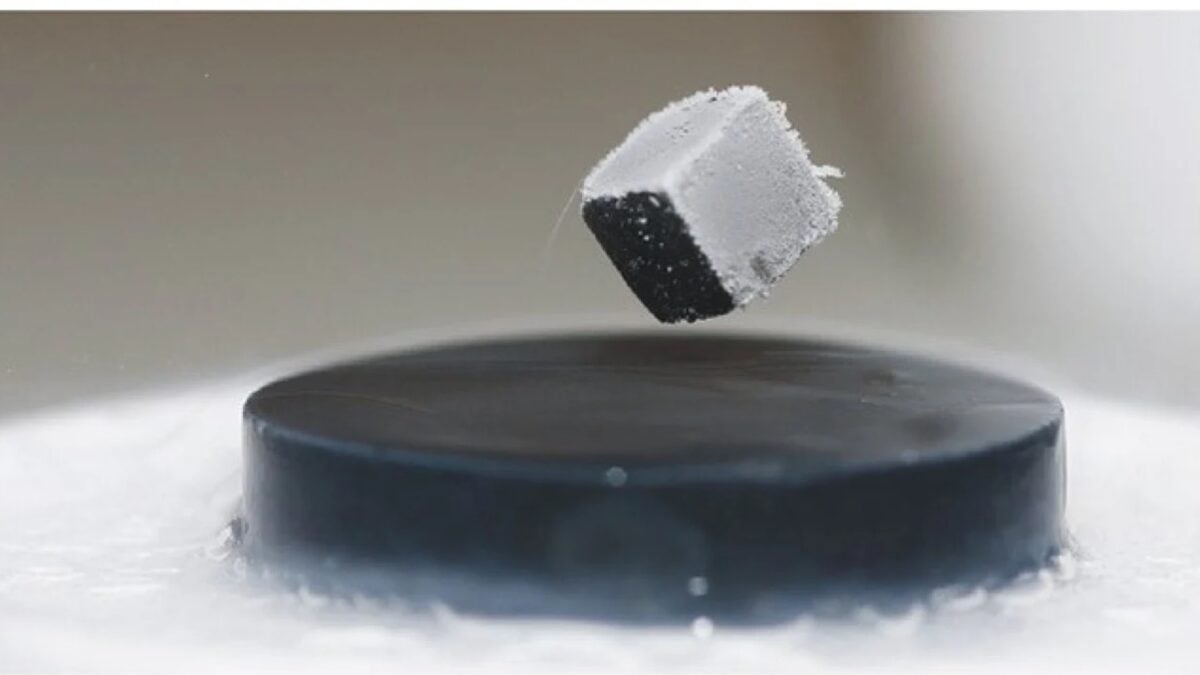
Under certain conditions – such as bone-brittling temperatures lower than that of deep space – superconductors can conduct electricity without resistance and resultant energy loss.
Though they vary in their chemical composition, operational temperature ranges, and magnetic properties, superconductors come in two groupings.
First, conventional and unconventional superconductors differ in how their electrons become entangled in tandems called Cooper pairs, an identity-sharing state that allows them to gracefully glide through the atomic jumble of their materials to facilitate uninterrupted electric flow.
Secondly, type I and type II superconductors respond differently to magnetic fields, with distinct types of thresholds at which they abruptly stop operating as superconductors and start acting like regular conductors.
Unconventional and type II varieties are generally considered more exotic; the Lamborghinis of their domain, pushing physical boundaries because they require bespoke engineering.
They may also be more suited as workhorses used in technologies like MRIs, much as Lamborghinis used to be tractors.
But perhaps no longer. Because, for the first time, physicists have created a type I superconductor material that can seemingly break the mathematical symmetry of time – a hallmark of unconventional, type II superconductors.
Known as time-reversal symmetry, this comprises a curious observation that most of the laws of physics work equally well whether time mathematically flows forward or backward
In a study recently published in Physical Review Letters, an international team of physicists led by the Indian Institute of Science Education and Research (IISER) Bhopal analyzed and described this material's unique electrical and quantum qualities, suggesting that it may eventually improve quantum computing designs.
The researchers synthesized single crystals of a material called ytterbium diantimonide (YbSb2) and used X-rays to determine its chemical purity and complex crystal structure – a structure common in conventional and unconventional superconductors because it allows quantum behaviors to emerge.
They determined that its electrical resistance dropped to zero and it abruptly became superconducting at a temperature of around -272 degrees Celsius (-457.6 degrees Fahrenheit), which is just a smidge above absolute zero (-273.15 degrees Celsius).
Combined with specific heat measurements of how its electrons respond to heat, the researchers confirmed that their material exhibited type I superconducting properties.
This measure also helped confirm its "fully gapped" state, meaning it features an energy barrier that makes it harder to disentangle its paired electrons, and therefore knock it out of a superconducting state.
The researchers also used two types of muon spin spectroscopy, a quantum probing technique that reveals the magnetic fields inside a material by zapping it with muons, or fundamental subatomic particles that act like little bar magnets.
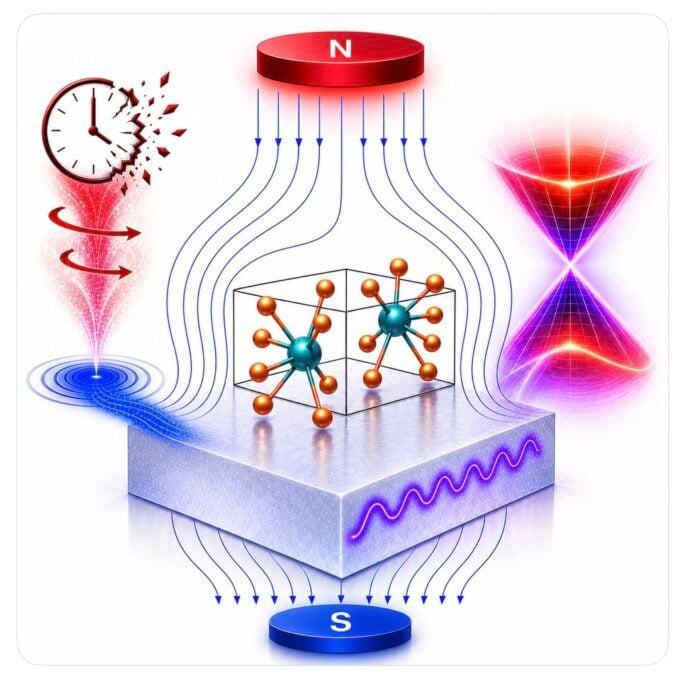
When they did so without applying an external magnetic field, they revealed that, once the material entered the superconducting phase, tiny internal magnetic fields spontaneously appeared within it.
This provided the key evidence that YbSb2 could break time-reversal symmetry, since magnetic fields reverse their direction when time is mathematically reversed – if they didn't, they would preserve, rather than break, this curious property of time.
In another version of this quantum probing technique, the researchers applied external magnetic fields while beaming the material with muons.
Additionally, when in a bulk superconducting state, the electrons in YbSb2 do not pair up in a traditional way.
Instead, they come together in an unconventional "spin triplet," which is a Cooper pair but called a triplet due to the possible combinations of the electrons' spins.
Importantly, this is more mouth-twistingly called an "internally antisymmetric non-unitary triplet (INT) state," so it displays a net magnetic moment – its magnetic forces do not cancel out.
This pairing allows YbSb2 to break the time-reversal symmetry on its own, without requiring an external magnetic field to do so.
To find out how triplets form, the researchers modeled their material based on fundamental physical qualities, revealing that each of the paired electrons comes from different energy orbitals.
As a result, its combined properties may make YbSb2 able to host "gapless Majorana surface modes," which is not a top-selling Zelda game.
It means that, at low temperatures, while its bulk acts like a superconductor through which electrons flow unimpeded, its surface may manifest Majorana modes, or quantum excitations that act as their own antiparticles. (Possibly comparable to a delicious Red Vine, which transmits air through its bulk and sugar through its edges)
This could represent more than a theoretical breakthrough.
Such "topological quantum materials" may be better able to protect quantum information by making it less vulnerable to external conditions like heat or electromagnetic noise – sources of interference that knock quantum systems out of their entangled (and therefore useful) states and relegate them to the computing powers of, well, regular computers.
The research has been published in Physical Review Letters.
This article was fact-checked by Fiona MacDonald and edited by Fiona MacDonald. While we pride ourselves on our process, we are only human. If you spot a mistake, please let us know.