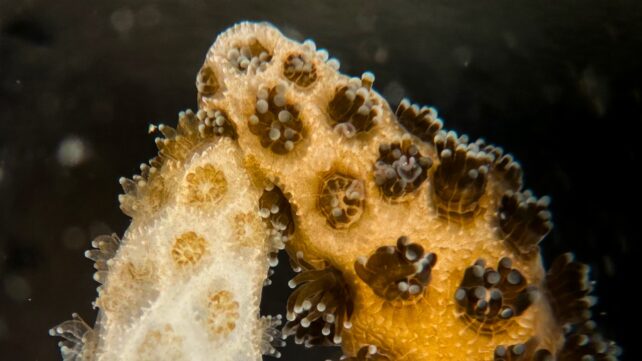
Corals cannot survive long without the algae that live inside their bodies.
But under stress from factors like heat, pollution, and UV exposure, these algae can become toxic to the coral, which evicts them.
Without their algal symbionts, corals turn white, in what is known as coral bleaching. A 'bleached' coral has limited time to acquire new algal symbionts before it starves to death.
With the threat of coral bleaching events growing each year, Stanford scientists have found a technique that could help rescue corals on the brink of death.
"While bleached corals may be dying, they are not dead yet," says Stanford marine scientist Danny Collins. "The question we wanted to answer is, once a coral has bleached, what can we do?"
A clue came from his colleague Steve Palumbi, who had noticed something interesting in a lab tank.
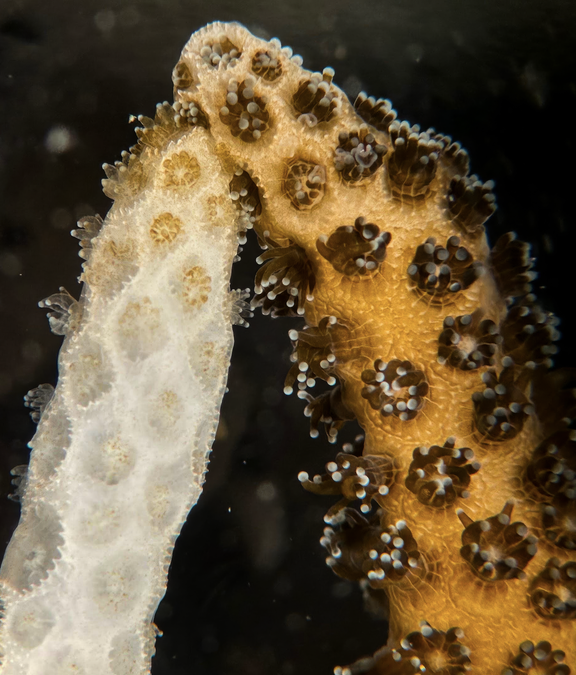
Two pieces of Pocillopora damicornis coral collected from the same colony had fallen onto each other. One was bleached, and the other was healthy. But at the point where they were touching, color was returning to the bleached fragment.
The healthy coral was transferring its symbiotic algae to its neighbor.
"What we've found is that if we put a healthy coral in contact with a bleached coral, the healthy coral actually sends over algal symbionts and nutrients to the bleached coral, fully recovering it in a short period of time," Collins says.
"I was blown away watching the actual color of this healthy coral slowly spread over into this bleached coral."
Direct contact is essential. Just a few millimeters between the two pieces of coral was enough to totally prevent transfer, as the researchers demonstrated in lab experiments. To transfer the algae, the two corals are actually fusing together, Collins explains.
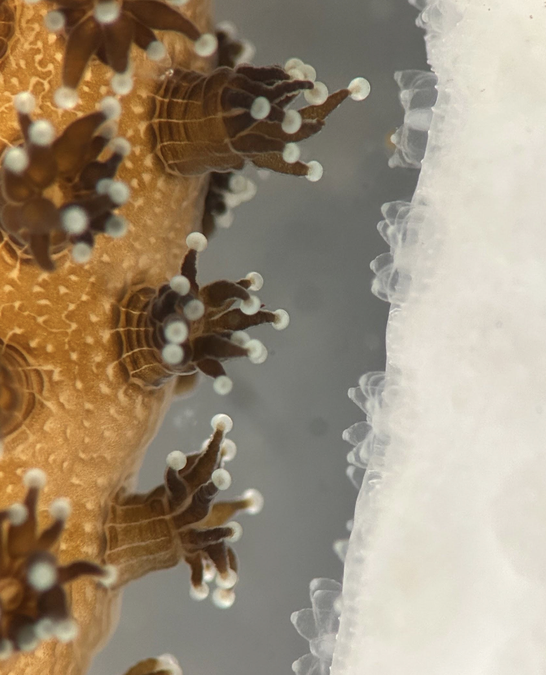
"Their tissues are growing and creating a nutrient bridge, allowing for the flow of nutrients and symbionts between those cells," he says.
"The healthy coral can jump-start the recovery of the bleached coral, by sending over these symbionts… We can take away the healthy coral, and the bleached coral can now recover itself."
Just one week of contact with healthy coral was enough to jump-start a complete recovery in the bleached pieces, which took up to seven weeks in total. This is an order of magnitude faster than recovery times seen in wild bleached populations.
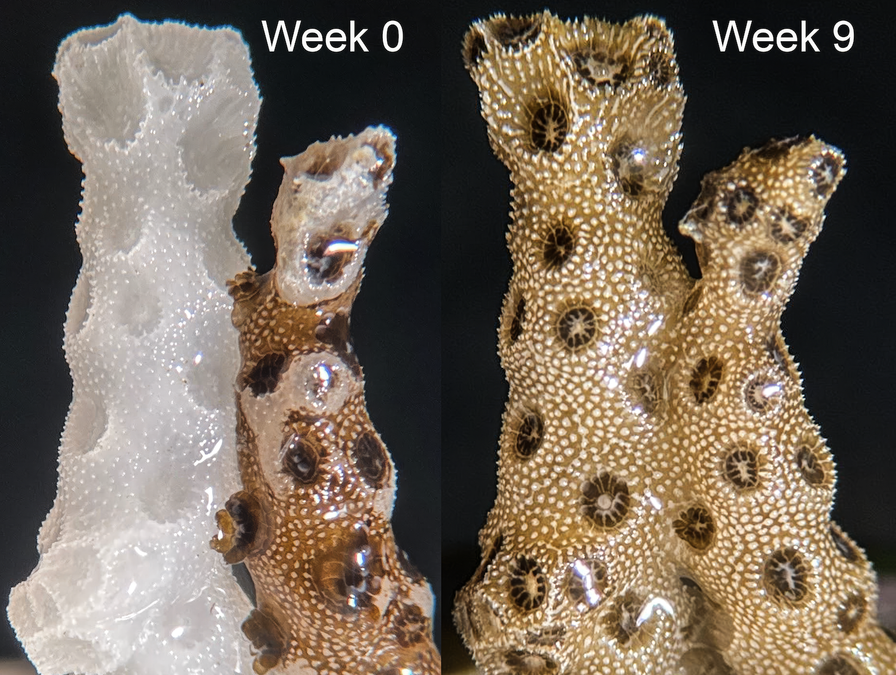
The rate of recovery was the same for corals left touching for the full seven weeks, or separated after one week, which means that after initial inoculation, the algae is replicating inside the recovering bleached corals.
The natural recovery of symbionts after a bleaching event can take months, by which time the coral has died.
The technique may have worked in the lab, with genetically identical pieces of coral sourced from the same colony, but it's still unclear whether the same approach would work out in the ocean, on wild, bleached reefs.
Theoretically, this technique could offer crucial life support to corals on the edge of death.
But it might not be practical at scale if bleaching events continue to become more frequent, persistent, and widespread, which they are expected to do if humans do not stop burning fossil fuels.
It's the emergency medicine of coral reefs, rescuing individual 'patients' at the pointy end of a growing systemic health crisis.
Perhaps this discovery will help reefs survive long enough to see us change our ways.
"These new insights into how corals can naturally recover give us hope for the future," says marine ecologist Fiorenza Micheli.
"They open the door to what's possible and may lead to the breakthrough we need to accelerate reef restoration."
The research has been published in Science Advances.
This article was fact-checked by Fiona MacDonald and edited by Fiona MacDonald. While we pride ourselves on our process, we are only human. If you spot a mistake, please let us know.