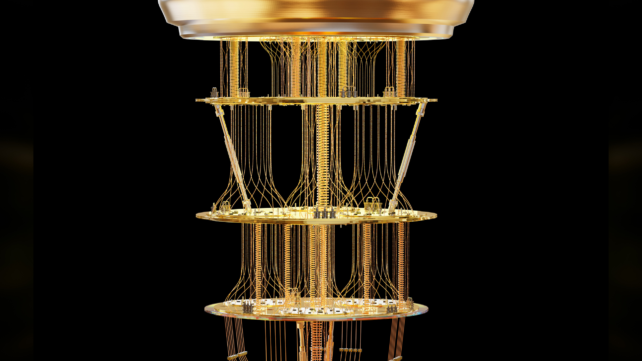
For all their promise, quantum computers have a hard time modeling the interactions between the two families of building blocks that underlie our Universe – can you imagine a chef that struggles to describe how sugar and milk make cake?
But researchers may have found a way to overcome this challenge by modeling a theoretical 'hybrid' quantum computer that promises to combine the best of both worlds.
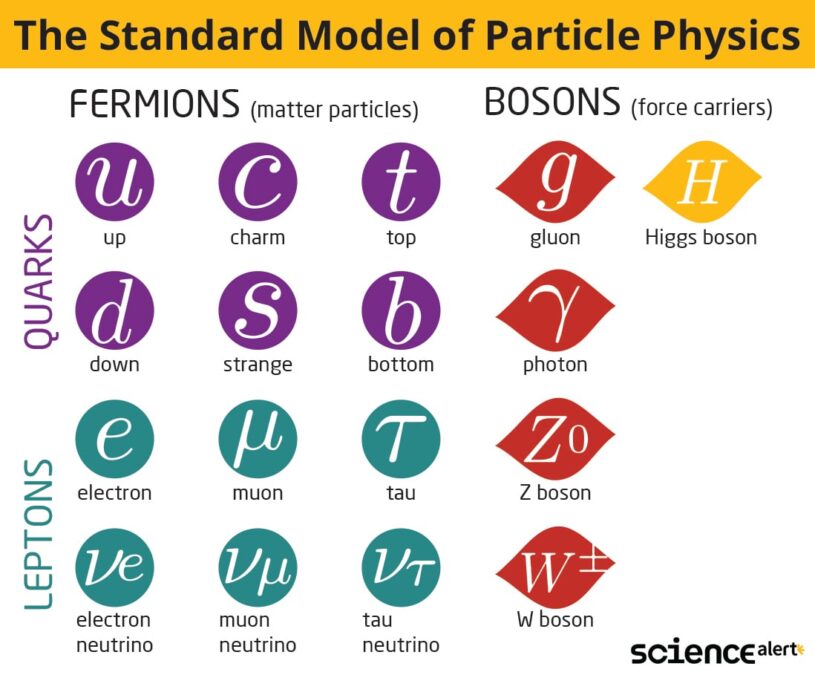
The fundamental particles that make up the cosmic cake of our existence are grouped as either fermions or bosons.
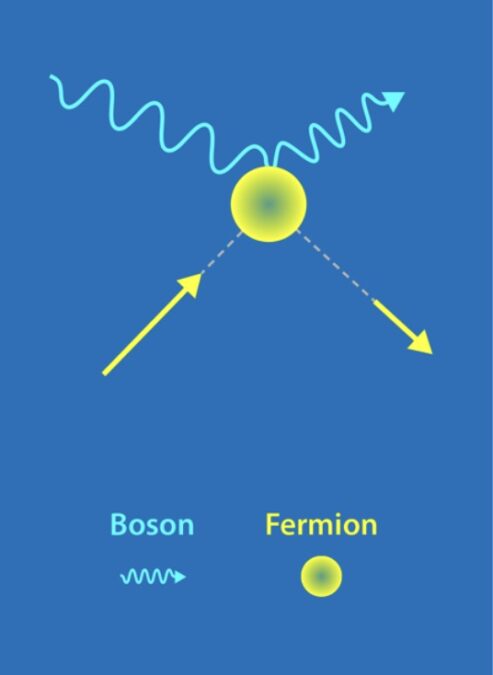
In simplest terms, fermions are particles of matter, including electrons and protons, and bosons include force-mediating particles, like the photons (light) that carry the electromagnetic force.
Quantum computers are great at modeling fermions, because they're more discrete, just like the qubits that power quantum computing.
But bosons are tougher because they can occupy the same quantum state and 'overlap', meaning that one can have a quantum stack of infinite bosons.
A new theoretical framework could bypass this issue and supercharge quantum computing, thanks to a new study from a team of physicists, engineers, and computer scientists, led by Eleanor Crane, a quantum computing lecturer at King's College London.
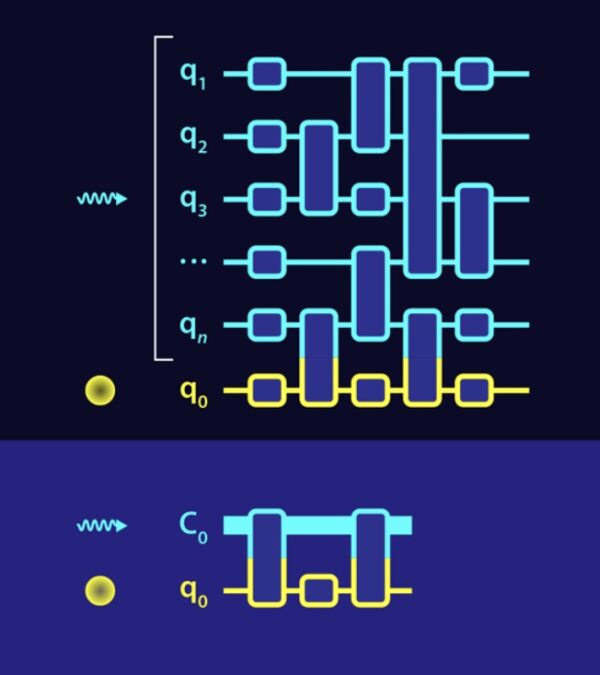
As they describe in the journal Physical Review X, the researchers developed a hybrid quantum computing strategy that incorporates two existing technologies: the qubits that power quantum computers, and microwave cavity resonators, little boxes that contain oscillating electromagnetic fields.
The latter are already used in superconductors, but the researchers envision using them for computation to store quantum information.
To replicate the action of bosons, quantum computers must use many qubits, which are discrete like fermions, but scaling this up also scales up the error rate. Incorporating resonators could avert this issue, providing a breakthrough:
"Because this [hybrid framework] cuts the work a thousandfold, chemistry and materials problems of practical value could come within reach of machines being built today, long before large error-corrected computers arrive," the researchers say in the popular summary of their work.
In laying the bedrock for the hybrid system's smooth digital integration, it's a bit like introducing two Star Trek fans from disparate world regions and having them communicate through Klingon as a shared language.
To offer a baseline for comparison between traditional and hybrid quantum computing, the researchers developed models of a beam splitter, which splits or combines light, and also a couple of super-simplified tiny min-Universes.
For example, the "notoriously challenging" (2+1)-dimensional gauge modeling comprises only two dimensions of space and the dimension of time, bringing us back to the days of Pong or Sonic.
This may sound underwhelming given the pop-media hoopla about quantum computing, but it's actually a scientific sweet spot.
Modeling things in one spatial dimension is too simple, and modeling things in the three (+1) dimensions of our known Universe is hugely challenging.
"Because this [hybrid framework] cuts the work a thousandfold, chemistry and materials problems of practical value could come within reach of machines being built today, long before large error-corrected computers arrive," the researchers say.
Perhaps surprisingly, (2+1) theories are relevant in the real world.
For example, the graphene that's said to be the strongest known material is effectively two-dimensional. Two-dimensional interactions are also vital in how electrons flow in superconducting materials, with significant implications for energy storage.
Overall, the researchers suggest that hybrid quantum computing can be much more accurate, and soon.
For example, to match qubit-boson hardware with 99.9 percent per-gate fidelity – which is the accuracy of a logic gate in modifying the quantum state of a qubit – a top-of-the-line qubit-only computer would need per-gate fidelities of at least 99.9999 percent.
This many "nines" displays a difference of three orders of magnitude and is currently unattainable.
Qubit-boson hardware could help illuminate numerous salient mysteries, such as the interactions of phonons ( quasiparticles of vibrational energy) and electrons, providing a fundamental blueprint for high-temperature superconductors.
This work could also suppress quantum computing errors by truncating the many qubit logic gates that must be otherwise strung together, further freeing up resources by eliminating guard-dog-style "ancilla qubits" used to detect errors.
By whatever strategy, quantum computing consequences may be world-shaping:
"Understanding how plants transport sunlight to turn it into energy, how some materials carry electricity without loss, or how drugs bind to their targets could bring better solar cells, power grids, and medicines," the researchers explain.
"All are quantum problems too hard for any classical supercomputer, and all involve bosons: vibrations or particles of light."
Perhaps the most intriguing aspect of this work is its apparent around-the-corner availability, the researchers stress, since it's an applicable framework:
If one could 'simply' combine a qubit and an oscillator, one could achieve synergistically better quantum computing results by cutting resource use.
Fortunately, both qubits and oscillators are commonplace.
"In my view, the most encouraging aspect of this proposal is how modest the hardware requirements are. These requirements can be met by near-term devices without waiting for quantum error correction," says Anthony Ciavarella, a computational research scientist at Lawrence Berkeley National Lab, in California.
"This work provides a concrete target for hardware development, and the required gate fidelities are close to what existing devices already achieve."
The research has been published in Physical Review X.
This article was fact-checked by Fiona MacDonald and edited by Fiona MacDonald. While we pride ourselves on our process, we are only human. If you spot a mistake, please let us know.