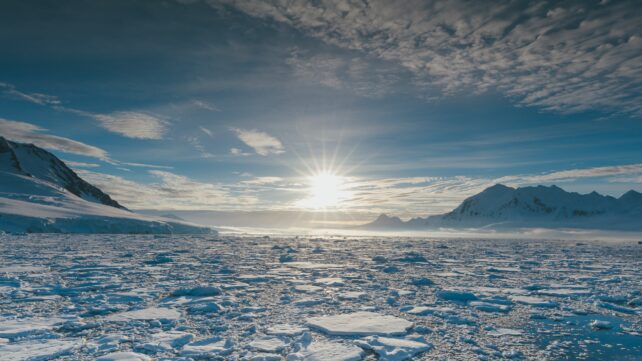
Every winter, Antarctica roughly doubles in size as sea ice locks into place over the ocean.
Typically, Breid Bay in East Antarctica is entirely covered in a frozen crust from July through August.
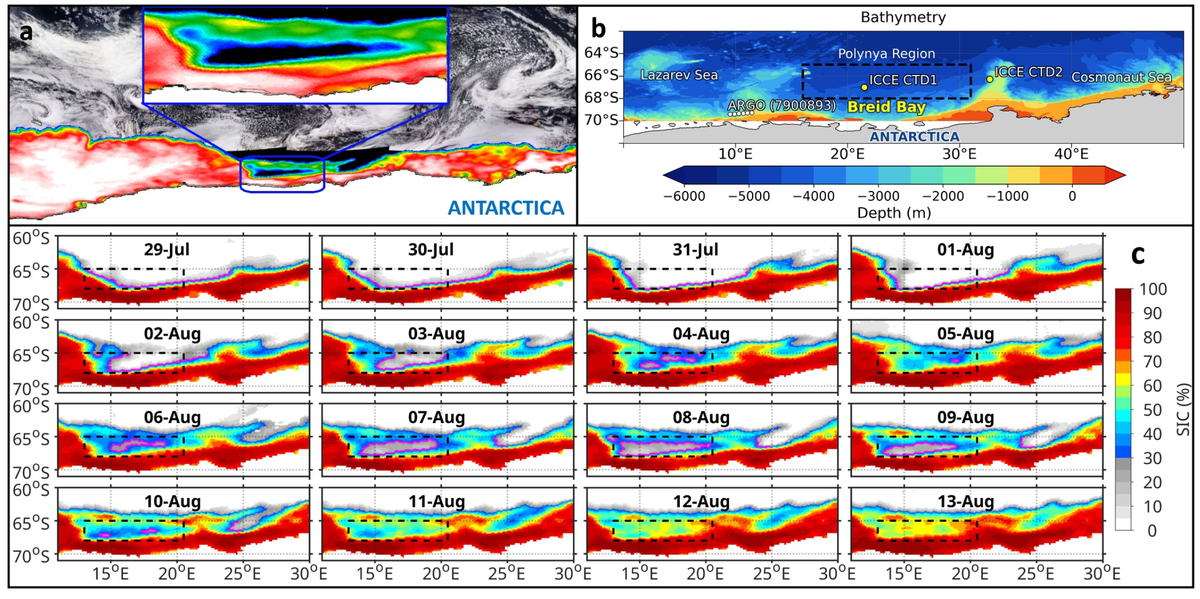
But in August 2024, satellite images revealed a massive hole in the ice, formally known as a polynya, which is a region of open seawater surrounded by sea ice.
It's something scientists have never seen before at that time of year.
At its largest, the hole reached an area of 89,121 square kilometers, which is only slightly smaller than the entire landmass of Portugal.
According to a research team from India led by earth scientist Jeebanjyoti Swain, the hole was the result of a series of extreme weather conditions, including a series of intense atmospheric rivers and marine heatwaves.
Swain and team have published their findings in Geophysical Research Letters.
"A series of intense atmospheric rivers, commonly known as 'rivers in the sky,' transported large amounts of moisture from lower latitudes into the Antarctic region, accompanied by a persistent southward flow that drove sea‐ice poleward," the authors write.
Six atmospheric rivers carrying warm moist air occurred from July 2024 through August. The scientists note these specific atmospheric rivers are among the strongest mid-winter moisture transport events on record.
"Together, they produced enhanced downwelling long-wave radiation, atmospheric warming, warm snowfall, and positive heat flux into the ocean, which collectively suppressed sea‐ice growth," the authors explain.
"At the same time, strong winds induced Ekman suction, bringing warmer subsurface water toward the surface and contributing to upper‐ocean warming, with sustained marine heatwaves further inhibiting sea‐ice freezing."
Ekman suction is a phenomenon that occurs when large volumes of surface water are displaced by the friction of wind blowing across the ocean.
In this case, the Ekman suction carried upper circumpolar deep water to the surface, which is relatively warmer and more turbulent than the surface water usually is at that time of year, slowing and preventing freezing.
Swain and team predict we will be seeing more of these Antarctic polynyas in the future, as climate change strengthens atmospheric rivers, produces more frequent and persistent heat waves in both air and sea, and heats up the upper layers of the Southern Ocean.
"The low sea‐ice conditions and polynya formation may become frequent in regions where sea‐ice has historically remained stable," the team writes.
This year, Antarctica reached its third-lowest level of winter sea ice extent on record.
All four of the lowest winter sea ice records have occurred within the past four years, with 2023 being the record minimum, and 2024 (the year the massive hole appeared at Breid Bay) in second.
In June this year, a large area of the Bellingshausen Sea (on the west side of the Antarctic Peninsula) failed to freeze over, leaving an area of ocean roughly the size of France exposed, which would usually have been covered by sea ice.
Sea ice comes and goes throughout the year, and it floats, so it's not directly involved in changes to sea level.
But it creates a buffer around the ice shelves and glaciers that do have the potential to accelerate sea level rise.
Without a wide skirt of sea ice through the winter, more of Antarctica's ice sheet will be exposed to the increasingly warm ocean water, which is what scientists are really concerned about.
Sea ice is also very important to Antarctic ecosystems: food webs that feed much of the world's oceans hinge on the ice's regular return.
There's clear evidence that these changes to our global climate are the result of human activities: primarily, burning fossil fuels. This also means we can change the trajectory of these concerning trends.
The research has been published in Geophysical Research Letters.
This article was fact-checked by Fiona MacDonald and edited by Fiona MacDonald. While we pride ourselves on our process, we are only human. If you spot a mistake, please let us know.