A brief blaze of gamma and X-ray light that lit up Earth telescopes in November 2024 may have come from an unexpected source.
Just a few seconds earlier, from the same tiny corner of the sky, LIGO-Virgo-KAGRA had detected the telltale gravitational wave signal of two black holes colliding. These massive events are some of the most extreme in the Universe; even so, they're not generally expected to produce detectable light.
A team led by astronomer Shu-Rui Zhang of the University of Science and Technology of China has linked the extraordinary detection to an even more extraordinary set of possible circumstances: the collision, the researchers believe, may have taken place in the enormous, roiling disk of dust and gas surrounding a third, supermassive black hole – the host galaxy's active galactic nucleus (AGN).
It's a bit hard to confirm from over 4.2 billion light-years away, but whatever the mechanism, the combined detections suggest that, when the stars align in just the right way, colliding black holes can be accompanied by a flash of light.
"Our model is predictive," the researchers write, "and we highlight the importance of further constraining the orbital eccentricity of the merger and conducting deep-field observations of the host galaxy to test our explanation."
Since the first gravitational wave observation back in 2015, the catalog of these ripples in spacetime has ballooned into the hundreds. Although not all the detected signals have been analyzed or even confirmed, most are thought to come from collisions between two black holes, the densest objects in the Universe.
Most of these collisions have been completely dark. Scientists have looked for a light counterpart for many of them, but the evidence suggests that when two smaller black holes merge to form a larger one, the fireworks – if there are any – take place behind the event horizon.
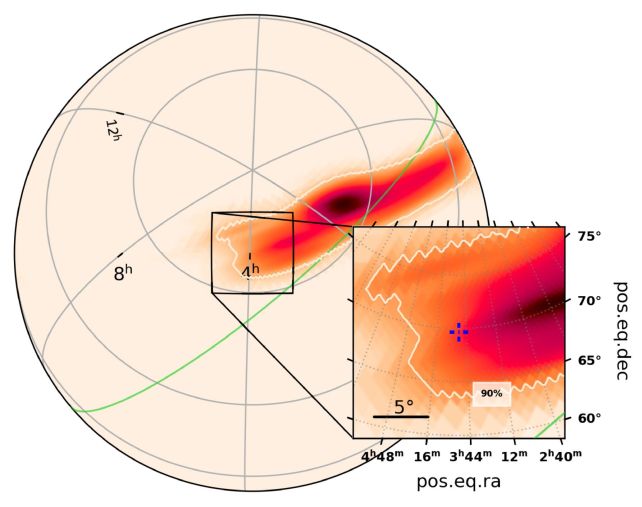
The gravitational wave event of 25 November 2024 – named S241125n – was different. The signal rippled across the LIGO-Virgo-KAGRA detectors scattered around the globe, alerting scientists to a black hole merger some 4.2 billion light-years away, producing a rather chunky object around 150 times the mass of the Sun.
Then, about 11 seconds later, multiple X-ray observatories caught a flash of X-ray light, as well as a gamma-ray burst, from the same patch of sky as the gravitational waves. The likelihood of this being an unrelated coincidence, the researchers calculated, is low, with only one chance event in 30 years of observations.
Gravity and light travel at the same speed. The sequence of observations therefore suggested that the two black holes merged first, and then released a blazing outburst of light.
Since black holes don't emit detectable light – like, they're famous for not doing that – and since so many black hole mergers take place without light, the researchers figured something else must have been going on.
We know that there is one thing black holes can do that is extremely bright: devour material in a process called accretion. When a black hole is surrounded by material, that material can form a disk that becomes superheated by gravity and friction as it swirls around the black hole, like water circling a drain.
That disk is one source of light. Another is the astrophysical jets formed from material that scientists think is diverted and accelerated along magnetic field lines just outside the event horizon, to be launched from the black hole's polar regions at tremendous speeds.

The gamma-ray burst detected after S241125n had some features that were a bit unusual, compared to the more typical gamma-ray bursts that come from core-collapse supernovae or neutron star mergers.
Zhang and his colleagues thought that an episode of rapid accretion might be one way to explain it. But for a newly merged black hole to undergo such an episode, the collision would need to take place in an environment where there's already enough material on which to feed.
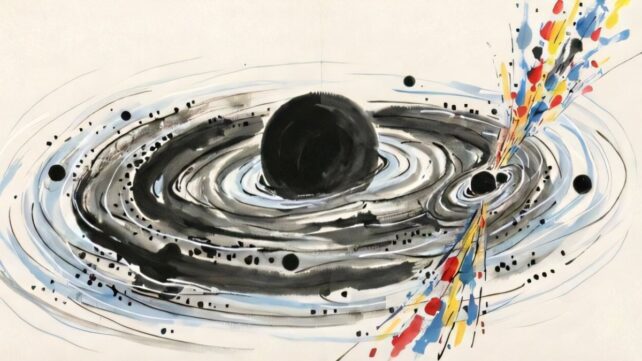
They simulated what would happen if two stellar-mass black holes collided inside the accretion disk of a much larger black hole, a supermassive behemoth millions to billions of times the mass of the Sun, itself actively accreting material in the heart of a galaxy.
When two black holes with uneven masses collide, the uneven mass distribution of the merger can give the newly formed black hole a "natal kick", sending it flying.
Related: Physicists Simulated a Black Hole in The Lab, And It Then Began to Glow
According to the team's simulations, a natal kick in an AGN accretion disk would send the newly formed black hole plowing into the dense dust and gas, triggering accretion and launching jets that produce features similar to the observed gamma-ray burst.
This is tidily plausible: Galactic centers are really busy places, filled with all sorts of nonsense, including smaller black holes and black hole binaries falling towards the center.
Further evidence is required to confirm the team's hypothesis, but it does present an intriguing scenario for understanding galactic centers and the black hole collisions that may be taking place within them.
"Future studies of S241125n and similar events could provide deeper insights into the fundamental physics of black hole mergers and their role in the broader cosmic landscape," the researchers write, "potentially uncovering new connections between gravitational waves, electromagnetic signals, and the host environments of these extraordinary phenomena."
The research has been published in The Astrophysical Journal Letters.