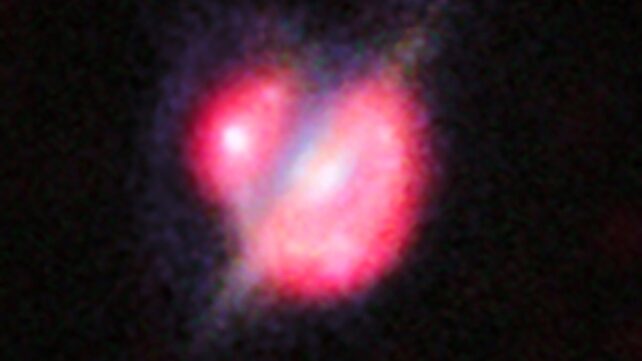
Despite sounding like something out of pulpy '50s sci-fi, 'space lasers' are real – and astrophysicists have now spotted the brightest and most distant one yet.
This 'gigamaser' is blasting out of a gigantic galactic collision some 8 billion light-years away, where compressed gas is stimulating hydroxyl molecules to emit intense radio waves at the same wavelength.
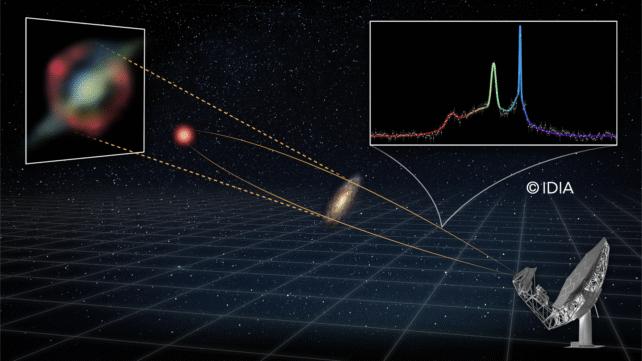
The record-breaking 'ginormous microwave laser' was discovered by the MeerKAT radio telescope in South Africa, with a bit of natural assistance from gravitational lensing.
"We are seeing the radio equivalent of a laser halfway across the Universe. Not only that, during its journey to Earth, the radio waves are further amplified by a perfectly aligned, yet unrelated foreground galaxy. This galaxy acts as a lens, the way a water droplet on a window pane would, because its mass curves the local space-time," says Thato Manamela, astrophysicist at the University of Pretoria in South Africa.
"So we have a radio laser passing through a cosmic telescope before being detected by the powerful MeerKAT radio telescope – all together enabling a wonderfully serendipitous discovery."
While we don't really treat it like one anymore, the word 'laser' began as an acronym. It stands for 'light amplification by stimulated emission of radiation' – but if you swap out light for microwave, you get a 'maser.'
Lasers and masers both arise under similar conditions. You need a lot of atoms or molecules in an excited state, and photons with a specific energy whizzing around. When a photon strikes an atom or molecule, it can trigger the emission of another photon at the same energy level. These extra photons can then go on to cause the release of even more photons, amplifying the emission.
Natural astrophysical masers can occur in systems such as comets warmed by stars, planetary and stellar atmospheres, star-forming regions, and supernova remnants. More powerful emissions, known as megamasers, can be produced by even more energetic events, like supermassive black holes or colliding galaxies.

The newly discovered example, designated HATLAS J142935.3–002836, blasts beyond megamaser status and into an even rarer category known as a gigamaser. These can be billions of times brighter than a garden-variety maser.
Releasing that much energy requires an unfathomable furnace, and in this case that's the power of two galaxies smashing into each other to become one. The intense gravitational interactions compress gas and trigger a burst of baby star formation. Photons from these stellar newborns stimulate hydroxyl molecules that are floating around, amplifying their microwave emission and producing a gigamaser.
Related: Three Supermassive Black Holes Discovered on Collision Course in a Cosmic First
The light from this event has traveled 7.82 billion light-years to reach the MeerKAT radio telescope, surpassing the previous distance record of 'only' 5 billion. It's also the brightest seen so far, largely thanks to the magnification of the gravitational lens the light passes through on its way here.
"This discovery highlights MeerKAT's potential to investigate high-redshift hydroxyl megamasers, enhancing our understanding of thereof and offering valuable tracers for exploring different aspects of galaxy outflows and merging activity," the researchers write.
The study has been accepted for publication in the journal Monthly Notices of the Royal Astronomical Society Letters and is currently available as a preprint.