Longevity is a key factor in modern appliances and essential in technologies like biomedical implants.
But most synthetic materials get weaker with constant use, especially with the modern onus on planned obsolescence – the "they don't build 'em like they used to" manufacturing principle discussed in many a hardware section.
But scientists have now developed a breakthrough material that does the opposite of deteriorating: it gets stronger with strain.
"Our smart material actually gets stronger the more it's bent and strained," says chemist Chenfeng Ke from Washington University in St. Louis, senior author of a new study published in Nature Materials.
"It has properties we have never seen before. It can remember, adapt, learn, and grow. We're excited to think about the possible applications."
This smart material is a hydrogel, a soft, flexible, water-saturated substance.
Despite its sci-fi-style ability to strengthen itself, it's made from just two surprisingly simple and individually edible ingredients: cyclodextrins and polyethylene glycol (PEG).
Cyclodextrins are ring-shaped sugar molecules extracted from starch. They're a common food additive used to improve shelf life, stability, and other qualities like a meatloaf's mouthfeel.
PEG may naturally follow a meatloaf meal because it's the active ingredient in laxatives like MiraLAX. It helps us poop because it traps lots of water, so it's also a ubiquitous additive in other personal care products like lotions and shampoos.
The mechanism behind the material's self-strengthening qualities is just as simple.
It's based on an inherent realignment of its components, a "capability commonly observed in natural materials," like skin, which forms calluses in response to, say, frequent contact with the knurling of a barbell.
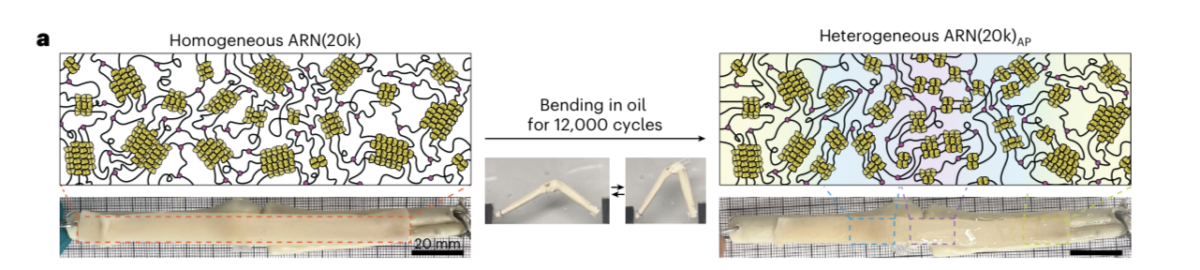
To demonstrate its abilities and real-world potential in medical implants, the researchers applied it to a knee-like joint, then put it through 12,000 bending cycles while bathed in silicone oil, which kept the water-filled gel from drying out.
"The polymers in the hydrogel become more uniform and organized, making it stronger in exactly the places where the strain is happening," Ke explains.
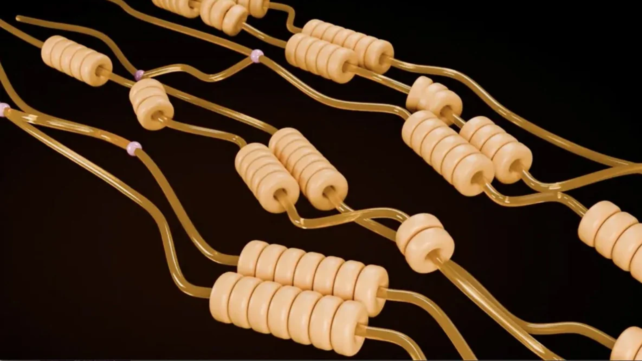
This slide-ring network is analogous to the bead maze toys in every pediatrician's waiting room.
The PEG forms the metal track along which the cyclodextrin sugar rings freely slide when the material is stretched or otherwise stressed.
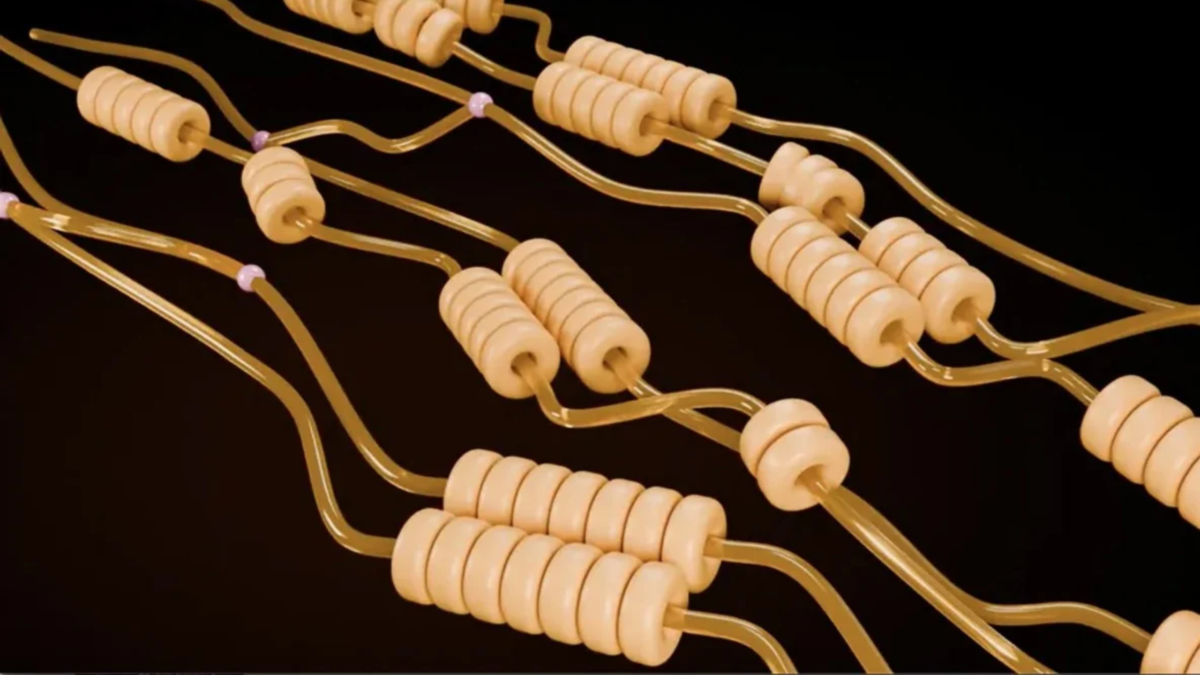
In response to such stimulus, the cyclodextrin rings (beads) self-organize, breaking out of their initially messy clusters and bunching up along the sites of stress, increasing the material's mechanical resilience.
"These moving rings are critical to the structural design," Ke explains.
Altogether, this transformation increases the material's stiffness, tensile strength, and fracture resistance by up to an order of magnitude, with some of its mechanical properties, like its Young's modulus, improving more than 20-fold under certain conditions.
Subjecting the material to ultrasonic waves during the stretching regime further fortified its stretchability and rupture resistance by facilitating the organization of its cyclodextrin sugar rings.
Additionally, the researchers made a modified version of their material with "dangling" PEG chains and placed it in a chemical solution containing cyclodextrin sugars.
They found that under stress, the material strengthened itself by pulling these sugars from its environment, mimicking biological reinforcement processes.
The material exhibits multiple other properties that may make it biomedically appealing.
"We see a lot of possibilities." – chemist Chenfeng Ke
First, unlike other single-memory synthetics, its strengthening process is reversible when treated with a solvent, so it can be made to 'forget' its current format and then retrained under different mechanical pathways.
It's also 3D-printable, so it can be fabricated via additive manufacturing methods.
This "represents a fundamental shift in how polymer networks can evolve under mechanical and chemical fields," the researchers write.
They summarize that their polymer is unique in its ability to grow like biological tissues, which pull compounds from their environment to strengthen themselves in response to mechanical stimuli.
Importantly, this material only becomes stronger in high-strain areas, while remaining otherwise pliable to maintain mobility:
"If you're putting material into a body, you don't necessarily want it to be completely rigid."
"The material gets stronger only where it's needed," Ke notes.
Related: FDA Approves First-of-Its-Kind Bone Repair Material Made From Pearl Shells
And though the researchers have only produced tens of grams of their material, they believe their production method is scalable and attractive to investors.
This work therefore provides an accessible blueprint for synthetic systems that can remember specific strain patterns and adapt accordingly.
"We've shown it's possible to produce smart materials with a 3D printer and the right chemistry," Ke concludes.
"We see a lot of possibilities."
The research has been published in Nature Materials.
This article was fact-checked by Rebecca Dyer and edited by Rebecca Dyer. While we pride ourselves on our process, we are only human. If you spot a mistake, please let us know.