
Every cell in your body is running on tiny power stations.
Mitochondria turn energy from food into ATP, the molecule that powers almost everything cells do. How they achieve such efficiency remains unclear.
Now, researchers in China think part of the answer may involve quantum physics.
In experiments involving living cells, mouse tissues, and isolated mitochondria, the team detected an unusual vibration that appeared only while mitochondrial structures remained intact.
A model linked the vibration to a possible quantum interaction. When researchers illuminated cells with selected infrared frequencies, the cells produced 10 percent more ATP.
Together, the results suggest mitochondria may contain a quantum state that influences cellular energy production.
The study has been posted on bioRxiv as a preprint, which means it has not yet been peer-reviewed.
Bo Song of the School of Optical-Electrical and Computer Engineering at the University of Shanghai for Science and Technology and colleagues studied a human cell line and tissues from mouse kidneys, livers, hearts, and skeletal muscles.
They used Fourier-transform infrared spectroscopy, a technique that shows how samples respond to different frequencies of infrared light.
Molecules and structures vibrate at characteristic frequencies, like radio stations on separate channels. Those frequencies offer clues about what is happening inside a sample.
The researchers found an unusual signal at 71 terahertz, meaning it oscillated 71 trillion times per second.
This signal appeared in living cells, mouse tissues, and isolated mitochondria. But it disappeared after the samples were dried and ground, destroying their organized structures.
"Mitochondrial quantum state provides a good way to explain the unknown frequency," Song told ScienceAlert.
That interpretation remains hypothetical, not direct proof.
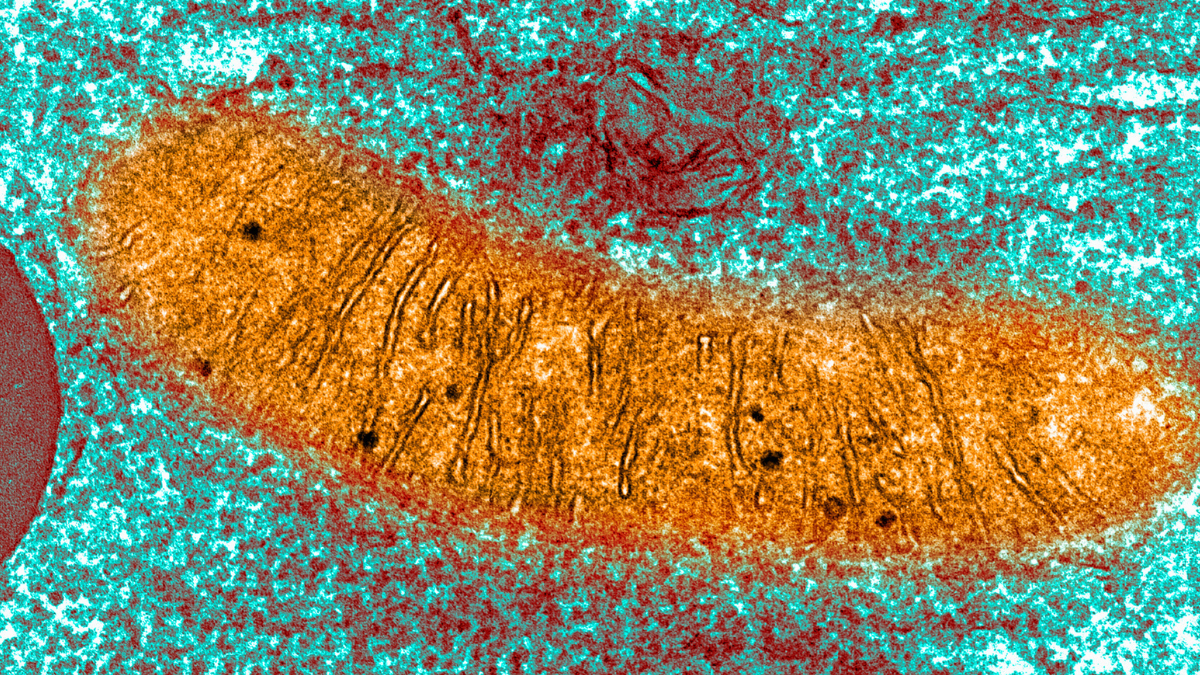
The team then focused on cristae, the tightly folded inner membranes of mitochondria. These folds are packed with lipids containing carbon-hydrogen, or CH2, bonds, which naturally vibrate at around 87 terahertz.
So what exactly is "quantum" here?
The researchers are not proposing a mysterious form of energy. Their model suggests that light particles inside a mitochondrion couple with the collective vibrations of its CH2 bonds. They form a shared hybrid state called a polariton, combining properties of light and matter.
This is a quantum effect because the coupled system is described as a superposition of light and molecular vibration with distinct, quantized energy levels.
According to the model, the interaction splits the original 87-terahertz vibration into two new levels, one near 71 terahertz and another near 103 terahertz.
This is why the numbers matter.
The predicted lower level matches the mysterious 71-terahertz signal detected in living samples. The higher level would overlap with vibrations from water and other biological molecules, making it difficult to distinguish.
The average length of active mitochondria matched the wavelength of 87-terahertz light inside them. Mitochondria might therefore act like microscopic chambers that briefly confine light and enable this interaction.
But was this proposed state doing anything useful?
Song proposes a link. Its frequency overlaps with carbon dioxide vibrations. CO2 is produced during the tricarboxylic acid, or TCA, cycle, a process supplying energy for ATP production.
In an earlier theoretical study, Song and colleagues proposed that NAD+ reduction during this cycle could release 87-terahertz photons.
"The mitochondrial quantum state might increase the efficiency of TCA cycles, influencing the ATP production," he said.
This mechanism has not been demonstrated directly.
To find out, the team exposed living cells to weak mid-infrared light for 10 minutes.
The 71-terahertz light matched the unusual signal, while 87-terahertz light matched the CH2 vibration thought to produce it.
Both produced a similar result. The 71-terahertz light increased ATP production by 10.3 percent, while the 87-terahertz light increased it by 10.1 percent.
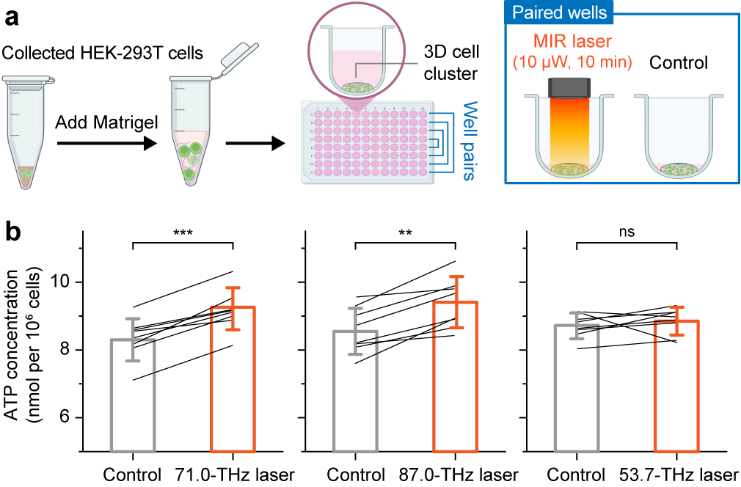
An unrelated control frequency caused no significant change, suggesting the result depended on frequency rather than infrared exposure alone.
The team interprets the findings as evidence that the proposed quantum state may provide an energy-efficient route for influencing ATP production.
That interpretation is not definitive.
An unusual spectral signal does not prove that a quantum state exists. The polariton was inferred by matching observations to a model, not directly observed. Other explanations must still be excluded.
The ATP experiment also involved one cultured human cell line, with eight samples in each group. It does not show that the same mechanism controls metabolism in whole animals or humans.
Heating is another concern, although the light was very weak and the control frequency did not affect ATP.

"Our main limitation is the lack of 87-THz light-related energy transfer dynamics," Song added.
Measuring those dynamics could clarify the proposed relationship. Independent laboratories must also reproduce the signal and directly test for quantum behavior.
For now, the findings raise an intriguing possibility: the cell's power stations may not operate through chemistry alone.
Related: The Cells in Your Body Fade With Age, But There May Be a Way to Reverse It
Deep inside their folded membranes, mitochondria might also exploit the strange rules of quantum physics.
The research is available on bioRxiv.
This article was fact-checked by Fiona MacDonald and edited by Fiona MacDonald. While we pride ourselves on our process, we are only human. If you spot a mistake, please let us know.