To properly understand aging, we have to understand what is slowly unravelling in individual cells.
What is it that makes our cells become less efficient and more vulnerable to disease over time, and eventually break down?
A new study, led by researchers from the Fritz Lipmann Institute (FLI) in Germany, details new findings about how the energy engine rooms of cells – organelles known as mitochondria – begin to slow down over the years.
Through an analysis of worm models, human tissue, and human cells, the researchers identified that levels of a particular lipid (or fat) molecule, phosphatidylcholine, decline with age.
Their experiments also showed that restoring phosphatidylcholine levels – through diet – can revitalize weary mitochondria.
"Our studies revealed a decline in phosphatidylcholine synthesis as a previously unappreciated, conserved driver of natural mitochondrial aging, which can be overcome by dietary supplements," the researchers report.
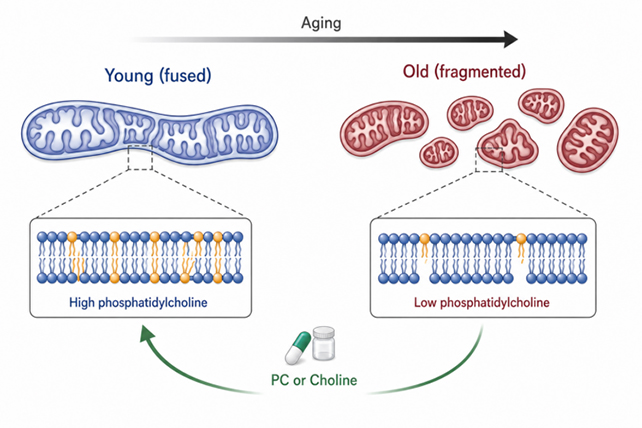
One of phosphatidylcholine's main jobs is keeping the membranes wrapped around mitochondria in good shape. Like cell membranes, mitochondrial membranes are made of lipids such as phosphatidylcholine.
As supplies of the lipid start to run out, this has a direct effect on how well mitochondria are operating in cells, the researchers found.
But adding phosphatidylcholine or choline (a nutrient that gets naturally converted into phosphatidylcholine) to the worms' diets returned mitochondria to a more youthful, flexible state.
"We were surprised ourselves by how strongly this molecule influences the structure, connectivity, and function of mitochondria," says FLI cell biologist Tetiana Poliezhaieva, first author of the new study.
Based on human tissue samples, lower levels of phosphatidylcholine were more common in people with diabetes or obesity, while higher levels corresponded to faster walking pace and better memory – signs of healthier aging.
Experiments comparing young, middle-aged and old worms showed that phosphatidylcholine levels decline over time because the production of proteins that make this lipid is gradually dialled down as aging progresses.
As a result, mitochondria have fewer building materials to make their membranes, so they become increasingly fragmented and dysfunctional.

Usually, in early life stages and healthy cells, mitochondria can readily fuse together to form long, flexible chains that help the cell distribute energy and other supplies.
However, experiments showed that with age and less phosphatidylcholine, mitochondria become less flexible and less able to adapt to the cell's energy demands.
"You can imagine the whole system as a finely branched power grid that becomes increasingly damaged with age: connections break down, and currents stall," says cell biologist Maria Ermolaeva, from the FLI.
"Although energy production continues, it becomes less efficient and sustainable, and energy can no longer be distributed flexibly."

Something else came up in the human tissue data: The decline of phosphatidylcholine was different in men and women. Men saw a gradual decline, while in women it was much sharper – especially around menopause age (typically from the mid-40s to the mid-50s).
The researchers suggest these chemical imbalances and subsequent changes in mitochondrial function could be playing a significant role at this stage of life.
"This observation is particularly noteworthy, as it coincides with a time when many women report a significant decline in energy levels and the onset of persistent fatigue," says Ermolaeva.
The newly discovered reduction in phosphatidylcholine isn't the only reason our cells' power stations start to wear down with age, but it appears to be a significant contributor, so it's something for scientists to investigate further.
And while humans are much more complex than worms, knowing that boosting levels of this missing lipid might reverse some signs of mitochondrial aging is encouraging.
Next, the researchers want to examine in greater detail how a drop in phosphatidylcholine levels affects mitochondrial membranes on a molecular level: How does the structure of those membranes change?
Related: One Sign of Aging Could Be a Powerful Predictor of Death if You Don't Act
Malfunctioning mitochondria are connected to a whole host of ailments and chronic conditions, including diabetes, cancer, and neurodegenerative diseases such as Parkinson's.
This work points to another way that some of the problems with aging mitochondria might be fixed.
"Our work shows that both mitochondrial aging and broader systemic aging are, at least in part, modifiable," says Ermolaeva.
"If we understand the underlying processes, we may be able to take targeted countermeasures."
The research has been published in Nature Communications.