
Feeling lonely now and then is part of life. It can happen after moving somewhere new, losing touch with friends, or spending more time alone than we'd like.
Sometimes, the feeling fades when we reconnect with people or find our place in a new environment.
But what if it stays?
A 30-year study of older adults in France, published in Aging & Mental Health, suggests that an occasional lonely day and repeated feelings of loneliness may have different implications for cognitive health.
People who repeatedly felt lonely had a 38 percent higher risk of developing dementia than those who never reported loneliness. Those who experienced loneliness occasionally showed no significant increase in risk.
Previous studies have linked loneliness to dementia, but many measured loneliness only once.
Epidemiologist Yvanna Simon and colleagues at the University of Bordeaux wanted to understand what happened when the feeling continued or disappeared over time.
They turned to the Paquid study, which began following 3,777 adults aged 65 and older in southwestern France in 1988.
For the new analysis, the team selected 1,540 participants who remained free of dementia during the first eight years and had provided enough information about loneliness.
At four visits over those years, participants were asked whether they had felt lonely during the previous week.
The researchers divided participants into three groups. Some 743 people never reported loneliness. Another 530 reported it at one or two visits, while 267 reported it at three or four visits and were classified as experiencing chronic loneliness.
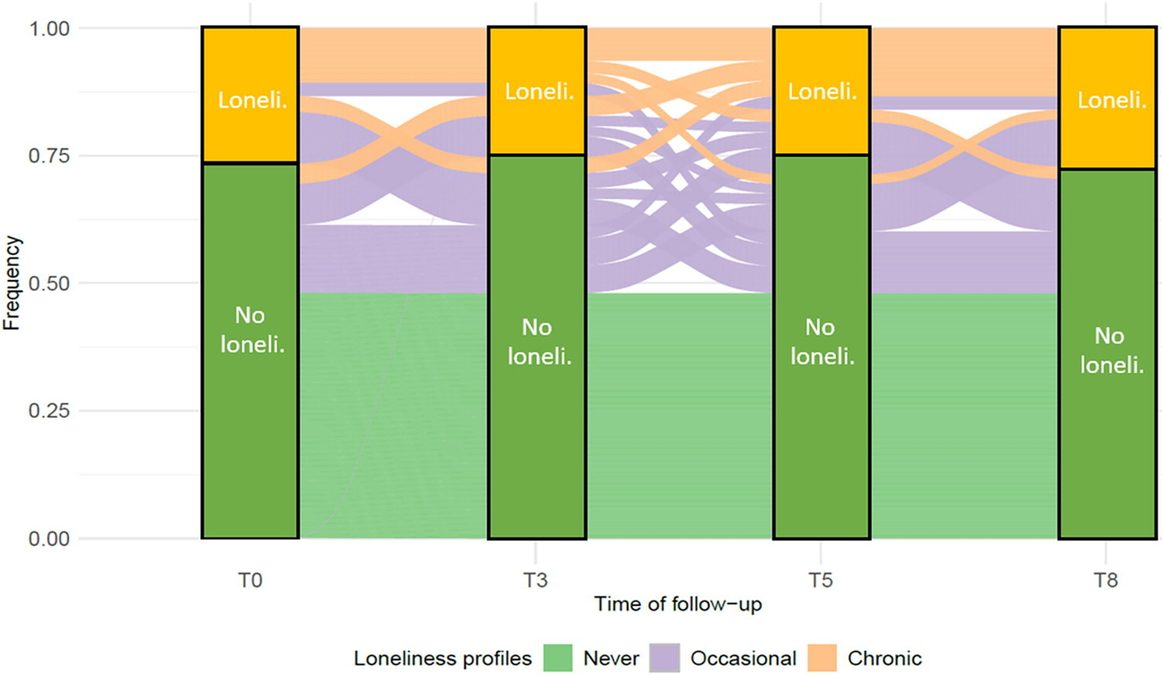
Over the following 20 years, 560 participants developed dementia. The condition affected 33.1 percent of those who never reported loneliness and a similar 34.5 percent of those who occasionally felt lonely.
For those experiencing chronic loneliness, the figure climbed to 49.1 percent.
The higher risk in the chronic loneliness group remained even after the researchers accounted for factors including sex, education, living arrangements, depressive symptoms, and general health.
The researchers also examined a smaller group of 217 people whose loneliness appeared to disappear. They had reported loneliness at just one of the first three visits and no longer felt lonely at the final assessment.
This group showed a tendency toward lower dementia risk than people who never reported loneliness, though the difference wasn't statistically significant.
The association with dementia remained after researchers accounted for whether participants lived alone. About 70 percent of those experiencing chronic loneliness lived alone, but the remaining 30 percent shared a home with someone.
"These findings confirmed that chronic loneliness is not only a social concern but is associated to an accelerated brain aging, with far-reaching implications for dementia prevention," Simon and team write.
Loneliness is complex. Someone can live independently and maintain fulfilling relationships. Another person might spend every day surrounded by family yet still feel disconnected.
Why persistent feelings of loneliness might affect the brain isn't yet clear. One possible explanation involves stress. Feeling lonely can activate the body's stress-response systems. When loneliness persists, those systems may remain active for longer.
Earlier research has associated loneliness with inflammation, changes in immune activity, and biological processes that could affect brain health.
Persistent loneliness may also shape everyday behavior, potentially reducing physical activity and opportunities for mentally stimulating social interaction.
Asking older adults about loneliness may be useful, even when they live with other people.
Meaningful relationships, community activities, and regular social contact may help people feel more connected.
There are important uncertainties, however. The researchers didn't directly test the proposed biological mechanisms or whether social activities could prevent dementia.
Loneliness was measured using one question about the previous week at visits several years apart, meaning changes between assessments could have been missed. The analysis also excluded people who died or developed dementia during the initial eight years, which the authors say may have led them to underestimate the link.
Because the study was observational, it can't prove that loneliness causes dementia. Early changes in brain health could also influence feelings of loneliness.
To explore whether early cognitive changes might explain the association, the researchers repeated their analysis after excluding 405 participants with mild cognitive impairment, a condition involving memory or thinking problems greater than expected for their age.
The association with chronic loneliness remained.
"As some situations of loneliness are a potentially preventable or reversible condition," the study authors conclude, "it may represent [a critical and actionable] target for interventions aimed at promoting healthy cognitive aging, preserving autonomy, and improving quality of life in later adulthood."
The research has been published in Aging & Mental Health..
This article was fact-checked by Rebecca Dyer and edited by Rebecca Dyer. While we pride ourselves on our process, we are only human. If you spot a mistake, please let us know.