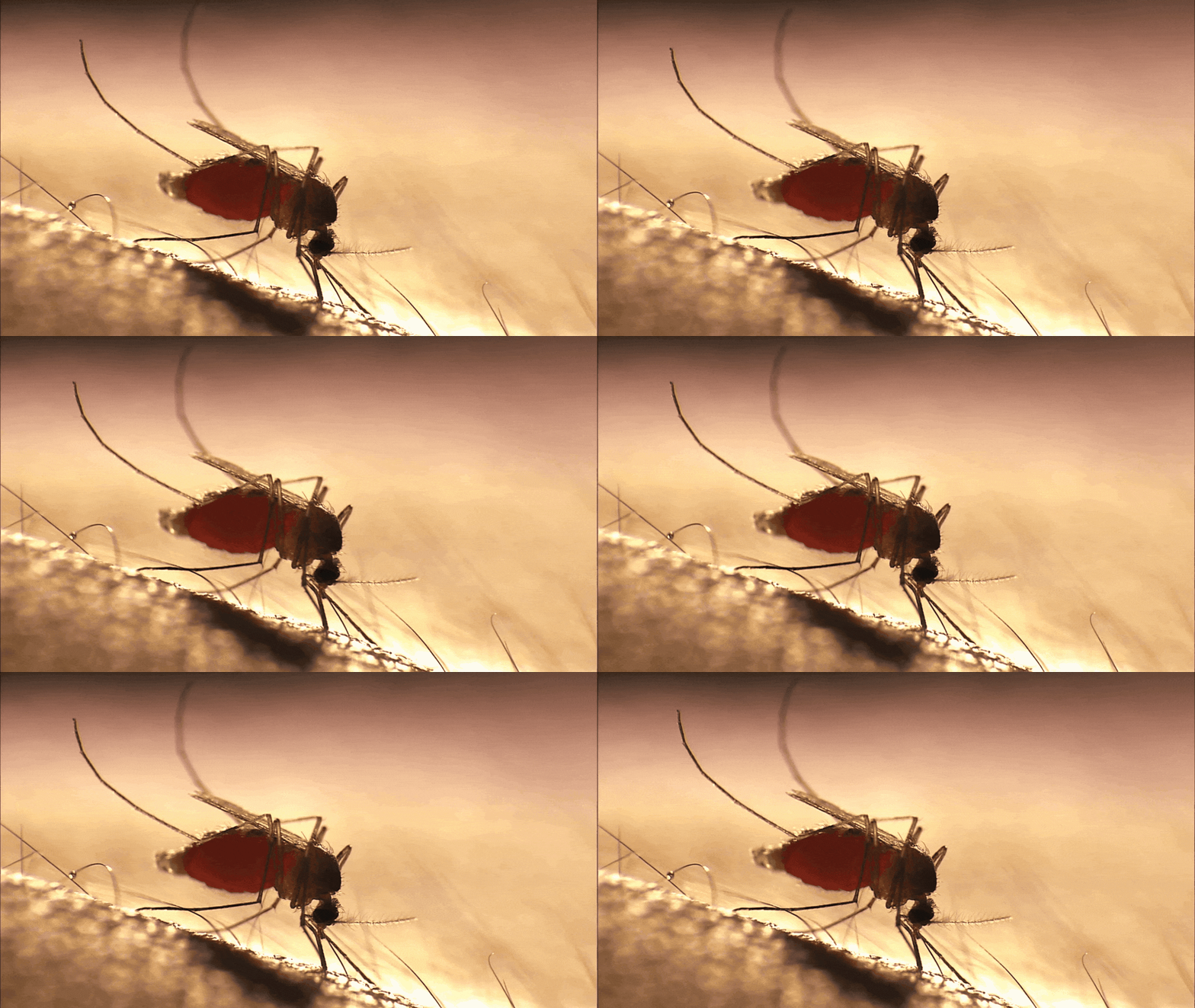
Microorganisms' ability to evolve rapidly has given them a leg up in this microbe-eat-microbe world.
As quickly as one organism evolves a defense, another evolves a way to overcome or evade it. Scientists refer to this as an evolutionary arms race, and it's one of the most powerful evolutionary forces in the natural world.
It becomes a problem for us when microbes turn this impressive arsenal of rapid evolution against the drugs we use to fight deadly infections.
And in the case of the most pernicious malaria pathogen, that drug resistance is becoming worryingly complex.
According to a new genetic analysis of Plasmodium falciparum – the parasite responsible for the most dangerous form of malaria – the pathogen appears to be stockpiling adaptations linked to resistance against a wide swath of drug treatments.
"These findings underscore the dual challenge of persistent resistance to discontinued drugs and rising threats to current frontline therapies," write infectious disease researchers led by Alemayehu Letebo of the Armauer Hansen Research Institute in Ethiopia, Leen N. Vanheer of the London School of Hygiene and Tropical Medicine in the UK, and their colleagues.
Their findings have been detailed in Nature Microbiology.
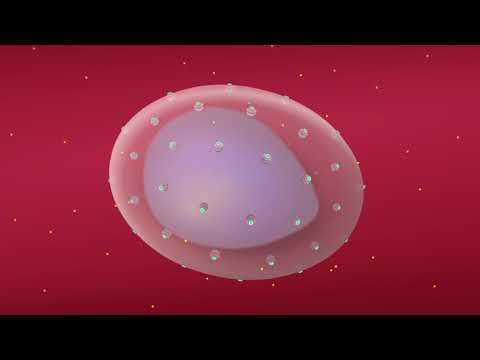
Malaria is one of the world's deadliest infectious illnesses, infecting hundreds of millions of people every year and killing hundreds of thousands – mostly children under the age of 5, and mostly in Africa.
The disease is preventable and curable, but researchers constantly race to stay ahead of the parasite. P. falciparum has developed resistance to almost all the antimalarial treatments developed in the last 70 years, including artemisinin, one of the most important malaria drugs, which was discovered in the 1970s.
Artemisinin partial resistance was first identified in Southeast Asia more than 15 years ago and has now been reported in several locations in Africa.
But resistance is not a simple switch that suddenly flips on, and then flips off when it is no longer needed.
It can involve many genetic changes, some that emerge to deal with drugs that are currently in use. Others may be lingering remnants from fighting retired drugs that are no longer in use.
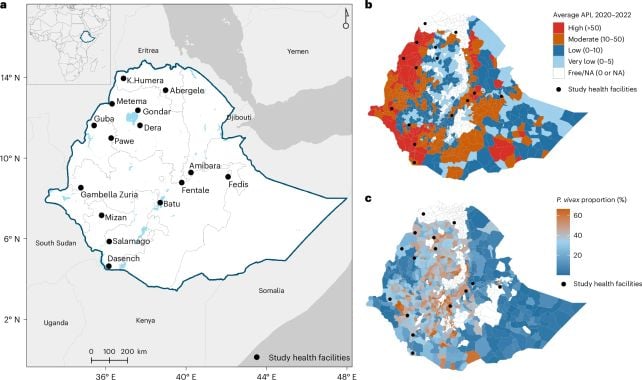
The picture in Ethiopia is especially complex. Chloroquine stopped being effective for P. falciparum long ago; the first-line treatment now is the artemether-lumefantrine combination drug, which deploys an artemisinin drug called artemether together with lumefantrine.
But P. falciparum is not the only parasite that can cause malaria. Another parasite, P. vivax, which usually causes a less deadly form of malaria, is still susceptible to chloroquine – and it circulates in many of the same areas as P. falciparum.
The researchers wanted to know if those overlapping drug pressures are shaping the evolution of P. falciparum – and whether the parasite is carrying multiple drug resistance markers in worrying combinations.
They sequenced drug-resistance genes from 605 P. falciparum samples collected from 15 Ethiopian districts between 2019 and 2023, across areas with different malaria intensity and different levels of P. vivax overlap.
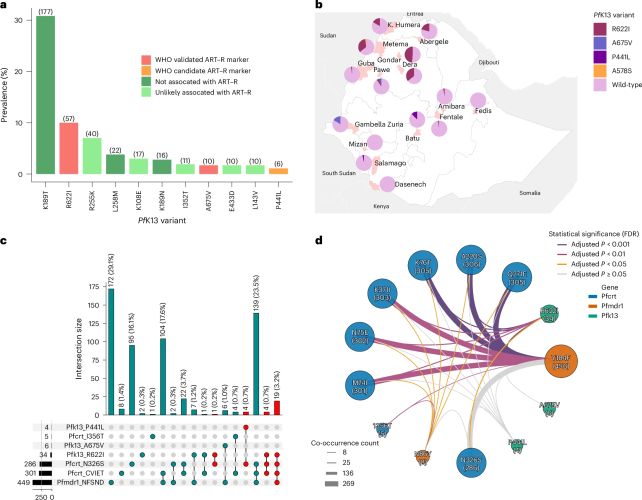
The data revealed that chloroquine resistance markers remain widely present in the parasite, even though chloroquine was withdrawn from the P. falciparum treatment kit decades ago. The genetic resistance pattern to the drug was found in 61.2 percent of 492 successfully classified samples.
The researchers believe that the drug's ongoing use to treat P. vivax malaria may be helping resistance linger in P. falciparum, and the geographic patterns support that interpretation, but more investigation is needed.
The researchers also found that markers associated with resistance to sulfadoxine-pyrimethamine remain common, detected in 42.8 percent of 453 samples, even though the treatment hasn't been used for malaria in Ethiopia since 2005.
In addition, resistance markers for current treatments are spreading. The main marker for artemisinin partial resistance appeared in 10 percent of 572 samples.
Other markers appeared at lower rates, but tended to be clustered in specific regions. In one district, artemisinin partial resistance reached as high as 48.6 percent.
The most concerning pattern, however, is that these resistance markers often appeared side-by-side. Parasites with chloroquine resistance markers, for example, were linked to more than threefold higher odds of also carrying artemisinin partial resistance markers.
And a genetic pattern associated with reduced sensitivity to lumefantrine was found in 93 percent of 483 classified samples.
That raises the possibility of a resistance double whammy, but it's important to note that the researchers looked at genetic markers, not whether artemether-lumefantrine is losing effectiveness.

The strongest conclusion is that Ethiopia does not have one uniform drug-resistance problem. It has a patchwork of parasite populations carrying different combinations of mutations.
This means that combating malaria and its resistance to treatments cannot be a blanket, one-size-fits-all approach.
None of this means that the current approach to malaria in Ethiopia has stopped working. However, it should be taken as a warning sign, the researchers say.
Related: Drug-Resistant Bacteria May Be Jumping Between Pets And Humans, Scientists Warn
The parasite is not evolving along a single, predictable path, and the same drug pressures may not be shaping it in the same way everywhere.
What health officials have now is the opportunity to adjust their surveillance strategies to better fit the changing, complex landscape of malaria parasite drug resistance.
"Taken together, Ethiopia's distinct P. falciparum cluster, marked geographic heterogeneity in resistance markers and correlation with species composition highlight the need for region-specific control strategies," the researchers write.
"Integrated surveillance systems that monitor both P. falciparum and P. vivax, coupled with whole-genome sequencing and longitudinal data linked to clinical outcomes, will be essential to track resistance evolution and guide tailored interventions."
The paper has been published in Nature Microbiology.
This article was fact-checked by Fiona MacDonald and edited by Fiona MacDonald. While we pride ourselves on our process, we are only human. If you spot a mistake, please let us know.