Parents strive to support their children's physical and mental well-being, whether it's constant cross-town drives to karate, mashing a million peas, or absorbing countless CoComelon marathons.
Adopting a pet is another common practice, but is there any science to support the benefits of animal companionship for kids?
A study from late 2025 is one of the few to explore these effects in youngsters aged 7 to 8 years old – with surprising results.
Published in the World Journal of Pediatrics, Spanish epidemiologists collected years of data on pet ownership, including the presence of beloved cats, dogs, birds, and other animals, such as hamsters or reptiles.
The intriguing result? Cats seem to be associated with worse mental health measures for children, while other pets, including rabbits, reptiles, or amphibians, seem to have the opposite effect.
Attachment, or the formation of emotional bonds, is crucial for social development. Yet it doesn't have to be between a child and their caregiver; it can also form between a child and an animal ally.
Therefore, a childhood pet can ostensibly yield numerous socio-cognitive benefits, including increasing compassion toward animals and "powering up a child's responsibility and moral norms," the researchers explain.
Additionally, pets may help children build the skills for strong human relationships by helping them to understand nonverbal language and improving prosocial behaviors.
However, some previous studies had turned up inconclusive results.
So, Spanish researchers launched the Infancia y Medio Ambiente (INMA; Environment and Childhood) project, involving nearly 1,900 mother-child pairs across seven areas of Spain, in the early 2000s.

Initially set up to study the effects of different environmental factors, such as pollutants, on child development, the project has since expanded to include other aspects, such as pet ownership.
In this study, the researchers used medical records, data on parental sociodemographics, and questionnaires administered during follow-up visits at pregnancy, birth, age 1, ages 4-5, and ages 7-8.
Parents then completed a behavior screening questionnaire when their children were 7-8 years old. It included questions related to emotional symptoms, conduct problems, hyperactivity, peer problems, and prosocial behavior.
The researchers were interested in internalizing and externalizing behaviors. The former are inwardly directed stress responses that may include inner turmoil symptoms associated with depression or anxiety. The latter are outwardly directed behaviors that may break rules or social norms and could cause turmoil in others.
About one-quarter of the 1,893 families had always owned a pet, most commonly a dog or cat.
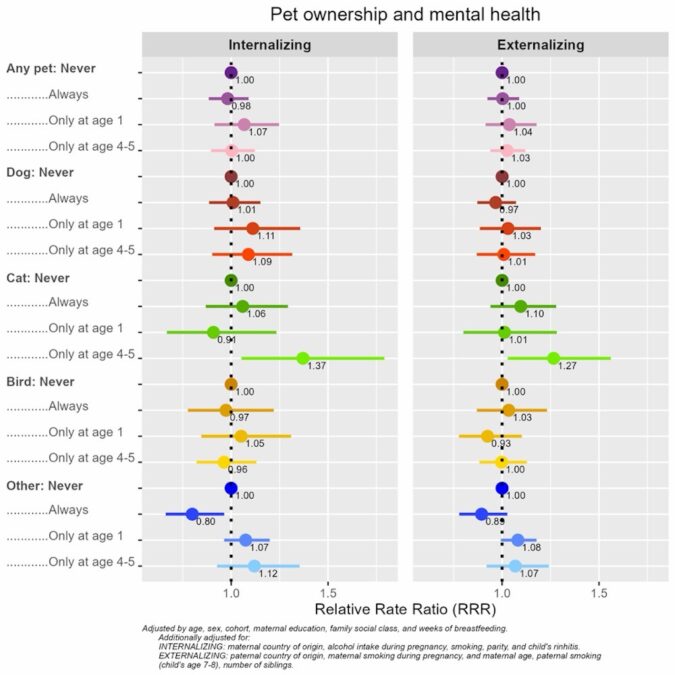
The study revealed that owning a cat – but only at ages 4-5 – was associated with an increased risk of both internalizing and externalizing problems.
In contrast, owning "other" animals (not a dog, cat, or bird) during both early childhood follow-ups seemed to have a protective effect, associated with a reduced risk of internalizing and externalizing problems.
The rest of the pet companionship scenarios did not show significant associations with the children's mental health.
The researchers offer multiple hypotheses to explain the lack of observed mental health benefits. First, an attachment model suggests that emotional bonds may not be fully formed until 18 years of age, yielding later benefits.
Or, 'little' pets like rodents, fish, and reptiles may inspire weaker emotional bonds because they're more evolutionarily distant from humans.
At the same time, the companionship of these other animals was the only thing that showed a mental health improvement, perhaps because they're often regarded as "children's pets" being easier to care for.
It might also have something to do with how owners interact with their pets. Cats don't usually indulge their owners in mental-health-boosting outdoor activities like jogging and fetching; they typically stay indoors.

But the findings could also be a reflection of the type of pet parents choose for their children. This is an observational study, so it can't untangle those factors and researchers can only speculate.
Pets have different relational patterns and attachment styles, and the researchers suggest that cats can be "less affectionate, exhibit avoidant attachment, and are often chosen by families with children who have mental health conditions, due to their lower maintenance needs."
Related: We're Not Taking Harmful Cat Behaviors on The Internet Seriously Enough, Researchers Warn
Another possibility is that the feline-facilitated fulcrum of misbehavior observed in this work may be influenced by toxoplasmosis, which affects about one-third of the global population and can adversely impact cognition and mental health in children.
"Collectively, our data highlights the complex relationship between early pet ownership and child mental health," the researchers conclude.
This research was published in the World Journal of Pediatrics.
This article was fact-checked by Rachel Garner and edited by Clare Watson. While we pride ourselves on our process, we are only human. If you spot a mistake, please let us know.