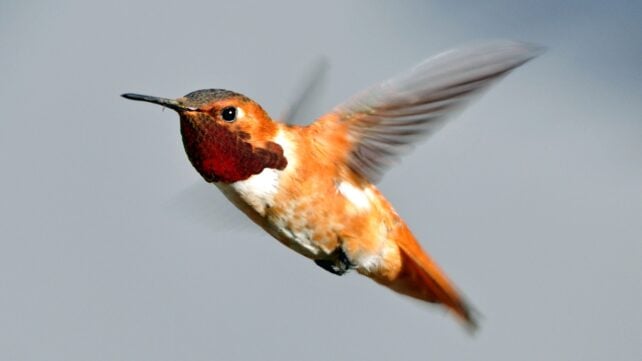
Small as a sparrow and light as a sugar cube, one male rufous hummingbird traversed a record-breaking 6,526 cumulative kilometers (4,055 miles) from Alabama to Alaska in just 38 days.
That's the longest hummingbird journey that scientists have ever caught on record.
Hummingbirds are very difficult to track. The kind of flight trackers scientists might use for larger migratory species are simply too heavy for hummingbirds, the majority of which weigh less than 5 grams (0.18 ounces).
Animal physiologist Emma Rhodes, who is based at the University of Memphis, led a team to create a tiny tracking device for hummingbirds that adds a burden of just 0.06 grams (0.002 ounces) to their journey. That's about the same weight as a grain of rice.
The results of their field tests are published in the scientific journal Ecology and Evolution, including the record-breaking route.
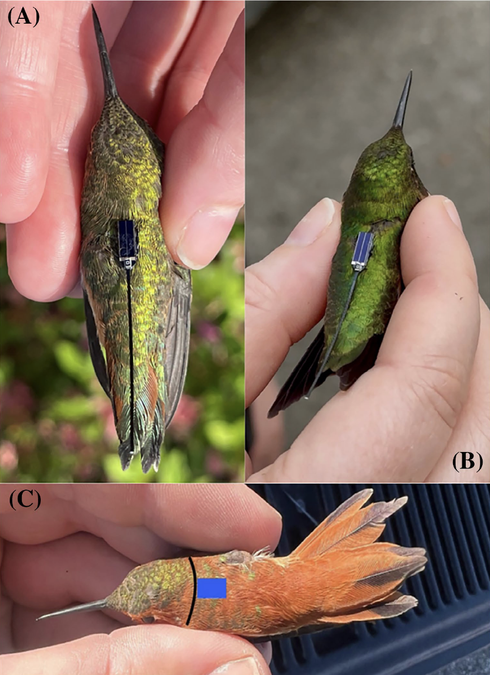
The transmitter emits a signal every 3 seconds, powered directly by a tiny solar cell. It needs no battery and no data storage: The signal can be picked up by a smartphone or computer within 200 meters of the bird via Bluetooth.
It could be an important breakthrough for hummingbird researchers, who have long relied on banding to track these birds.
Trained hummingbird banders use nets or cages to trap hummingbirds, and then swiftly fit each bird with a uniquely numbered metal 'bracelet' around its ankle.
Birders, banders, and ornithologists alike check for bands when they sight a bird, and this has given scientists a lot of data on where hummingbirds travel throughout the year.
But as hummingbird populations continue to decline, scientists need more detail so they can find exactly where and why things are going wrong.
Bugging the birds with miniature radio tags has begun to help fill some gaps in our hummingbird data. The Motus Wildlife Tracking System shows it can be done, but according to Rhodes and team, it's also "innately limited by the number of working and compatible telemetry towers capable of receiving detections".
Their tracker, BlūMorpho, relies on an Internet of Things approach, in which any computer with the right software can detect the signals from nearby birds. And since almost everyone has a smartphone in their pocket these days, that's a pretty high-resolution array of receivers already set up.
Rhodes and team mounted their trackers on four rufous hummingbirds (Selasphorus rufus) and seven ruby-throated hummingbirds (Archilochus colubris) in March and April of 2025, in time for the birds' spring migration from coastal Alabama and the Florida Panhandle.
The researchers ensured each device was less than 3 percent of a bird's body weight, a load which, in one study of yellow-rumped warblers carrying radio telemetry devices, resulted in no extra energy expenditure during flight.
The transmitters were glued on between the birds' shoulder blades, antennas pointing backward.
Watching the birds' flight paths evolve in near real time, the scientists noticed some surprising detours.
After heading north a little while, one rufous hummingbird followed a "serpentine-like track" throughout several eastern states during a 23-day period, including "a large ~345 kilometer loop cutting up into eastern Tennessee on 2 April 2025, heading north until it reached Fredericktown, Missouri, in which it circled back south and ultimately headed eastward until 14 April 2025," the researchers report.
Two ruby-throated males banded on the same day took off in a similar northerly direction. Over two days in April, they were moving northward alongside each other in almost perfect parallel, separated by around 83 kilometers longitudinally.
Another ruby-throated hummingbird unexpectedly traveled southeast from its capture location, traveling from Coastal Alabama to Florida.
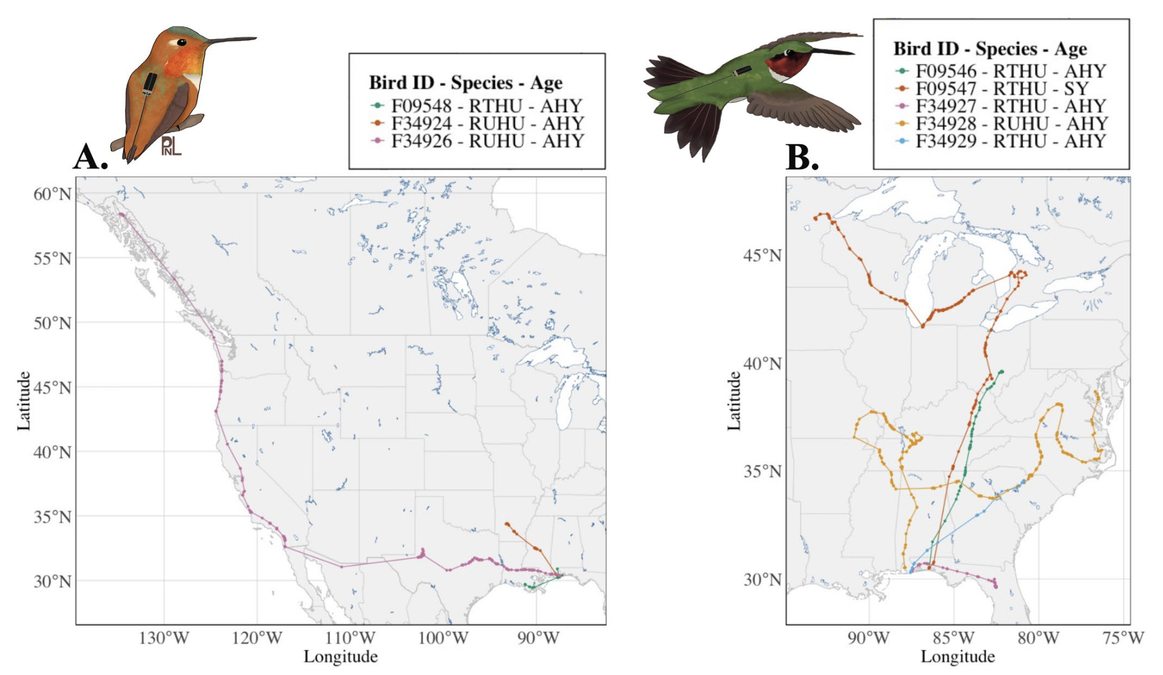
And then, of course, there's the record-breaking rufous, whose 38-day journey from Alabama to Alaska swung west across northern Mexico and then ran straight up the Pacific Flyway.
The device isn't perfect: It doesn't work at night, and isn't much use in remote areas where there are no computers or smartphones to transmit to.
The other challenge is in keeping the trackers stuck to the birds: They worked for an average of almost 47 days before presumably falling off when the glue failed.
"Previous methodological and technological complications have limited our ability to answer critical population-level questions such as whether migratory connectivity exists in migratory hummingbird species and if so, to what extent," Rhodes and team write.
"With both rufous and ruby-throated hummingbirds experiencing recent population decline, this new technology will provide critical insights for species management, conservation, and to understand the current population shifts."
The research has been published in Ecology and Evolution.
This article was fact-checked by Peter Dockrill and edited by Peter Dockrill. While we pride ourselves on our process, we are only human. If you spot a mistake, please let us know.