If an asteroid above a certain size ever gets close enough to Earth, humanity may be in serious trouble.
Even a relatively small space rock – around the size of a football field – would be large enough to completely destroy a city.
Because some are so dark and non-reflective, asteroids can be hard to spot, too, and it's not like we can just put up a shield that will gently deflect asteroids away.
So how do we stop an asteroid from wreaking destruction on Earth? Well, one potential method that sounds straight out of science fiction but could actually work would be to wallop it with the most powerful weapon humanity has ever devised – a nuclear warhead.
Now, we can't actually test this easily. Nukes aren't exactly lying around waiting for someone to chuck them at asteroids, and hauling a spacecraft to an asteroid isn't a walk in the park to boot.
So, in a new simulation, a team led by astrophysicist Isaiah Santistevan of Lawrence Livermore National Laboratory in the US pitted a 1-megaton nuke against a 160-meter (525-foot) city-killer asteroid.
And the cockamamie thing is that it could actually work – but absolutely not in the way you're probably thinking.
"Based on the extent of damage, the directionality of the material motion, and the [velocity change] that we impart on these asteroids, we suggest that disruption is highly likely for two of the three scenarios," the researchers write in a paper in The Planetary Science Journal.
"Simulations such as these help to further inform the viability of nuclear mitigation options for planetary defense and support emergency response planning."

The idea of nuking an asteroid has been around for decades, and you probably imagine it would involve detonating a device sitting on – or even under – the surface to either blow the rock to smithereens or impart enough momentum to kick it off its current trajectory.
It makes sense, right? But the problem is, there's no guarantee the asteroid itself would play ball.
An asteroid doesn't present a simple, stationary target; it can tumble and rotate through space. Getting a spacecraft to one is doable, but difficult; it's far harder to land on the surface, stay there, and start drilling.
Fortunately, as the new work shows, the nuke doesn't have to touch the asteroid at all. Its detonation can take place several meters from the asteroid surface.
That sounds counterintuitive. Space is an effective vacuum; there's insufficient medium to carry a shockwave, even from a megaton warhead, even at a distance of just 10 meters.
But the shockwave is not the mechanism that can alter the asteroid here.
Instead, it's X-rays – scads and scads of blazing X-rays.
Around 70 to 80 percent of the energy produced by a nuclear explosive can emerge as X-rays, and it's this radiation that would sear the asteroid's surface.
"These X-rays deposit energy in a thin surface layer of the asteroid, driving vaporization and ablation," the researchers explain.
"The vaporized material expands, and if it can overcome the local gravitational field, it is ejected, which imparts a change in momentum that alters the asteroid's velocity."
It's not dissimilar to the way material escaping a comet imparts momentum that can change the spin of the comet's nucleus – think of the way a garden hose jumps and twists when the escaping water pressure is high enough.
But for a nuked asteroid, there's an additional effect.
The sudden blast of X-ray energy also drives a powerful shock wave into the asteroid itself, where it can crack and fracture the rock from within.
It was this last part that particularly intrigued the researchers. It's possible that, one day, an asteroid is discovered that is too large or spotted too late for simply nudging aside to be a viable strategy.
So, they ran three detailed 3D simulations, using the shape and porous structure of asteroid Bennu (upon which NASA landed a spacecraft in 2020) as a realistic basis for their simulated space rock.
They tweaked parameters such as the distance of detonation and how easily the asteroid fractured under the X-ray-induced stress.
For this, they used fracture models based on two real space rocks: the Chelyabinsk meteorite, which exploded over Russia in 2013, and the Aba Panu meteorite, which fell in Nigeria in 2018.
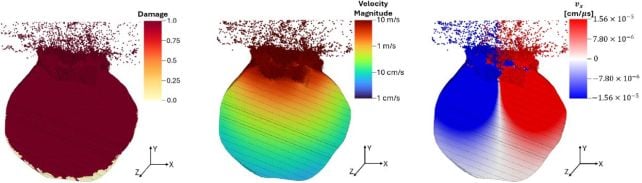
In the longest simulation, with the bomb 10 meters above the surface, 98.2 percent of the asteroid material became fully damaged, and roughly 97 percent was moving faster than the asteroid's escape velocity. Large portions were also moving sideways in opposite directions – basically showing the asteroid pulling itself apart.
When they moved the bomb farther away, to 25 meters, things got even weirder.
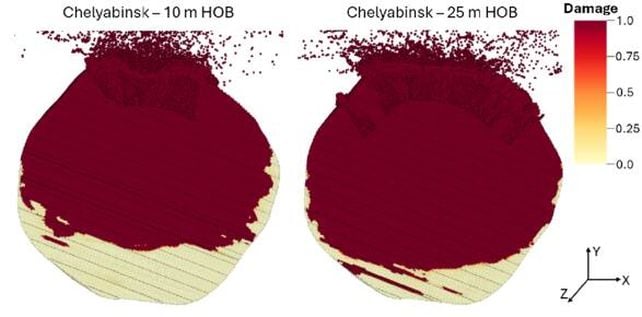
Less nuclear energy actually reached the asteroid, but the X-rays illuminated a larger area of its surface – a bit like pulling a flashlight away illuminates a larger area with a slightly dimmer beam.
But that beam produced more widespread damage: after 68 milliseconds, 92.6 percent of the asteroid was fully damaged, compared with 78.1 percent in the equivalent 10-meter simulation at the same point in time.
That suggests that zooming the nuke in as close as possible may not always be the best strategy for disrupting an asteroid.
Before we get too carried away, there's a catch.

The simulations were extremely computationally expensive. The longest one, which followed just 145 milliseconds of action, took 59 days to run on 1,680 computer processors.
This means that the researchers could not determine the long-term fate of the disrupted asteroid.
It could have broken up and the pieces dispersed safely; it could have fragmented into smaller pieces that were still large enough to pose a threat; or the asteroid could have managed to bind itself back together gravitationally after a pebbly shrug.
Still, the work represents a significant step towards working out whether nuclear weapons really could work as an effective last line of defense against an Earth-bound asteroid.
"These results are a step toward the immensely difficult problem of doing comprehensive nuclear mitigation modeling for planetary defense scenarios," the researchers write.
"High-fidelity simulations such as the ones presented here allow us to continue pushing the limits of what is possible."
The findings have been published in The Planetary Science Journal.
This article was fact-checked by Clare Watson and edited by Clare Watson. While we pride ourselves on our process, we are only human. If you spot a mistake, please let us know.