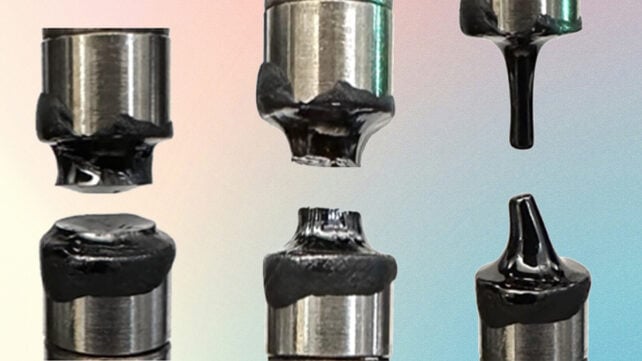
Just when you think you've got a handle on how the Universe works, physics goes and surprises you again. Researchers have discovered that simple liquids can have breaking points, beyond which they suddenly fracture like solids.
The finding is a significant one for fluid mechanics. If liquids can snap, as well as stretch and flow, it has implications in everything from 3D printing technology to the biological systems inside our bodies.
The surprise discovery was made by researchers from Drexel University in the US and ExxonMobil, who were conducting experiments to see how viscous liquids respond to strong forces. They initially thought the lab equipment had broken.
"The fracture caused a very loud snapping noise that actually startled me," says chemical engineer Thamires Lima, from Drexel University.
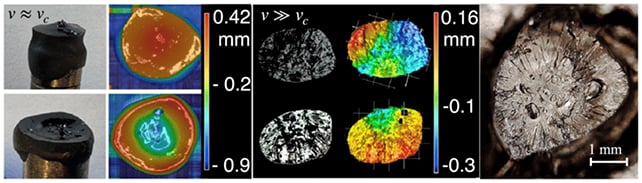
The team says they repeated the experiments a few times to ensure the results were reliable.
"What we observed was so unexpected," says Drexel University chemical engineer Nicolas Alvarez.
"Once we confirmed the phenomenon, the research became an entirely different scientific endeavor."
The setup involved liquids placed between two metal plates, observed by a high-speed camera, and with a variety of forces applied. The first snap occurred when the liquid was pulled with a force comparable to that of a bag of bricks hanging from a fingernail-sized area.
That was in a tar-like hydrocarbon blend liquid, and the same breaking point was subsequently found in a different liquid, styrene oligomer. This, too, was thick and tar-like, and the researchers think viscosity (how a liquid flows) is important.
Stress builds up differently in a thicker, more viscous liquid compared to a runnier, less viscous one. Based on these experiments, thicker liquids can crack even when they are pulled more slowly – but the amount of force needed seems to be the same, irrespective of the viscosity involved.

While it was known that liquids could crack if cooled sufficiently or mixed to achieve the right properties, this is a new discovery. The researchers think it likely applies to more liquids beyond those tested.
"Our findings show that if pulled apart with enough force per area, a simple liquid – a liquid that flows – will reach what we call a point of 'critical stress', when it will actually fracture like a solid," says Lima.
"And this is likely true for all simple liquids, including common examples, such as water and oil."
One of the next areas to explore will be the mechanics of why this is happening. The team found that the liquid cracks formed very quickly once they'd started, at a rate of 500–1,500 meters per second.
The fracture speed is consistent with cavitation, a phenomenon theorized for decades. The hypothesis is that enough stress on a liquid will cause a tiny vacuum bubble to form inside it, which then helps tear the liquid apart.
As these experiments have shown, the process happens so fast that it's going to be challenging to get a good look at. Now that there's solid evidence of this happening, scientists have more to work with.
Something else to investigate next is how these fractures might occur in other liquids and outside very precise laboratory settings. Inkjet printing and soft robotics are two real-world applications mentioned by the researchers where these findings will be useful.
Liquids continue to reveal hidden properties and internal physics as scientific methods and research instruments improve – and it's likely that there's still lots more to discover.
Related: Wild Experiment Coaxes Liquids Into Amazing Square And Hexagonal Shapes
"Now that we have reported this unanticipated behavior, the work of fully understanding why it happens and how the behavior manifests in other liquids is an important next step," says Lima.
"It will also be interesting to see how this finding may be applied to assist fiber spinning and other applications that use viscous liquids."
The research has been published in Physical Review Letters.