Some truths about the Universe seem absolute.
Entropy flows one way. Gravity sucks. And nothing can outrun the speed of light.
But a quirk of how sound waves interact in water may have just shown how something can appear to.
According to two researchers, interference between waves traveling along two different paths can make their combined energy peak appear sooner than the peak of a wave traveling directly from source to receiver.
It works underwater with sound – which means that, theoretically at least, it could also work with waves of light in a vacuum. And it wouldn't even need to break physics.
"We prove the speed of information is less than or equal to the speed of light in a vacuum, so the effect does not violate special relativity," acoustician John L. Spiesberger of the University of Pennsylvania and oceanographer Eugene Terray of the Woods Hole Oceanographic Institution write in a paper accepted for publication in Physical Review E.
The research emerges from earlier work studying how sound behaves underwater – and it all starts with whales.
Researchers studying whales calling to each other in the ocean can track down where a whale is by recording using multiple hydrophones – basically, the timing of the signal arrival at each hydrophone allows signal triangulation.
But Spiesberger and his colleagues found that, in some situations, this method could produce significant errors. In a 2025 paper, they elucidated a phenomenon that could explain why.
If the whale was close enough to the surface, some of the sound of its call would travel directly to the hydrophone, while some would reflect off the underside of the water's surface.
If the two waves overlapped at the hydrophone, their interference would shift the peak of the received wave, making it appear to arrive later – that is, at a slower effective speed than the direct wave alone.
The previous work showed that the interference could make sound appear to move more slowly – but when Spiesberger started looking at different, more realistic pulse shapes, he noticed something extraordinary.
Under the right conditions, the effect could work in the opposite direction.
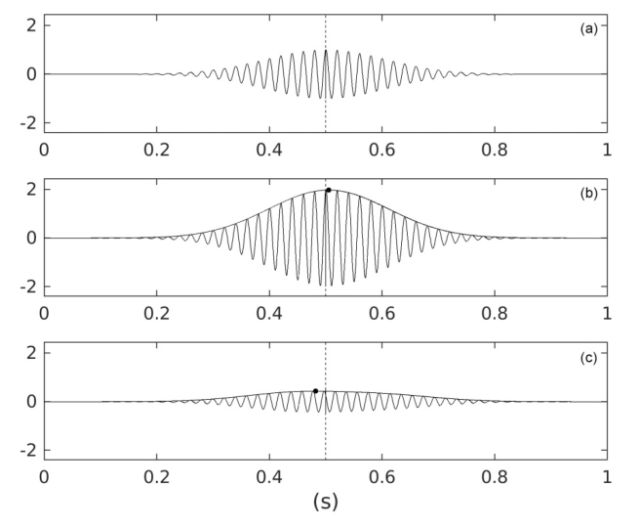
You have the pulse traveling directly, and the pulse bouncing off a flat surface. If you tweak the timing between them just so, interference reshapes the combined pulse so that the peak reaches the receiver before the peak of the direct pulse.
In one simulation, the researchers modeled sound traveling underwater at a speed of 1,500 meters (4,920 feet) per second.
The resulting energy peaks, they found, could appear to travel at 1,694.5 and 2,782.5 meters per second – the latter of which is nearly double the speed of sound in the simulation.
Here's the thing, though. This phenomenon may not be limited to sound. The researchers posit that it should work for light in a vacuum, too.
"Our conjecture that the direct + reflected path effect exists for electromagnetic waves provides a mechanism for superluminal propagation distinct from microwave tunneling, quantum tunneling, and anomalous dispersion," Spiesberger and Terray write.
"These yield effects occurring at speeds exceeding light speed in a vacuum, yet the speed of information is less than the speed of light in a vacuum. Hence, we explore if the direct + reflected path effect also conveys information at speeds less than light speed in a vacuum."
Now, according to special relativity, information cannot exceed the speed of light in a vacuum. But there's a distinction to be made between the energy peak of the wave and the information it carries.
To test the speed of the information, the researchers modeled the transmission of two different signals, represented by a 1 and a 0. Up to a certain point known as time zero, the two signals are identical; at time zero, the source switches to either 1 or 0, which then propagates towards the receiver along the direct and reflected paths.
The point at which the receiver can reliably tell whether the signal is 1 or 0 marks the point at which new information has successfully reached the destination.

And the researchers found that this information could not travel any faster than the wave carrying it along the direct path. Interference can shift the energy peak forward, but it couldn't create information at the receiver before that information had traveled there the old-fashioned way.
Related: Physicists Found Something That Can Move Faster Than Light: The Darkness Inside It
Curiously, though, although interference couldn't push information beyond the speed limit, it did give it a little speed boost. The researchers weren't sure why.
The next step is to experimentally try it – either with sound or with light – to see what happens.
"Should the direct + reflected path effect occur for electromagnetic waves, and should it yield superluminal speeds, it would be the simplest method for doing so among other superluminal phenomena," Spiesberger and Terray write.
"Classical physical effects are sometimes echoed in quantum mechanics, and it might be worth considering if the direct + reflected path has analogies in the quantum world."
The research will appear in Physical Review E.
This article was fact-checked by Fiona MacDonald and edited by Fiona MacDonald. While we pride ourselves on our process, we are only human. If you spot a mistake, please let us know.