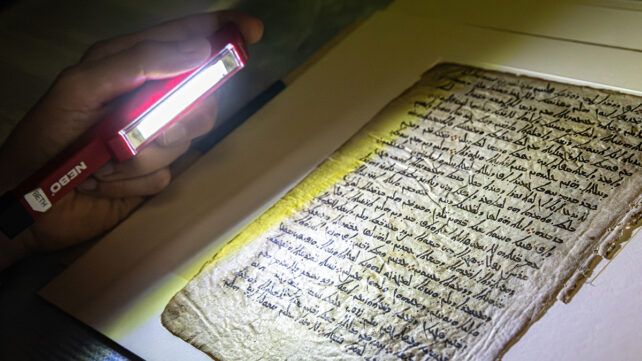
Researchers are painstakingly reconstructing the oldest-known map of the night sky – previously thought lost forever – by X-raying parchment that contains the star catalog hidden beneath other text.
The map of the cosmos is thought to be the work of the renowned ancient astronomer Hipparchus, who lived from around 190 to 120 BCE, long before the invention of the telescope. He's credited as the first astronomer in the Western world to attempt a catalog of this kind and the first to determine the motions of the Sun and Moon.
Until now, however, the only remnant of Hipparchus's lifetime of work was a commentary he wrote on two pieces describing stellar constellations – works he had several issues with.
Now we may be able to access a much fuller and more informative work by Hipparchus. The story starts in 2022, when a close analysis of a 6th-century monastery manuscript revealed that it could contain an ancient star map written by Hipparchus.
Given the price of parchment in the Middle Ages, it was often scraped clean of ink and reused, and that seems to have happened here.
While underlying astronomical text had been spotted on the folio before, in 2022, researchers were able to link these references to Earth's precession (axis wobble) to the time when Hipparchus would have been working.
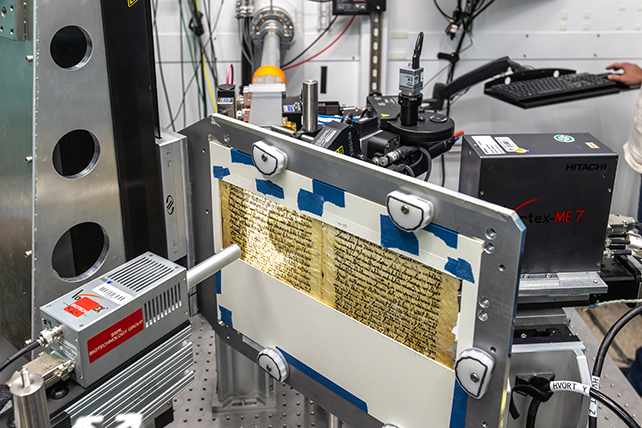
That brings us to the latest chapter in this extraordinary restoration story. The manuscript, known as the Codex Climaci Rescriptus, is currently being X-ray scanned at the SLAC National Accelerator Laboratory, to see just how much it's hiding.
"The goal is to recover as many of these coordinates as possible," historian Victor Gysembergh, from the French national scientific research center CNRS, told Ayah Ali-Ahmad at KQED. "And this will help us answer some of the biggest questions on the birth of science."
"Why did they start doing science 2,000 and more years ago? How did they get so good at it so fast? Because the coordinates we are finding are incredibly accurate for something that is done with the naked eye."
The machine being used for the work is a particle accelerator known as a synchrotron, which creates X-rays by accelerating electrons to nearly the speed of light. These X-rays can then distinguish between different chemicals in a material, without destroying the fragile material.
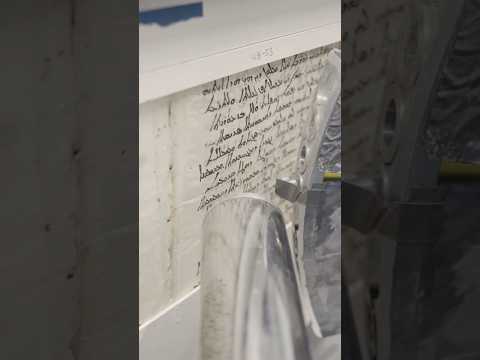
While the monks who overwrote the star catalog used ink rich in iron, the underlying text – in Greek, not the Syriac the monks wrote in – has a calcium signature. That gives researchers the opportunity to reveal the hidden text.
And progress is already being made: several star descriptions have been recovered, together with a reference to "Aquarius", KQED reported. The hope is that with further scanning, experts can reveal as much detail as the manuscript holds.
Thought to have been originally recovered from St Catherine's Monastery in Egypt, the oldest continuously inhabited Christian monastery in the world, the Codex Climaci Rescriptus has been carefully transported from The Museum of the Bible in Washington DC for this analysis.
That in itself has been a major operation: The manuscript pages have been put in custom-made frames, placed in humidity-controlled cases, and carried by hand. Light in the scanning room is also deliberately controlled to prevent further ink fading.

However, only 11 pages are currently being scanned at the SLAC lab. The manuscript runs to some 200 pages in total, and those pages are scattered across the world, so further coordination may be needed to bring this map back in full.
Even with the challenges that still lie ahead, having a chance to be able to reconstruct the very first map of the night sky is incredible – especially as we thought no one would ever set eyes on it again.
Related: A Giant Telescope Searched 3I/ATLAS For Signs of Aliens. Here's Why.
"I am at the peak of my excitement right now," Gysembergh told KQED. "Because of this new scan that we started, line after line of text [is] showing up in ancient Greek from the astronomical manuscript."