
There's something special about the APOE2 variant of the APOE (apolipoprotein E) gene: People who carry it tend to live longer, and they have a lower risk of developing Alzheimer's disease.
Scientists are still trying to figure out why, and now, they have a new lead.
A team led by researchers at the Buck Institute for Research on Aging in the US set out to answer that question using human stem cell-derived neurons and mouse studies.
"We've known for years that APOE2 carriers tend to live longer and have a lower risk of Alzheimer's," says chemist Lisa Ellerby, from the Buck Institute.
"But the protective mechanism has been a black box."
Ellerby and colleagues analyzed how neurons expressing APOE2 behaved differently from those expressing APOE3 and APOE4, the other common variants.
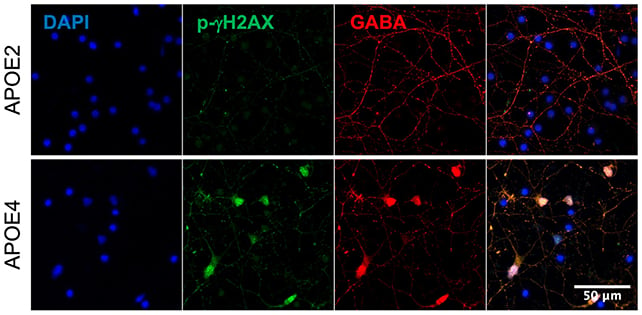
Crucially, they found APOE2 appears to help keep the DNA inside neurons intact and protected against damage from the biological weathering that can come with age and stress on the body.
Understanding these mechanisms more fully could eventually lead to new ways to tackle the onset of dementia, or stop it from taking hold to begin with, the researchers suggest.
"Our work shows that APOE2 neurons are better at preventing and repairing DNA damage, and they resist the cellular aging program that drives so much of late-life decline," says chemist Lisa Ellerby, from the Buck Institute.
"Our findings point to entirely new therapeutic directions."
The APOE gene is best known for producing apolipoprotein E (APOE), which ferries cholesterol and fats throughout the body.
A significantly higher risk of Alzheimer's comes with the APOE4 version of the gene, while APOE2 carriers have a much lower risk.

Here, the team engineered human stem cells to carry APOE2, APOE3, or APOE4 alleles, then differentiated them into two types of brain cells, both of which are important in Alzheimer's: GABAergic neurons that calm the brain and glutamatergic neurons that excite it.
In lab tests, the APOE2 neurons collected less damage, with the excitatory types boosting emergency response and repair processes. These APOE2 neurons also showed greater resistance to senescence: a state in which cells stop functioning but don't die off, leading to inflammation and damage around them.
Studies have shown that senescence could play an important role in Alzheimer's disease, which makes this new discovery even more significant. In addition, the team found that treating APOE4 neurons with the APOE2 protein could help protect against damage, suggesting potential therapeutic options.
Follow-up tests on elderly mice brains engineered to express the APOE2, APOE3, or APOE4 genes backed up the findings in lab-grown neurons.
The APOE2 neurons in these experiments showed several similar signals associated with healthier brain aging, including stronger cell scaffolding.

"What surprised us was how consistent the picture was across two very different neuron types and across human cells and mouse brain tissue," says Cristian Gerónimo-Olvera, from the Buck Institute.
"APOE2 neurons aren't just less damaged at baseline, they recover faster when stressed."
The buildup of DNA damage and cellular senescence – the two main processes APOE2 appeared to protect against here – are vital cogs in a number of age-related diseases in the brain. If drugs can be developed to mimic the effects of APOE2, we could be looking at powerful new treatments.
That's still some way off, though. First, scientists need to establish the step-by-step mechanisms that explain how APOE2 confers these benefits on neurons – if we can understand them better, we can try and copy them.
It's also worth noting that the brain cells studied here were deliberately stressed with radiation and chemicals, which doesn't necessarily reflect the wear and tear of regular brain aging.
Related: Just One Gene May Be Responsible For Over 90% of Alzheimer's Cases
Ultimately, Alzheimer's is a complex disease that will most likely require complex treatments to beat it.
These findings offer another promising angle of attack, one that goes beyond the toxic accumulation of amyloid-beta and tau proteins in the brain, which is most commonly discussed in dementia treatment.
"Until now, the APOE field has focused largely on lipid handling and amyloid-beta biology," says Ellerby.
"By showing that APOE alleles also tune how neurons defend their genome, this study connects a major longevity gene to two of the most actively studied hallmarks of aging."
The research has been published in Aging Cell.