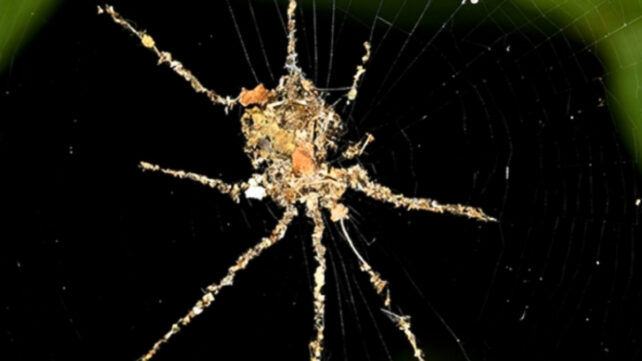
Some spiders build delicate little nets, others colossal web megacities, and now some in Peru and the Philippines have been found sculpting giant doppelgängers out of silk, prey carcasses, and debris.
This remarkable behavior has just been formally documented for the first time, based on a handful of discoveries dating back to 2012.
"They don't just decorate their webs – they meticulously arrange detritus, prey carcasses, and silk into a structure that's not only larger than their own body, but clearly resembles the silhouette of a bigger, menacing spider," says ecologist George Olah from Australian National University.
Related: Spider With No Venom Has a Deadly Trick to Poison Its Prey
And when something threatening approaches their web, the creative sculptors jiggle threads to make their creations move like a giant puppet spider.
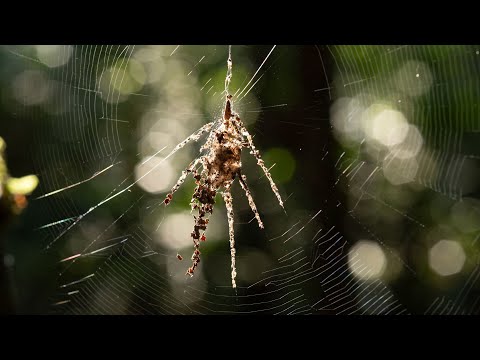
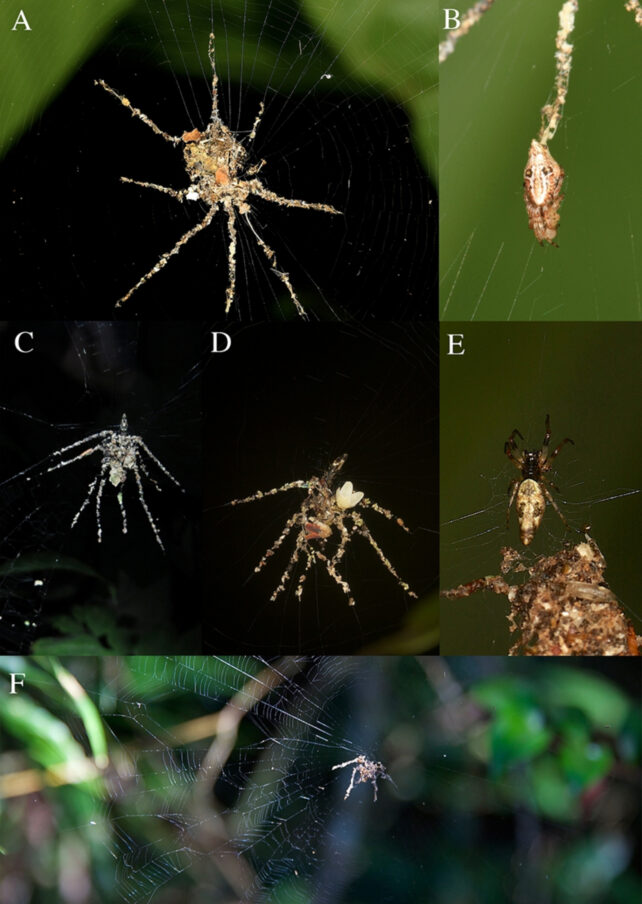
In Peru, these spider-like decoys, or stabilimenta, were often more than three times the length of their creators, who are only a few millimeters long, Olah and colleagues found. The orb weavers, Cyclosa longicauda, also added an average of five protruding 'legs' to the blob of their puppet's 'body'.
"Of the spiders we photographed, we found both males and females to be occupying stabilimentum-adorned webs," the researchers write in their paper.
"Some females had camouflaged egg sacs and occasionally, spiderlings, hidden among the debris of the stabilimentum."
Helicopter damselflies specialize in preying on web-building spiders, like the little orb weavers. This predatory flyer is known to avoid larger spider species, so Olah and team suspect giant spider puppeteering may have evolved to deter the damselflies.
Future studies comparing the survival rates of spiders with and without their doppelgängers are required to confirm this.
The decoy may also deter other predators, from birds to lizards, and serve to divert predatory attention away from its fragile eight-legged creator, the researchers speculate.
They have yet to capture and ID the species they observed building decoys in the Philippines.

"Unlike many orb-weavers that build a physical retreat to hide, these Cyclosa species appear to invest their time and resources into building an expendable visual defense instead," explains University of Florida entomologist Lawrence Reeves.
"This behavior is not just a quirky biological observation; it illustrates a fundamental evolutionary trade-off in the spider world."
This research was published in Ecology and Evolution.