Blood Falls is already one of the strangest landmarks in the world.
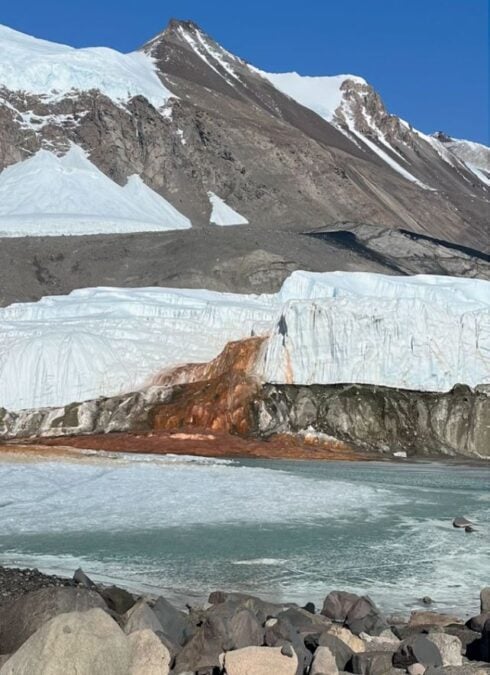
Against the gleaming white backdrop of Antarctica's Taylor Glacier, a vivid vermilion cascade tumbles into Lake Bonney, staining the pure ice as it falls.
The blood-red hue comes from iron that has spent an eon dissolved in the salty brine trapped beneath Taylor Glacier, suddenly and dramatically rusting when it gushes into the open air.
The coloration isn't caused by algae, as scientists initially suspected. But there does appear to be life in the ancient reservoir – as a new paper in Nature Geoscience reveals – and it's stranger than even Blood Falls itself.
The new study, led by microbiologist Angela Zoumplis of the University of California, San Diego, has revealed that a rich community of microorganisms appears to be thriving around the ancient brine system beneath the glacier – the descendants of a marine community that may have been isolated from the rest of the world for millions of years.
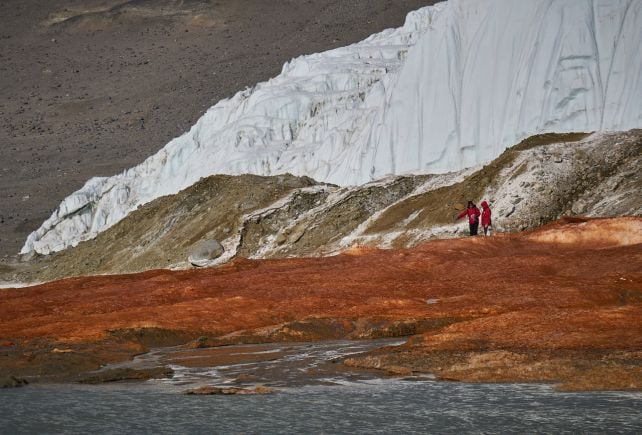
Blood Falls has captivated scientists ever since British-born Australian geologist Thomas Griffith Taylor stumbled across it during an expedition in 1911.
Initially, scientists thought that the sanguine stain was due to algae, much like the pink snow sometimes found at high altitudes and in polar regions.
Instead, researchers eventually discovered that the 'blood' comes from an ancient reservoir of hypersaline water trapped beneath Taylor Glacier. Because the freezing point of brine is lower than that of water, it remained liquid even while encased in a tomb of ice.
The brine is rich in dissolved iron, which remains invisible while sealed away beneath the ice, formed when ancient seawater became trapped beneath the advancing glacier, where it has remained for at least 1.5 million years.
Only when the brine reaches the surface and meets oxygen does the iron rapidly oxidize, turning the outflow a deep rusty red.
Blood Falls is already known to host a remarkable microbial ecosystem. But while scientists have spent years studying its bacteria and archaea – the simple, single-celled organisms known collectively as prokaryotes – much less attention has been paid to its eukaryotic microbes.
Unlike bacteria, eukaryotic organisms – from single-celled amoebae to multicellular humans and plants – possess nuclei and the complex internal machinery.
Eukaryotes also include microscopic diatoms, photosynthetic protists usually confined to fresh or saltwater, whose presence can preserve clues about ancient environments.
Zoumplis and her colleagues wanted to know whether previous surveys had overlooked the eukaryotic inhabitants of Blood Falls – and whether these overlooked microbes might reveal something new about the history of the brine reservoir trapped beneath the glacier.
They collected 167 samples from around Blood Falls, the McMurdo Dry Valley region, and the surrounding marine environments, including the blood-red flow itself, but also from the sediment, ice, and mud.
Then, they analyzed environmental RNA, allowing them to distinguish organisms that were actively living in the brine system from those represented only by lingering genetic traces (in the form of DNA).
Rather than finding a handful of stray organisms blown and washed in from elsewhere, the researchers uncovered a distinctive community of eukaryotic microbes centered around Blood Falls itself.
Many belonged to groups more commonly associated with the ocean, including diatoms, dinoflagellates, haptophytes, and ciliates.
Even more remarkably, their RNA showed that these organisms were transcriptionally active – carrying out the normal business of life beneath the glacier.
Marine microorganisms can be carried inland by the wind, so the team looked for signs that these species had simply drifted in from the coast.
That wasn't what they found.
The marine eukaryotes were concentrated around Blood Falls rather than scattered across the Dry Valleys, and many differed genetically from their modern marine relatives in ways consistent with long isolation.
This painstaking puzzle-piecing paid off.
The results suggest that Blood Falls may preserve the descendants of a marine community that became trapped beneath Taylor Glacier when ancient seawater flooded the valley long ago, surviving as Antarctica transformed from a much warmer landscape into the frozen continent we know today.
Exactly how these lineages endured remains an open question.
When the ancient seawater first became trapped beneath Taylor Glacier, Antarctica was a very different place. Over the intervening millions of years, the continent became colder, drier, and increasingly buried beneath trillions of tons of ice.
Yet somehow, descendants of that ancient marine community appear to have weathered the transformation.
The researchers think the hypersaline brine itself may have acted as a refuge. Salt lowers water's freezing point, allowing pockets of liquid water to persist beneath the glacier even as the surrounding landscape froze; indeed, some of the organisms show adaptations for living with salinity.

Some organisms may also have survived long periods in dormant states before waking back to life when conditions allowed.
Together, those strategies may have allowed an ancient marine community to persist while Antarctica itself changed almost beyond recognition.
Related: Antarctica's Blood Falls Hides a Hidden World That's Never Seen The Sun
If the team's interpretation is correct, Blood Falls preserves something extraordinarily rare: the living descendants of an ecosystem that predates the modern Antarctic ice sheet and has spent many millennia in an unchanging environment.
That means that, rather than reconstructing that vanished world from rocks or fossils alone, scientists may be able to study organisms whose ancestors actually lived there.
"In highlighting this area as a unique refuge of ancient lineages," the researchers write, "this study establishes a foundation for future work on how relict ecosystems illuminate past environmental change and future polar vulnerability."
The findings have been published in Nature Geoscience.
This article was fact-checked and edited by Clare Watson. While we pride ourselves on our process, we are only human. If you spot a mistake, please let us know.