The Classic Maya period, from around 250-900 CE, is seen as something of a golden age for the civilization.
During that time, the Maya people made huge leaps forward in terms of architecture, city-building, art, writing, mathematics, and astronomy.
However, in those last two disciplines, scientists have been unable to identify individual scholars who made a difference during this time – until now.
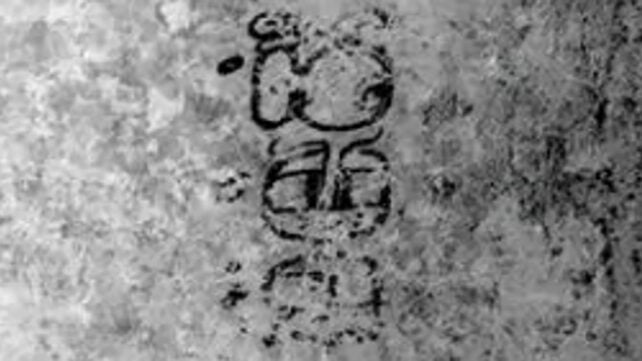
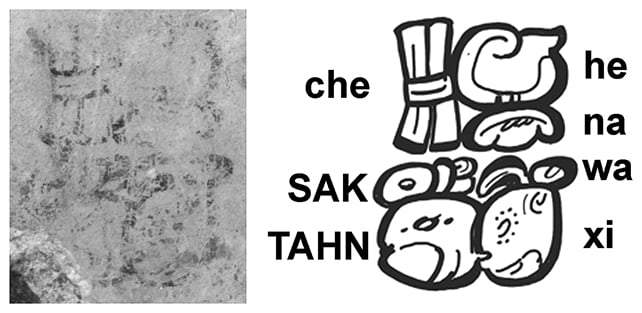
A team of researchers from the US, writing in the journal Antiquity, has identified someone called Sak Tahn Waax, which translates as 'White-chested Fox'. The name of this Indigenous mathematician-astronomer was left alongside a rather impressive mathematical formula.
It's the first time a specific piece of work in mathematics or astronomy from the Classic Maya period has been attributed to a specific individual.
"While artists' and sculptors' signatures for painted ceramic vessels and carved monuments have been identified, the scholars behind computational timekeeping have remained anonymous," says archaeologist Franco Rossi, from MIT.
The finding comes from the Xultun archaeological site in Guatemala. In one of the small buildings there, the researchers discovered more than 50 mathematical and astronomical 'microtexts' – short inscriptions listing dates, numbers, and calculations.
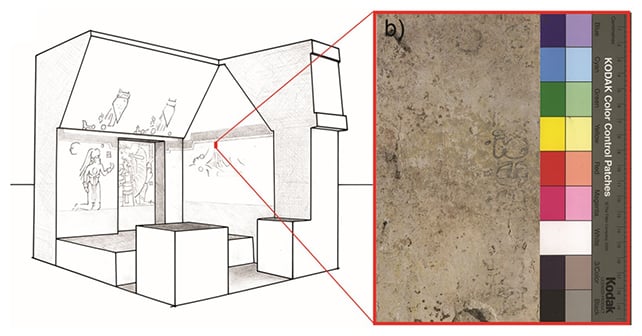
When one of these texts was deciphered, using a combination of drawing, photography, and digitally enhanced images, it was discovered that it not only contained a mathematical formula but also credited the person responsible for it.
The formula itself is unique in Maya texts, the researchers say.
It rather cleverly plots the movement of Venus and other planetary bodies in a way that had no precedent at the time, though the astronomical and calendrical units used in it are familiar.
"The math involves his unique understanding of connections and patterns between several cycles of time, including the 260-day ritual day-count, the solar year, as well as the cycles of Venus and Mars," says Mayanist David Stuart, from the University of Texas at Austin.
And these calculations would have mattered: in the Classic Maya period, dates corresponding to the movement of celestial bodies would've been used to schedule royal events and plan building projects.
Some 16 years after this particular room at the Xultun site was discovered, researchers now have a special and unprecedented discovery to take away from it – based on the scribblings and inscriptions on the walls.
"These 'rough draft' calculations and tables are akin to finding an early version of a well-known manuscript, or a sketch of a great artwork," says archaeologist Heather Hurst, from Skidmore College.
"This fills out an important dimension of Classic Maya life that had typically been reconstructed through ethnohistories and Spanish accounts written centuries later."
Given the uniqueness of the formula, the academic behind it may have been keen to get recognition for it, the researchers suggest, which may be why the name was left.

Work is now continuing to analyze the dozens of other microtexts at the same site, some of which may also be the work of the newly identified Sak Tahn Waax.
Correlations can now be drawn to other writings both in terms of the style of the text used and the characteristics of the calculations.
The discovery sits alongside many other incredible Maya works in the fields of astronomy and mathematics – including maps of the Universe and charts of solar eclipses.
This was a civilization that knew its numbers well.
As well as telling us more about the people who made a difference during this fascinating period in Classic Maya history, the discovery also helps historians put the Maya civilization in context with the other nations and empires of the time.
Related: The Maya Blessed Their Ballcourts With Rituals Using Psychedelic Plants
"Contemporaries of the ancient world in India, Iraq, China, and Greece were similarly calculating solar and planetary cycles, predicting eclipses, and charting star progressions, their achievements often ascribed to individual thinkers," says Rossi.
"We can now add Sak Tahn Waax to such thinkers, highlighting the great Indigenous astronomy and calendrical traditions of the Americas."
The research has been published in Antiquity.
This article was fact-checked and edited by Rebecca Dyer. While we pride ourselves on our process, we are only human. If you spot a mistake, please let us know.