Scientists have compiled the first global map of fault ridges in the Moon's maria, revealing that lunar tectonic activity across these dark basalt plains is far more widespread than previously thought.
Not only that, some of the ridges have been dated to just a few tens of millions of years old – relatively recent, in geological terms. It's the clearest picture yet of how the Moon as a whole is still slowly shrinking, wrinkling up its surface like a drying-out old apple.
The findings suggest that the Moon's dark basalt plains – prime targets for future missions and potential long-term bases – are not geologically quiet after all.
"Since the Apollo era, we've known about the prevalence of lobate scarps throughout the lunar highlands, but this is the first time scientists have documented the widespread prevalence of similar features throughout the lunar mare," says geologist Cole Nypaver of the Smithsonian Institution's Center for Earth and Planetary Studies in the US.
"This work helps us gain a globally complete perspective on recent lunar tectonism on the Moon, which will lead to a greater understanding of its interior and its thermal and seismic history, and the potential for future moonquakes."
Previous studies had identified similar ridges in isolated regions, but this is the first time they've been mapped globally and analyzed as part of a unified contraction system.
The Moon doesn't have tectonic plates that move around like Earth's, but it does have its own internal activity. After it formed around 4.5 billion years ago, it was a hot, gooey ball of molten material that has been slowly cooling ever since.

Evidence of this can be found in surface features called lobate scarps, ridge-like formations with which the rocky lunar highlands are riddled. But these features are not the only manifestation of the Moon's gradual shrinkage.
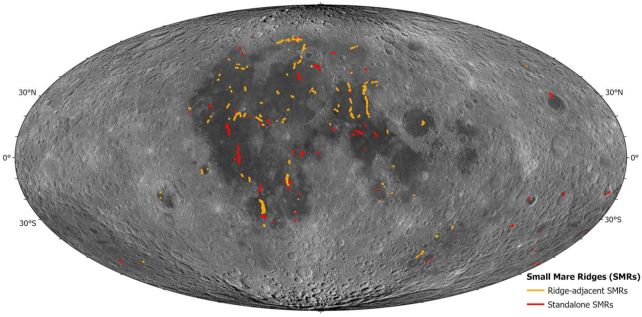
On the lunar maria – large, flat, black plains of volcanic basalt – the Moon is also wrinkling. These features are known as small mare ridges, or SMRs, compressional tectonic features formed by shallow thrust faults in the dark mare basalts.
These appear to have formed around the same timeframe as the lobate scarps, but their distribution and relationship to the Moon's ongoing contraction had not been established. This is what Nypaver and his team set out to do.
Using high-resolution images from NASA's Lunar Reconnaissance Orbiter, the team mapped 1,114 previously undocumented SMR segments on the Moon's near side. Combined with earlier surveys, that brings the global total to 2,634 SMR segments across both near and far hemispheres of the Moon.

Next, the researchers painstakingly figured out how long ago the ridges formed. The ridges can't be dated directly, but the surrounding area provides a reliable timeline: When these faults slip, they trigger moonquakes strong enough to erase tiny impact craters nearby. By counting how many small craters remain, scientists can estimate when the fault last moved.
Using this method, the researchers determined that the SMRs formed between approximately 310 and 50 million years ago, with the youngest being about 52 million years old. The average age was around 124 million years, very close to the average age of 105 million years for the lobate scarps.
To quantify the Moon's contraction, the team also modeled the geometry of the faults, estimating their dip beneath the surface and the amount of slip. From those measurements, they calculated that the lunar maria have shrunk by roughly 0.003 to 0.004 percent – a tiny fraction, but comparable to the amount of contraction previously measured in the highlands.
That similarity suggests the same global stresses are shaping both terrains. The Moon's shrinkage has left its mark on both the rocky highlands and the smooth, dark volcanic plains.
Related: It's Official: Scientists Confirmed What Is Inside Our Moon
"Our detection of young, small ridges in the maria, and our discovery of their cause, completes a global picture of a dynamic, contracting moon," says geologist Tom Watters of the Center for Earth and Planetary Studies.
The findings dramatically expand the inventory of possible seismic sources on the Moon, broadening our toolkit for understanding the Moon's ongoing evolution.
"The widespread presence of recently or currently seismically active tectonic features across the maria provides new opportunities for future lunar missions and investigations," the researchers write in their paper.
"The distribution of SMRs may also be of relevance to any long-term lunar habitation due to the hazards that shallow moonquakes pose to human-made lunar infrastructure."
The research has been published in The Planetary Science Journal.