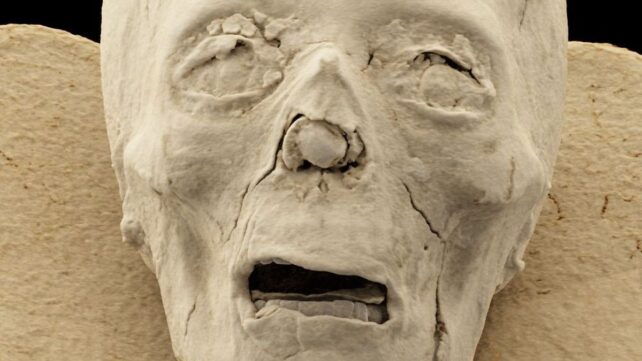
Using medical technology designed for the living, scientists are peeling back the secrets of the dead.
Studying the mummified remains of ancient Egyptians who lived and died long ago was once a process that couldn't guarantee the bodies would emerge intact.
Now, hospital-grade imaging technology means that what's inside those ancient wrappings can be laid bare, layer by layer, without dislodging a single linen thread.
When the Hungarian National Museum Public Collection Center's Semmelweis Museum of Medical History in Budapest was founded in 1965, it obtained a number of ancient Egyptian mummies – the innermost mysteries of which researchers now hope to uncover, using high-resolution CT scanning.
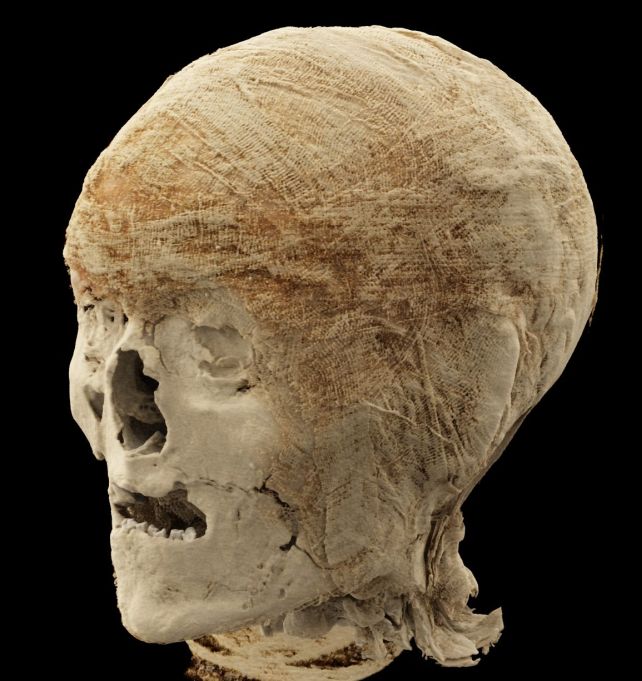
"The aim of the examinations is to obtain as accurate a picture as possible of the internal structure of the remains, any abnormalities, and the preservation techniques used," says chief clinical physician and radiologist Ibolyka Dudás of Semmelweis University's Medical Imaging Center.
CT, or computed tomography, scanning technology has done wonders for many fields of scientific research. It's a high-tech, high-resolution form of X-ray that uses rotating X-ray machines and a computer to construct detailed images of the internal contents of an object or living body in either two or three dimensions.
The medical benefits of this technology are well established and far-reaching, but scientists have also used it to perform non-destructive, non-invasive investigations of a variety of specimens, including ancient fossils, delicate insect brains, and even a meteorite that originated on Mars.
Now, Dudás and her colleagues are using the center's newest CT scanner – equipped with a state-of-the-art photon counting detector – to learn more about the museum's mysterious mummies.
"The remains had previously been examined by a research team," explains the museum collection's curator, Krisztina Scheffer, "but the current images provide a more detailed view than ever before and are expected to yield new, scientifically valid findings regarding the remains that have been preserved in the collection for decades."
Six of the museum's mummies have been carbon-dated, but only three returned reliable results. The oldest of these dates to between 401 and 259 BCE, but Egyptians had been deliberately mummifying their dead for several millennia before that.

Analyses of the scan data are underway and yet to be published, but other projects using CT scans to image equally precious remains have revealed much about the lives of our forebears.
Ancient Egyptian embalmers often tucked precious items into their wrappings, including coins and amulets, for instance.
Scans of other Egyptian mummies have revealed health problems, such as arthritis, and one study found a high rate of anemia in ancient Egyptian children.
CT scans of ancient remains can also reveal hidden cancers, and it took one CT study of pre-Columbian South American mummies to reveal a brutal massacre.
Initial analyses of the Semmelweis mummies suggest that the CT scans could help date some of the remains based on the mummification techniques used.
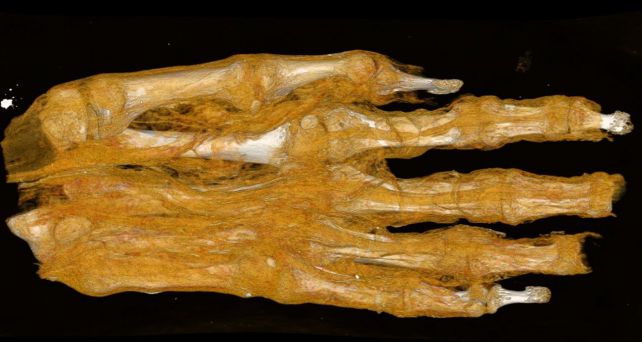
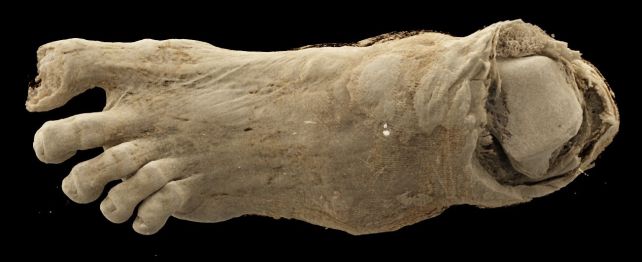
One specimen was particularly interesting – a bundle whose contents were impossible to identify from the outside. Researchers thought it might be a bird; the ancient Egyptians mummified many birds. Another possibility was a head – but the scans revealed it was actually a foot.
Related: Scientists Are 'Sniffing' Ancient Egyptian Mummies. Here's Why.
A scan of a different mummified foot also suggests that the individual suffered from osteoporosis. Other scans, the researchers hope, will help reveal more details about the individuals and the techniques used to preserve their bodies.
"Based on the results so far, it is evident that modern imaging technology opens up new perspectives in mummy research," Scheffer says.
"It can reveal information hidden in finds that are thousands of years old without damaging them."