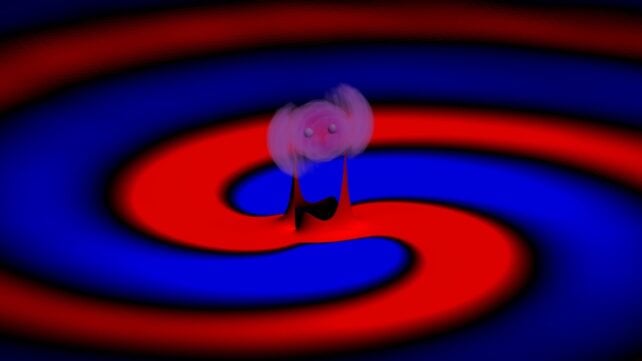
We may have accidentally detected dark matter back in 2019.
This potentially history-making discovery could be lurking in existing data from gravitational waves – ripples in the fabric of spacetime itself.
Physicists from the US, UK, and Europe propose that if two black holes happened to collide while enveloped in a cloud of dark matter, the gravitational waves they send across the cosmos could carry the imprint of that environment.
When they applied their model to dozens of gravitational wave detections, they found one event that potentially fits the bill.
It's far from a confirmation yet, but the team says it could lead to a new way to investigate both gravitational waves and dark matter.
"Using black holes to look for dark matter would be fantastic," says Rodrigo Vicente, a physicist at the University of Amsterdam.
"We would be able to probe dark matter at scales much smaller than ever before."
In 1916, Einstein published his general theory of relativity, which describes gravity as a product associated with the curvature of spacetime. Its predictions were later confirmed, one by one, through observations – but one niggling thing persisted for almost a century.
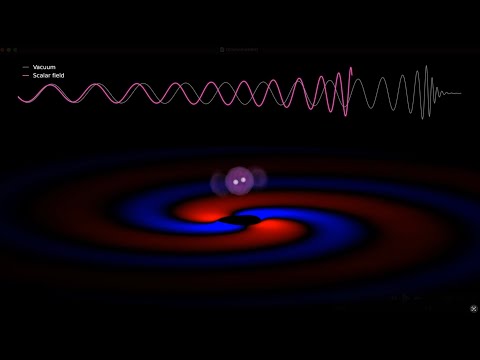
Einstein predicted that the motions of high mass objects – say, from black holes or neutron stars merging – could send ripples through spacetime at the speed of light.
It took until 2015 for these gravitational waves to finally be directly detected, and hundreds of events have been recorded in the decade since.
Each one is imprinted with information about the event itself, including the masses of the objects involved and, by extension, their identities.
Usually it's mergers between black holes of different sizes, pairs of neutron stars colliding, or black holes swallowing up stellar remnants. Others may hint at more exotic objects, like wormholes to parallel Universes.
The researchers behind the new study wondered if other information could be hiding in gravitational wave signals.
Specifically, could they help us solve another long-standing mystery: that of dark matter, the strange stuff predicted to pervade the Universe and interacting with regular matter only through its gravitational influence.
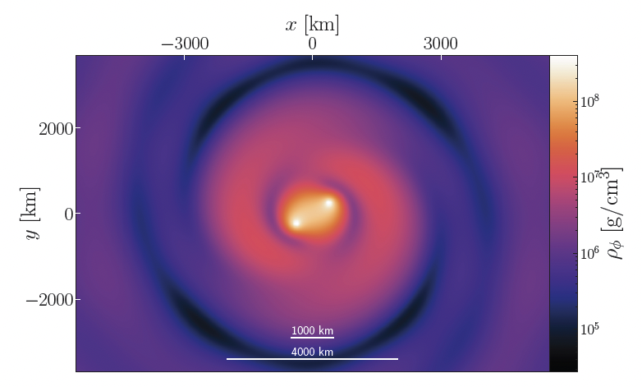
(Roy et al., Phys. Rev. Lett., 2026)
One model describes dark matter as being made up of ultralight particles. These particles could form a field and behave collectively as a wave in extreme environments – say, near the intense gravity of black holes.
Spinning black holes are already known to drag spacetime itself around, so it's not much of a stretch to suggest that this rotational energy could also affect clouds of dark matter around it.
In turn, these clouds should change the dynamics of binary black holes as they smash into each other – and this should imprint specific signatures into the gravitational waves they emit, the researchers say.
The team modeled what effect this phenomenon would have on gravitational wave signals by the time they reached our Earthly detectors, and compared them to mergers that occur in an environment without a big cloud of dark matter hanging over it.
Finally, they applied their model to 28 detections made by the LVK network of gravitational wave observatories: LIGO in the United States, Virgo in Italy, and KAGRA in Japan. Of those, 27 signals showed patterns for having originated in a vacuum.
But one event, detected in July 2019 and designated GW190728, showed a pattern consistent with a pair of black holes merging within a dense dark matter cloud.

It's definitely an intriguing result, but the researchers caution against drawing any strong conclusions just yet.
"The statistical significance of this is not high enough to claim a detection of dark matter, and further checks should be performed by independent groups," says physicist Josu Aurrekoetxea from MIT.
"What we think is important to highlight is that without waveform models like ours, we could be detecting black hole mergers in dark matter environments, but systematically classifying them as having occurred in vacuum."
Related: Wild New Theory Suggests Gravitational Waves Shaped The Universe
Of course, we still don't even know what form dark matter takes – it might not even form clouds like this. Maybe dark matter is WIMPy or MACHO; it may be self-interacting or inert; it may interact with electromagnetism; it may even be tiny, primordial black holes.
Or there's always the chance that it doesn't exist at all, and our models of gravity need modifying.
It'll take a lot more work to shed light on dark matter.
The new research was published in the journal Physical Review Letters.