Heading to the dentist for work on cavities isn't the most pleasant childhood experience – even if it's for the best when it comes to oral health and hygiene.
But what if there was a way to stop serious tooth decay without drilling or anesthetic?
That's the premise of silver diamine fluoride (SDF), a liquid that's painted over cavities and essentially stops tooth decay in its tracks. It kills off bacteria, while strengthening the remaining parts of the tooth.
While SDF isn't new, it hasn't yet been granted FDA approval for use by dentists on kids in the US – something that may be about to change after a successful clinical trial involving 830 children under the age of 6, who all had severe cavities.
Run by researchers from institutions across the US, the trial results have now been published in JAMA Pediatrics.
"If we want more children and families to benefit from this treatment, we need rigorous evidence showing both that it works and that it's safe," says Margherita Fontana, a dentistry researcher at the University of Michigan.
Six months after one SDF application, tooth decay was stopped in more than half of the children's baby teeth that were treated.
"From a public health perspective, if we want broader implementation across the United States, including in medical settings, we need carefully collected data in US populations, and we now have that," explains Fontana.
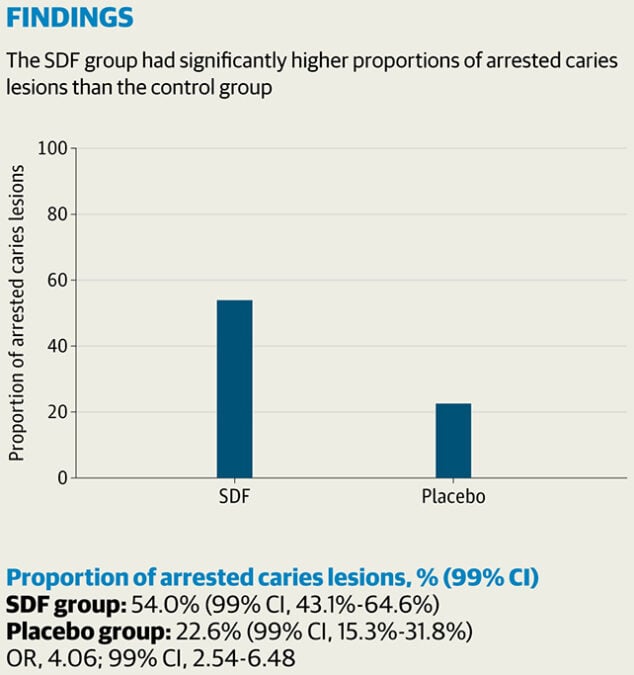
The study got underway in 2018, and covered three sites in the US. SDF was put up against a placebo treatment – with SDF arresting tooth decay in 54 percent of cavities, compared to 22.5 percent for placebo, at follow-up six months post-treatment.
"This is a very effective and safe treatment – even in children as young as one." – dentistry researcher Margherita Fontana
There were no differences in tooth pain between the groups, and mostly mild–moderate side effects that may not have been directly linked (including sore throats).
The treatment only takes about 10 seconds to apply, with perhaps the biggest drawback being that it covers the affected tooth with a permanent dark stain.
"For almost anyone, this can arrest the decay and stop the infection and the pain it causes," says Fontana.
"This could benefit many people."
The treatment has been FDA-cleared for off-label use for treating tooth sensitivity in adults in the US, but there's a higher safety bar for children.
While the results of the trial don't guarantee regulatory approval, it's strong evidence in favor of SDF.
"This is a very effective and safe treatment – even in children as young as one," says Fontana.
There is another reason the team wants SDF to become more widely available for treating childhood decay: to help address the lack of access to dental care in our most vulnerable populations.
The researchers note in their paper that "many children – especially those in underserved communities – have limited access to dental care, but more frequent interactions with medical professionals."
Because SDF is quick and noninvasive, they suggest it may be feasible to use in primary-care settings as well as dental clinics. But that would require clinicians to be trained to identify suitable cavities and to have clear pathways for referring children to dentists.
"In medicine, clinicians want high-quality evidence before changing practice," says Fontana.
"It is important to have data they can refer to because young children often see pediatricians years before they ever visit a dentist."

The trial only tested SDF on baby teeth in children aged 1 to 6. So it cannot tell us whether SDF should replace fillings or other restorative treatment for cavities in permanent adult teeth.
"Our results support FDA approval of SDF for managing arrest of tooth decay in young children," says Amr Moursi, a pediatric dentistry researcher at New York University.
"Removing SDF from off-label status would be an important innovation which could lead to increased utilization by providers, enhanced payments by insurers, and more consistent product quality."
The stats on tooth decay in the US don't make for particularly good reading. More than 1 in 10 kids aged 2–5 have at least one cavity in their baby teeth, while for ages 6–8 that increases to almost 1 in 5 children.
Severe early childhood caries can cause pain, infection, and tooth loss, and affect nutrition and quality of life. For some children with severe decay, conventional treatments can require general anesthesia, and the researchers note that waits for hospital-based dental procedures can be prolonged.
A treatment capable of arresting some cavities quickly and without drilling could therefore be especially useful while children move through the dental-care system.
Related: This New Treatment Could Heal Tooth Cavities Without Any Fillings
"Broader acceptance could allow many more cavities to be treated while a referral to a dental home is successful, and before they become painful, infected, or require surgery," explains Fontana.
The research has been published in JAMA Pediatrics.
This article was fact-checked by Rachel Garner and edited by Rebecca Dyer. While we pride ourselves on our process, we are only human. If you spot a mistake, please let us know.