Fusion power aims to provide a revolutionary energy source, but achieving it remains perennially around the technological corner.
Who knew that harnessing the same basic process that powers the Sun would be so tricky?
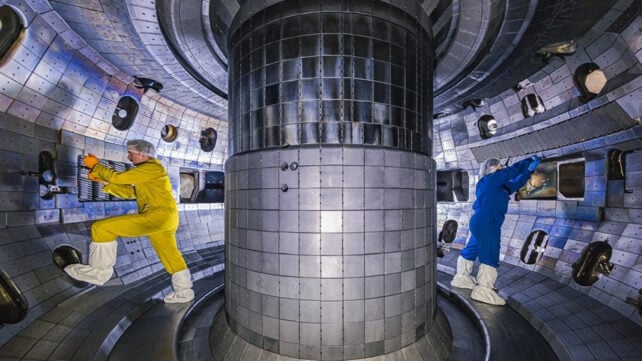
Currently, many experimental fusion reactors are of the mouthwatering 'doughnut' shape, called a tokamak. Or, according to its Russian acronym etymology, a toroidal chamber and magnetic coil.
In looser, more exciting terms, a tokamak is like a miniature star on Earth.
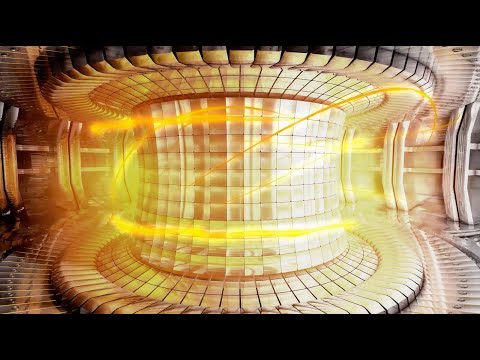
A tokamak uses intense magnetic fields to heat plasma to 150 million degrees Celsius (270 million degrees Fahrenheit), about ten times the temperature at the core of the Sun, causing heavy hydrogen isotopes to fuse and release immense energy.
That's the goal, anyway, but it's fraught with difficulties.
For example, one integral issue is the turbulence that forms in this astronomically hot plasma, causing it to lose heat.
Or so it was thought, but the relationship between instability and turbulence is turning out to be more complicated, which may flip this supposition on its doughnut-shaped head.
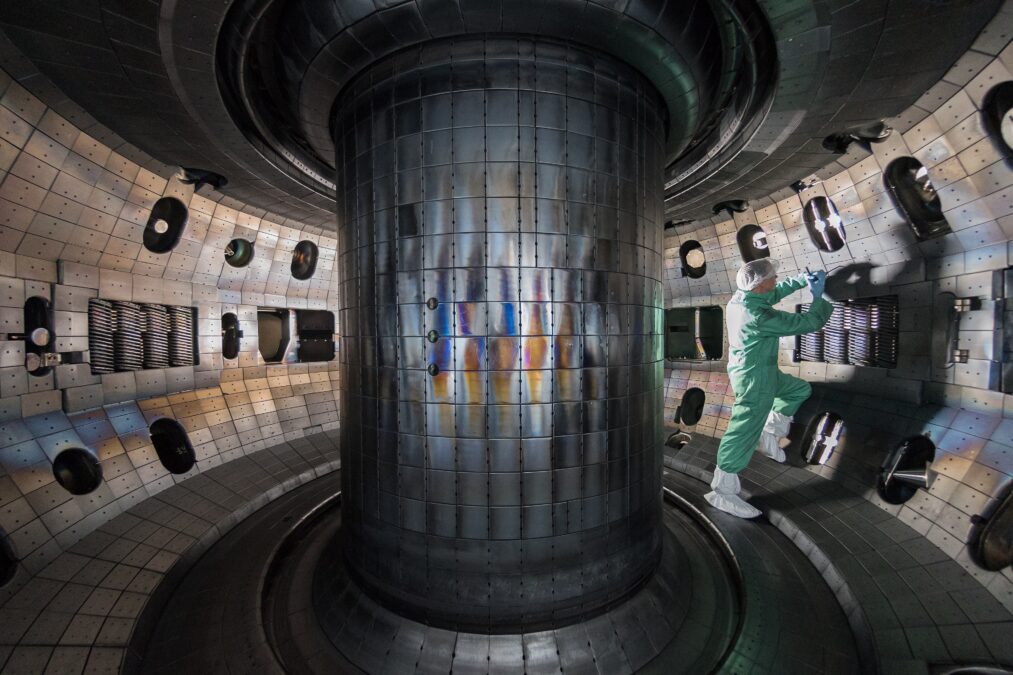

In a paper recently published in Physical Review Letters, researchers used North America's largest operating tokamak, the DIII-D National Fusion Facility in San Diego, California, to provide the first experimental evidence that a type of plasma instability may actually improve the performance of fusion reactors.
Specifically, the researchers provided evidence that electric currents driven by Alfvén eigenmodes (AEs), or plasma waves, facilitate a self-regulating effect that stops turbulence in its tracks.
AEs have generally been considered a hindrance to fusion performance because they can degrade the containment of energetic particles.
But, supported by theories and simulations, the researchers demonstrate that AEs may also drive plasma flows and electromagnetic currents that create shear flow.
This shear flow suppresses plasma turbulence within the tokamak, increasing the temperature of electrons and ions (charged atomic nuclei) to create more fusion-conducive conditions.
This, in turn, reduces thermal transport, which may sound bad but is actually the opposite. In practical terms, reduced transport means more heat stays confined in the plasma core, rather than leaking outward, increasing fusion potential.

The researchers used a nuclear-fusion diagnostic tool called the Motional Stark Effect (MSE) to determine magnetic changes occurring inside the tokamak.
In the DIII-D tokamak, MSE works by shooting a beam of neutral deuterium atoms into the plasma and then measuring how the plasma's shifting magnetic field alters the polarization of the emitted light.
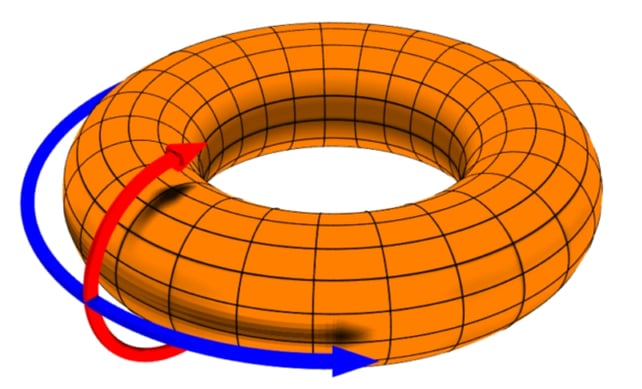
This MSE revealed a change in an aspect called the safety factor, a measure related to how magnetic field lines travel around the inner confinement area's long (toroidal) dimension and its short (poloidal) dimension – imagine one of those spiral 'tornado potatoes' suspended on a stick.
As per the structural integrity of said potato, these lines form a helical structure that traps the plasma, and the safety factor is one of the quantities physicists use when analyzing stability as it spirals around the hundred-million-degree doughnut (yes, nuclear physics is wild).

Accordingly, the researchers measured a 5 percent change in the safety factor across 20 milliseconds, which they interpret as evidence of AE-driven zonal currents and say is consistent with "rough estimates."
Overall, the result is counterintuitive: The instabilities thought to disrupt fusion may actually self-regulate once a certain energy threshold is reached.
Related: Fusion Physicists Found a Way Around a Long-Standing Density Limit
Therefore, nuclear physicists now have experimental evidence that AE processes help generate the forces that actually rip apart turbulence, ostensibly helping the tokamak 'oven' get nice and toasty to facilitate fusion.
Being able to leverage such a self-regulating, turbulence-taming process, however, remains on the horizon – but what a bright horizon it appears to be.
This study was published in Physical Review Letters.
This article was fact-checked by Rebecca Dyer and edited by Rebecca Dyer. While we pride ourselves on our process, we are only human. If you spot a mistake, please let us know.