
For some people, rising from bed or completing daily tasks can feel like extricating oneself from quicksand or the grip of a coiling anaconda.
Those with chronic fatigue syndrome, sometimes known as myalgic encephalomyelitis (CFS/ME), suffer from symptoms like extreme and persistent exhaustion and cognitive issues, including 'brain fog'.
CFS/ME is an 'unambiguously biological' condition for which there is no known cause or cure.
Yet long-lasting, chronic fatigue is a hallmark of numerous other commonly debilitating illnesses, including long COVID, post-traumatic stress disorder (PTSD), rheumatoid arthritis (RA), and multiple sclerosis (MS).
Now, researchers from the University of East Anglia (UEA) and Oxford BioDynamics – a biotech company designing commercial diagnostic molecular tests – say they have revealed the underlying mechanisms shared by these five major illnesses.
These conditions have vastly different pathologies. Long COVID emerges from a viral infection (which is a possibility for CFS/ME too); PTSD results from traumatic experiences and has been linked to chronic inflammation, while RA and MS are considered autoimmune disorders caused by the body mistakenly breaking down its own tissues.
"But one thing that links them all is that patients frequently report remarkably similar symptoms – overwhelming fatigue, brain fog, poor concentration, disturbed sleep, autonomic dysfunction and a dramatic reduction in everyday functioning," explains Dmitry Pshezhetskiy, a clinician-scientist at UEA and the study's lead researcher.
"We wanted to find out why this is."
So Pshezhetskiy and colleagues curated data from existing genome-wide association studies (GWAS) encompassing thousands of cases across these five illnesses. GWAS look for links (associations) between genetic variants and disease at a population level.
Then the researchers turned to their EpiSwitch® platform, a set of machine learning algorithms developed by Oxford BioDynamics and previously used to develop a prototype blood test for CFS/ME – which raised both hope and skepticism when preliminary results were announced late last year.
This platform allowed the researchers to look beyond linear DNA sequences encoding individual genes and explore the genome's 3D architecture to see how spatially distinct genes interact, something that can be affected by the shape of chromosomes or epigenetic markings, for example.
"What we discovered is something approaching a biological unifying theory of fatigue," says Pshezhetskiy.
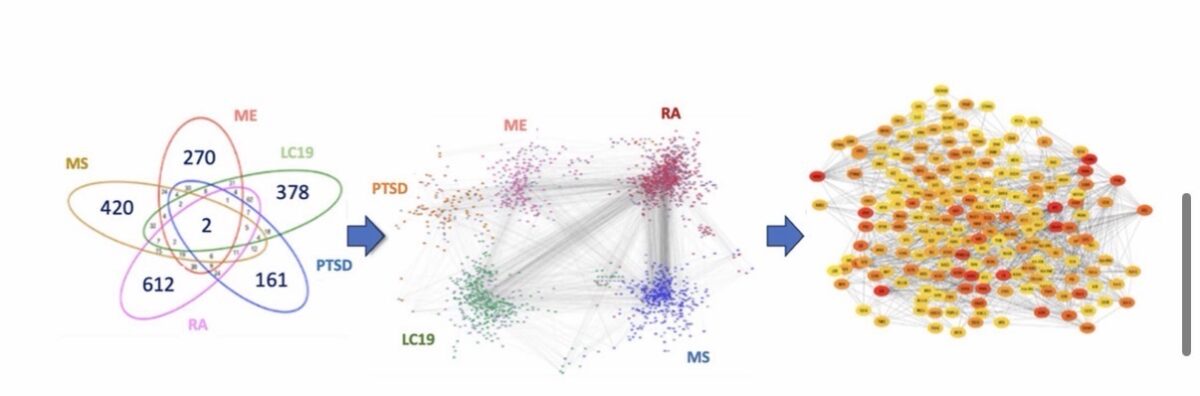
There was little direct overlap in the genes associated with each condition, but the illnesses appear to be deeply connected.
Like the confluence of streams, each carrying its sediments into a river, the genes linked to each of the five illnesses feed into the same biological networks.
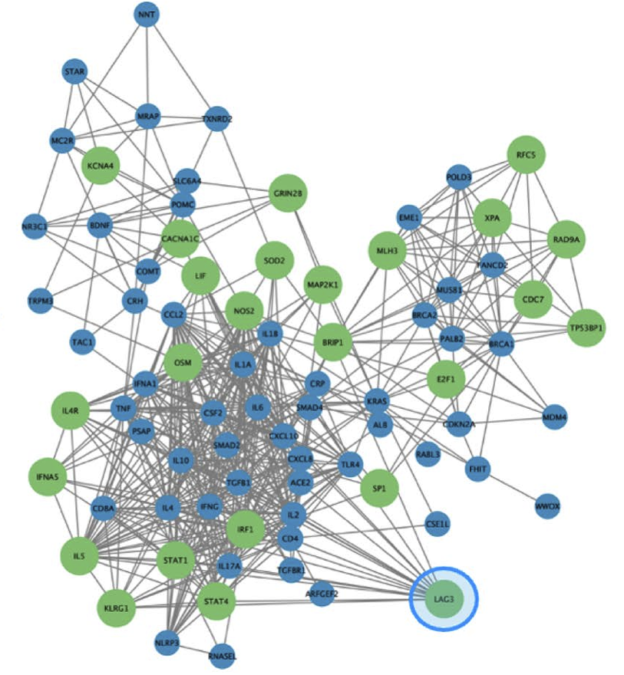
Through their network analysis, the researchers identified several highly influential 'hub' genes, located at the busiest points, or confluences, of these networks.
Further experimental and clinical validation is required to confirm their association to each illness, but we know these genes and pathways control major bodily functions.
They regulate life-shaping processes like immune and inflammatory responses, brain-mediated hormonal signaling, and mitochondrial energy production – processes that have been implicated in ME/CFS and long COVID before.
Importantly, many of these gene 'hubs' weren't previously identified as standout candidates in the GWAS data.
"This is not something you can see by reading the genetic sequence alone, which is why these conditions may have looked unrelated for so long," Pshezhetskiy notes.
"Although these conditions are triggered by completely different events, they may ultimately disrupt the same fundamental biological systems and produce the similarly devastating exhaustion experienced by millions worldwide."
Similar to other recent analyses of gene expression, the study highlighted immune cell exhaustion as a central mechanism potentially connecting these five conditions.
"These findings suggest a state of chronic immune activation followed by functional exhaustion, which may contribute to persistent symptoms," the researchers write in their paper.
Overall, they hope their findings, if validated, might pave the way towards diagnostics that use laboratory tests rather than more subjective means to assess CFS/ME and long COVID.
But there's a lot this study could still be missing: The known disease associations are from GWAS data, which capture only select populations and a tiny fraction of the functional genome (many regulatory elements hide in 'dark', non-coding regions of DNA).
However, the EpiSwitch® platform looks beyond linear DNA at the genome's 3D architecture. This is promising because it encompasses epigenetic modifications – molecular tags that can change how DNA is bundled up, altering gene expression.
These epigenetic markings are thought to reflect environmental exposures, including stress and infections, and although they aren't permanent, they can have long-lasting effects.

"We hope our work could pave the way for objective blood tests capable of identifying underlying biological signatures rather than relying solely on patient-reported symptoms," Pshezhetskiy says.
Further down the line, work like this could also guide the development of new therapies that might try to calm overactive immune cells or boost mitochondria's ability to produce energy, as a way to fight fatigue.
In the meantime, this work may inspire new thinking about specific conditions as manifestations of broader dysfunctions in biological networks.
Related: In a First, Chronic Fatigue Syndrome Linked to The Brain's Clearing System
"In that scenario, chronic exhaustion is not simply a symptom. It is the visible consequence of a deeper systems failure affecting immune function, metabolism, and stress-response pathways," concludes Pshezhetskiy.
"This study offers a framework for understanding how different triggers can converge to cause the exact same profound clinical exhaustion."
This research was published in the Journal of Translational Medicine.
This article was fact-checked by Clare Watson and edited by Clare Watson. While we pride ourselves on our process, we are only human. If you spot a mistake, please let us know.