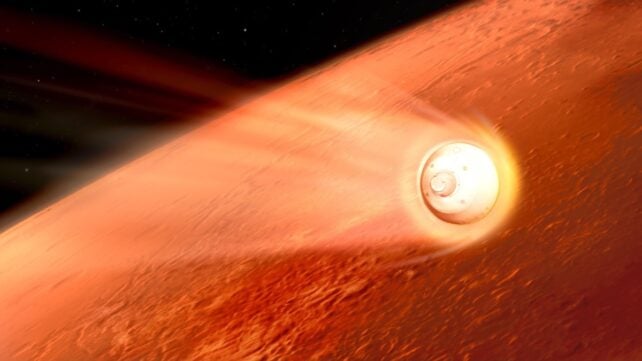
In space exploration, efficiency is key. And NASA has become so efficient that even its discarded hardware is performing valuable science.
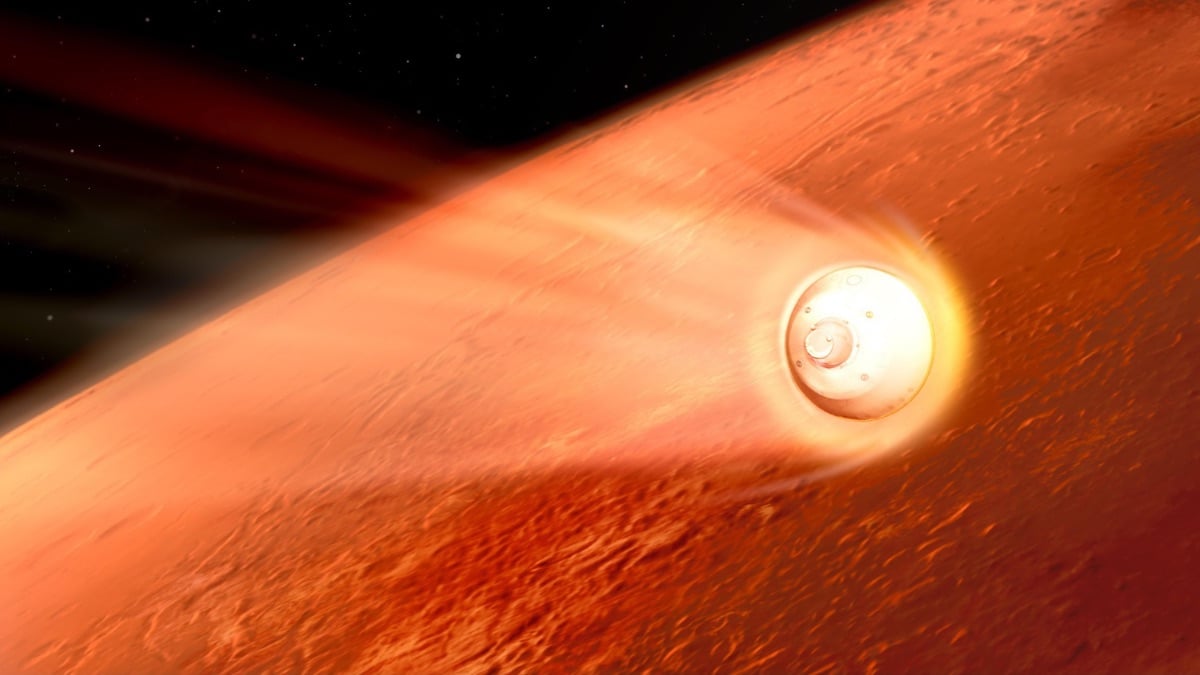
As the NASA Mars 2020 mission delivered the Perseverance rover to our planetary next-door neighbor, it also punched a number of holes into its dusty red skin.
When Percy's spacecraft was projected to be around 1,300 kilometers (nearly 800 miles) above Mars, smashing at a planet-relative velocity of 4.7 kilometers per second, the entry vehicle jettisoned two tungsten, 77-kilogram (170-pound) cruise ballast mass devices (CBMDs), which it carried to stabilize itself and our precious Percy.
These CBMDs, along with fragments from a cruise stage weighing nearly 540 kilograms, smacked into the Martian surface, as falling things are wont to do, creating five craters.
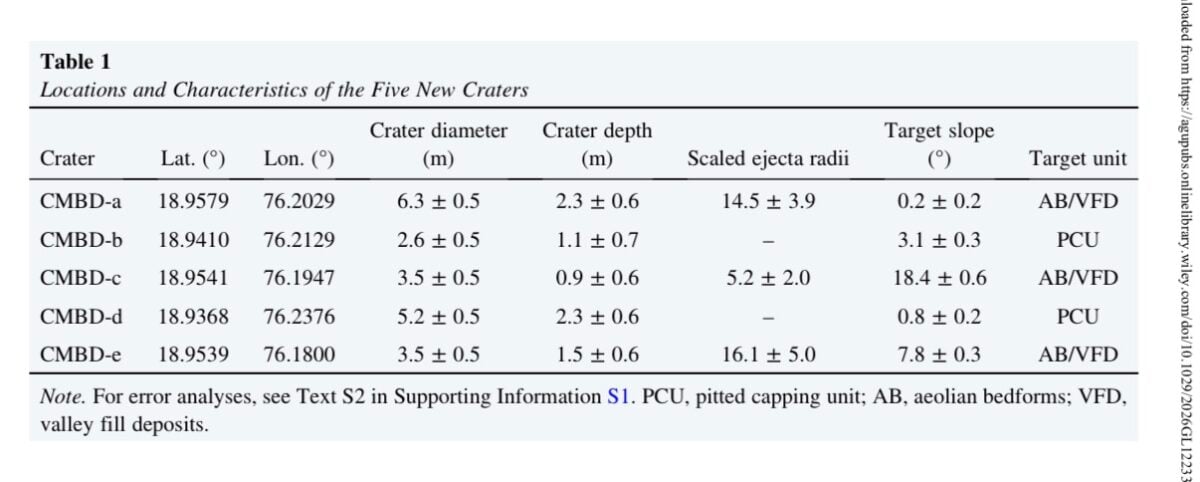
In a recently published study in the journal Geophysical Research Letters, engineers turned these human-made meteorites into spontaneous science, by using different models to analyze the Martian surface.
Craters made by space rocks have offered some previous evidence of how well Mars can take a punch. But they're less than empirically ideal because the space rocks' sizes, masses, and ballistics are generally unknown.
Fortunately, NASA scientists know the characteristics of their equipment to a high degree, since it's kind of their job to do so.
The researchers identified the five new craters using two cameras aboard the Mars Reconnaissance Orbiter, which has snapped a slew of spectacular shots from its orbital perch, including this century's "Face on Mars," an adorably smiley bear.
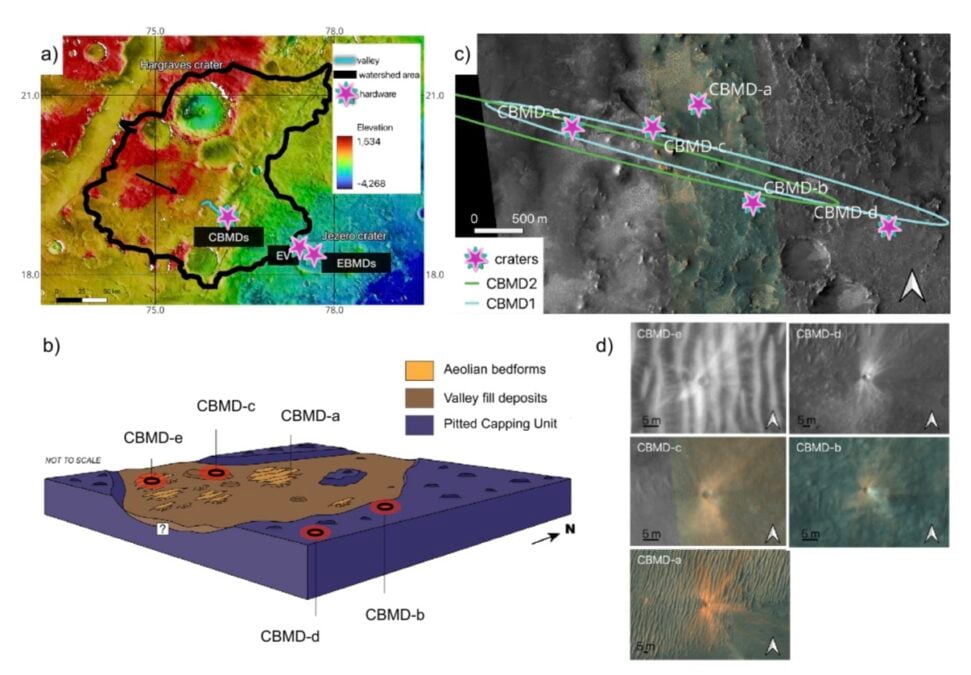
They could tell the craters were new because they were absent in pre-2020 images that include some of these locations. They also display telltale freshness and reflectivity patterns.
The impacting hardware hit the Martian surface about 70 kilometers northwest of the rim of Jezero crater, the (figuratively) hottest spot in the solar system at the moment for its multiple potential life signs.
The craters are upon a land of sinuous valleys that converge into the Jezero delta, a once-wet landscape that holds tantalizing evidence of Mars' habitability billions of years ago.
The CBMDs and cruise-stage fragments hit the ground at a shallow angle of 10 degrees, creating varied scars because they impacted different types of surface material, such as loose regolith.
Based on numerous factors, such as the simulated crash sites, the craters' sizes, and their ejecta, the researchers believe that craters CBMD-c and CBMD-e are the ones most likely to have been produced by the ballast; the other three resulted from the cruise-stage fragments.
"We find that the material is far weaker than predicted by standard crater-scaling laws, which overestimate crater size in this type of impact," the researchers explain.
In fact, as demonstrated in this work, those standard laws may be off by an order of magnitude when dealing with high-density objects, like spacecraft debris, impacting low-density surfaces at shallow angles.
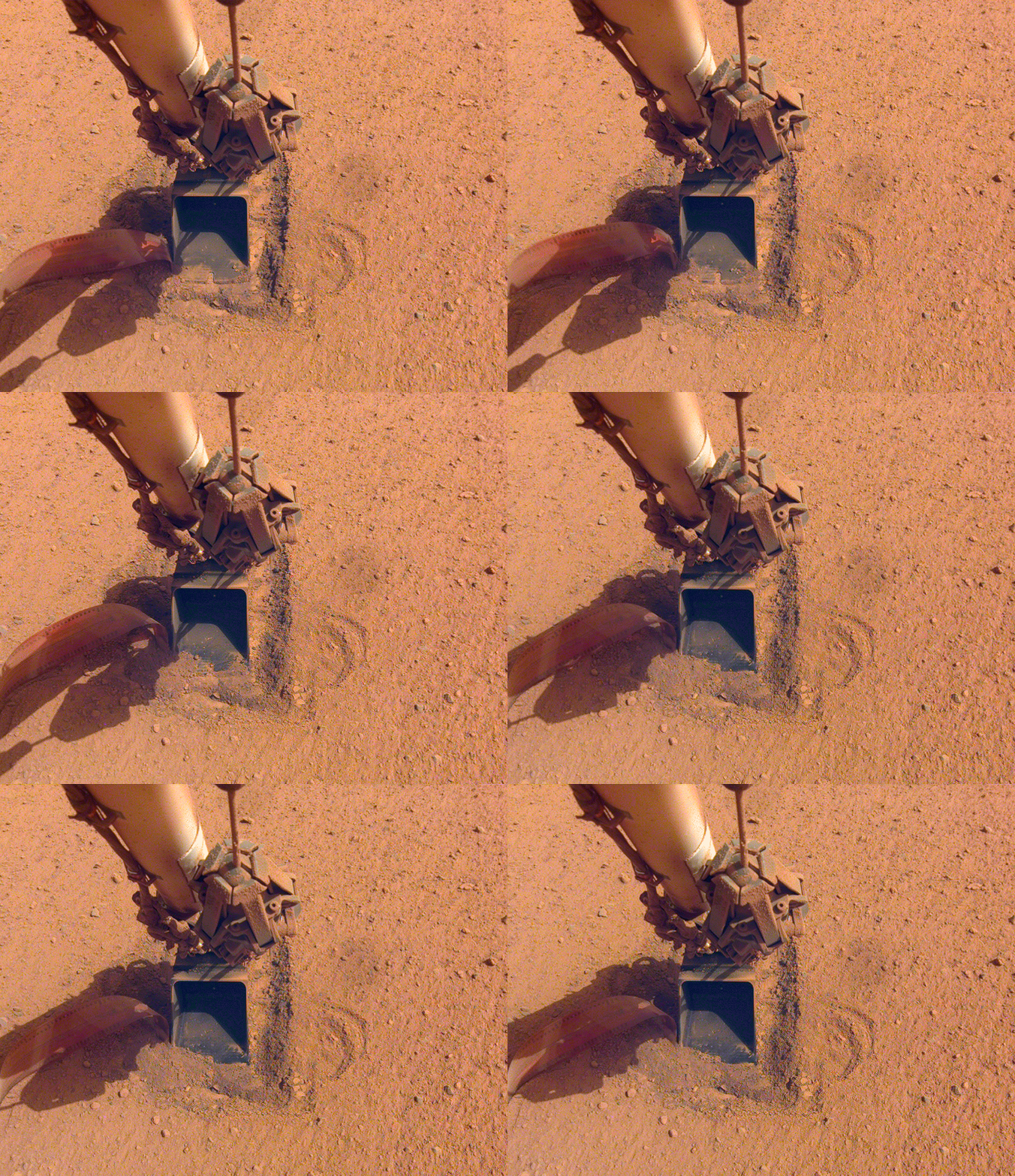
Subsequently, image analysis and 3D shock-physics modeling yielded a cohesion strength of around 7 kilopascals – a somewhat sandy material one could mash between their fingers – which is in agreement with previous findings from NASA's "mole" heat probe, the researchers note.
Overall, while one might imagine science as a delicate dance of flasks and meticulously pipetted droplets, some revealing experiments result from smashing things together.
In addition to terrestrial particle experiments that recreate the Big Bang's soupy sloshy-ness, outer space astrophysics is rife with rifle-like impacts, the researchers remind us.
These include the Hayabusa2 spacecraft that shot a cosmic bullet at asteroid Ryugu, and the potentially Earth-saving DART kinetic impactor that bullied an innocent moonlet into changing its (and its larger companion's) orbital path.
Most recently, a Falcon 9 rocket stage slammed into the Moon.

In the future, scientists may glean information from natural impactors that crash into Mars, if they can reverse-engineer their characteristics after observing their fireballs.
Related: NASA Found Strange Holes on Mars. Scientists Aren't Sure What Made Them.
Finally, this work increases the value of future missions, the researchers conclude, by repurposing their debris as impact experiments – in other words, let's pelt some planets. (Popcorn not included.)
This research was published in Geophysical Research Letters.
This article was fact-checked by Rebecca Dyer and edited by Rebecca Dyer. While we pride ourselves on our process, we are only human. If you spot a mistake, please let us know.