The Solar System's orbital do-si-do can get far more complicated than our classroom pictures might suggest.
We are all taught, for instance, that Earth has just one Moon, compared to the hundreds that orbit Saturn and Jupiter.
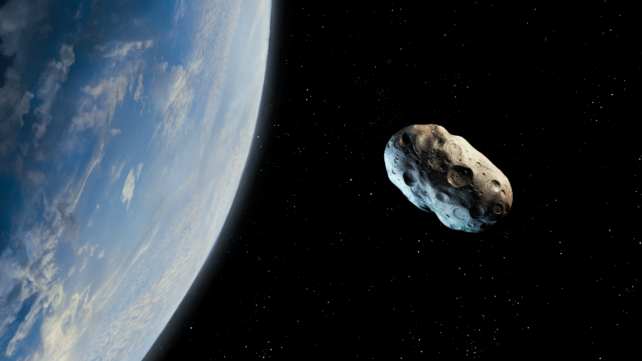
But that's not always the case. Sometimes, a smaller object can get temporarily caught up in Earth's gravitational net – a fleeting moonlet that hangs around for a few months before continuing on its way.
Our planet has just such a visitor right now.
Its name is 2026 QQ8 – a small rock just a few meters across. It slipped into Earth orbit in April of this year, but its stay will be a short one.
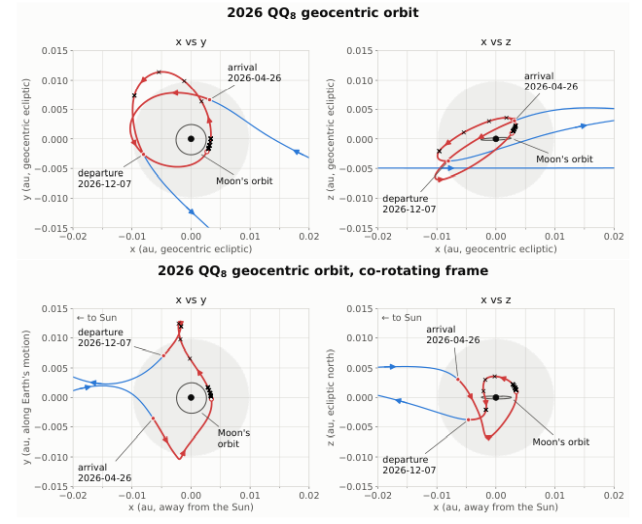
It is predicted to depart again on 7 December 2026 – but in its very brief time accompanying Earth, it has already given astronomers their first glimpse of a curious orbital configuration predicted nearly 150 years ago.
"Its unusual orbit lies close to the theoretical upper duration limit of an object captured in the Earth-Moon system, and has now been observed for the first time," writes a team led by astronomer Grigori Fedorets of the University of Turku in Finland in a preprint uploaded to arXiv.
By the time QQ8 was discovered, it had already been in Earth orbit for several months.
The first identification was made on 19 August 2026 by astronomer Krisztián Sárneczky at the Konkoly Observatory in Hungary – but it didn't take long for problems to emerge.
While the object's orbital relationship with Earth was immediately apparent, its identity was not – and astronomers could not immediately establish whether it was a natural object or a piece of space junk.
This is a surprisingly common dilemma in astronomy. Humans have littered the space around Earth with so much junk that sometimes it can masquerade as something more cosmic in origin – even, potentially, a gamma-ray burst from the dawn of the Universe.
QQ8 shows that the problem can go the other way, too. And it caused quite some trouble for astronomers trying to get a bead on the thing.
Objects suspected of being artificial – as most objects in Earth orbit are – are routinely removed from the Minor Planet Center's Near-Earth Object Confirmation Page, which astronomers use to coordinate follow-up observations of newly discovered objects. QQ8 was removed twice.
This threw a spanner into the works of astronomers trying to plan those follow-ups – but they were undeterred. As a workaround, they circulated their measurements directly to their colleagues via the Minor Planet Mailing List, allowing observations to continue.
It wasn't until October 29 that the Minor Planet Center officially announced the discovery of Earth's newest natural satellite, giving it the designation 2026 QQ8 and the classification Temporarily Captured Object.
The confusion arises because, at such great distances, even powerful telescopes can resolve little more than a speck of light from such a small object – and figuring out what QQ8 actually was took some lovely astronomical detective work.
One of the clues has to do with the faint pressure exerted on objects by the light of the Sun.
Photons – the particles that make up light – carry momentum, which they transfer to objects when they strike them. This generates a tiny force known as radiation pressure.
How much this force alters an object's trajectory depends on the ratio of its cross-sectional area to its mass, among other things. A hollow, discarded rocket stage, for instance, is much more easily pushed around by sunlight than a similarly sized lump of solid rock.
By precisely tracking QQ8's movements, Fedorets and his colleagues were able to measure the effect of solar radiation pressure on its trajectory. That effect was much too small to be consistent with typical space debris, but well within the range expected for a natural object.
The next line of evidence came from the way the object reflects light.
Different materials absorb and reflect the light spectrum differently. By measuring QQ8's brightness through four different filters using the Nordic Optical Telescope in the Canary Islands, the researchers were able to determine that its pattern of reflectance was a close match to that of S-type asteroids – rocky objects rich in silicate minerals.
Based on the typical albedo, or reflectivity, of S-type asteroids and QQ8's brightness, the researchers could then estimate its size – just 1.3 to 1.9 meters (4.3 to 6.2 feet) across.
Given that QQ8's closest approach to Earth is estimated to be 537,000 kilometers (334,000 miles), that level of detail is pretty amazing.
Which brings us, naturally, to its orbit – and why we can't confidently call QQ8 a minimoon.
Earth's temporary natural satellites fall into two categories: temporarily captured orbiters and temporarily captured flybys. It's the former that we call minimoons.
The key distinction lies in whether or not the object completes a full revolution around Earth before escaping its gravitational clutches.
But what constitutes a full revolution is, it turns out, a surprisingly complicated question – because Earth isn't stationary in space. It moves around the Sun in its own orbit.
To make sense of the movements of Earth's temporary companions, astronomers use what's known as a co-rotating reference frame – a perspective that rotates with Earth as it orbits the Sun, keeping the positions of Earth and the Sun fixed relative to one another.
From this perspective, QQ8 travels only about three-quarters of the way around Earth during its capture, technically making it a temporarily captured flyby rather than a minimoon.
An alternative method of counting revolutions, however, based on how much the object's three-dimensional trajectory curves, yields a different result. In a separate preprint led by astronomer Bryce Bolin of Eureka Scientific, researchers calculated that QQ8 completes more than one revolution.
By that definition, it does qualify as a minimoon. Schrödinger's minimoon – it both is and is not, depending on your math.
What's less ambiguous is how long QQ8 is hanging around, and that's the more interesting part.
The two previously identified temporarily captured flybys, 2022 NX1 and 2024 PT5, were gravitationally bound to Earth for only about a month each. QQ8's comparatively lengthy 7.5-month sojourn puts it among the longest-lasting 0.3 percent of theoretically modeled flybys.
And the reason for this lies in a curious orbital configuration first proposed in 1878 by US astronomer and mathematician George William Hill, known as an orbit of maximum lunation.
In the co-rotating reference frame, an object on such a trajectory can appear to almost come to a standstill, even as it accompanies Earth around the Sun, lingering for months in regions of space roughly 90 degrees from the direction of the Sun, known as quadratures.
QQ8 represents the first observational evidence that such orbits exist.
There may be other surprises in its tiny body, too. Bolin and his colleagues attempted to figure out where the heck the rock had come from.
Using observations from the Very Large Telescope in Chile and the Keck and Gemini North observatories in Hawaiʻi, the researchers compared QQ8's reflective properties not only with those of different asteroid types, but also with those of rocks brought back from the Moon.
Two basalt samples collected by the Apollo 17 astronauts in 1972 were particularly good matches.
So, it's possible that QQ8 is a chunk of rock blasted off the Moon by an impact, sent careening into space to orbit the Sun before being temporarily recaptured by Earth.
If that's the case, QQ8 could be a little larger than the estimate made by Fedorets and his colleagues. Based on the lower reflectivity of the lunar samples, Bolin's team calculated a diameter of around 2.5 meters.
The match isn't conclusive, though – the measurements are also consistent with a rocky asteroid. More detailed measurements of the light reflected by QQ8, particularly at infrared wavelengths, could help distinguish between the two possibilities.
In the meantime, the difficulties astronomers encountered in identifying QQ8 have highlighted the need for better procedures for recognizing Earth's temporary natural companions – especially since many more of them are predicted to be out there.
QQ8 is only the fifth natural temporary Earth companion to be discovered – and the fourth since 2020 – but theoretical models suggest that our planet should have at least one at any given time.
With the Vera C. Rubin Observatory poised to discover many more of them in the years to come, we may yet discover that our Moon has been sending us little rocky love letters all along.
The two papers are available on arXiv. You can find Fedorets et al. here and Bolin et al. here.
This article was fact-checked by Fiona MacDonald and edited by Fiona MacDonald. While we pride ourselves on our process, we are only human. If you spot a mistake, please let us know.